Examining the Impact of the Consequences of the Shanghai Pact on Eurasian Security Using Structural Equation Modeling
DOI:
https://doi.org/10.61838/kman.isslp.436Keywords:
Shanghai Pact, Eurasian security, multilateral cooperation, regional stability, strategic policies, security information exchange, regional infrastructureAbstract
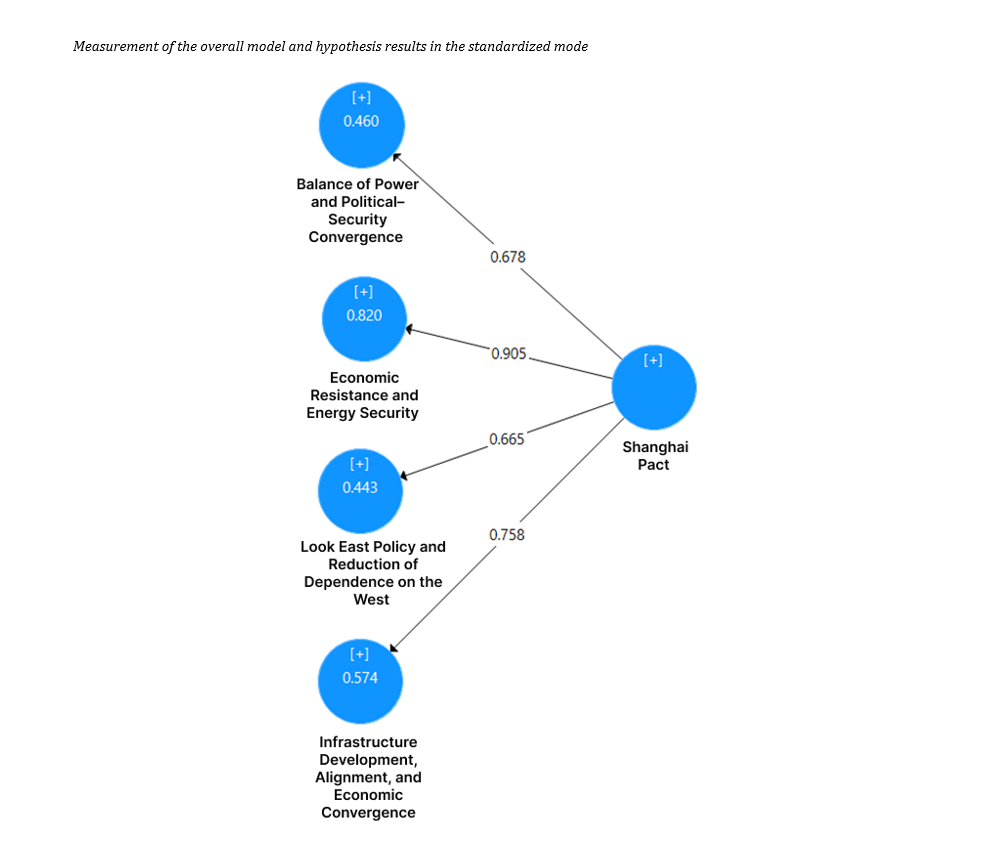
The Shanghai Pact, as one of the most significant multilateral mechanisms in Eurasia, plays a pivotal role in enhancing political stability, regional security, and economic cooperation among its member states. The present dissertation aims to examine the impact of the Shanghai Pact on Eurasian security. This study adopts a mixed qualitative–quantitative approach, initially conducting an analysis of historical and political documents related to the Shanghai Pact and subsequently measuring its effects on regional security indicators. The research findings indicate that multilateral cooperation within the framework of this pact has increased levels of political stability and border security, strengthened economic and energy interactions, and enhanced regional resilience against external threats and geopolitical shocks. Furthermore, data analysis demonstrates that the development of joint committees and institutions, the exchange of security-related information, and the implementation of shared infrastructure projects have played a significant role in reducing tensions and improving coordination among member states. Considering the limitations of the study, including restricted access to classified information and the influence of extra-regional variables, several recommendations are proposed to strengthen managerial mechanisms and expand strategic cooperation. This research may serve as a practical guide for decision-makers and regional policymakers in their efforts to enhance security and stability in Eurasia.
Downloads
References
Alimov, R. (2018). The Shanghai Cooperation Organisation: Its role and place in the development of Eurasia. Journal of Eurasian Studies, 9(2), 114-124. https://doi.org/10.1016/j.euras.2018.08.001
Bakhshayesh Ardestani, A. M., Shafiee, N., & Dehshyar, H. (2024a). The impact of the permanent membership of the I.R. Iran in the Shanghai Cooperation Organization on its political-security relations with the United States. Political-Social Studies of Iranian History and Culture, 3(2), 19-31. https://doi.org/10.61838/kman.jspsich.3.2.2
Bakhshayesh Ardestani, A. M., Shafiee, N., & Dehshyar, H. (2024b). The Shanghai Cooperation Organization in the "Look to the East" policy of the Islamic Republic of Iran. International Relations Researches, 14(2), 313-337. https://doi.org/10.22034/irr.2025.536871.2735
Bokeriya, S. (2019). The Interconnection of Global and Regional Security Systems: The Case of the United Nations, the Collective Security Treaty Organization and the Shanghai Cooperation Organisation. International Organisations Research Journal, 14, 21-38. https://doi.org/10.17323/1996-7845-2019-01-02
Ergül Jorgensen, F. A., & Jørgensen, K. E. (2025). The European Union and the crisis of multilateralism in an era of uncertainty and power politics. Third World Quarterly, 1-20. https://doi.org/10.1080/01436597.2025.2518319
Haghshenas, M. J., & Bashiri, S. (2011). NATO and Iran's inclination toward the Shanghai Cooperation Organization. Political and Economic Information, 25(284).
IMF. (2020). Direction of Trade Statistics Yearbook (2010-2020). http://www.imf.org
Jackson, K., & Shepotylo, O. (2024). Political alliances and trade: Europe in a polarized world. European Journal of Political Economy, 85. https://doi.org/10.1016/j.ejpoleco.2024.102612
Lukin, A., Novikov, D., Puzanova, O., & Yenikeyeff, S. (2025). The Shanghai Cooperation Organization Amidst the Rising International Tensions. Journal of Eurasian Studies, 16. https://doi.org/10.1177/18793665251357320
Maduz, L. (2018). Flexibility by Design: The Shanghai Cooperation Organisation and the Future of Eurasian Cooperation. https://www.research-collection.ethz.ch/bitstream/handle/20.500.11850/314633/Maduz-080618-Shanghai%20Cooperation.pdf?sequence=1&isAllowed=y
Mahmood, M., & Mostafa, G. (2018). Eurasian Economic Union: Evolution, challenges and possible future directions. Journal of Eurasian Studies, 163-172. https://doi.org/10.1016/j.euras.2018.05.001
Mohebpour, I., Shafiee, N., & Babri Gonbad, S. (2023a). Economic capacities of the Shanghai Cooperation Organization for the Islamic Republic of Iran. International Relations Researches, 13(1), 341-367. https://doi.org/10.22034/irr.2023.384685.2348
Mohebpour, I., Shafiee, N., & Babri Gonbad, S. (2023b). The impact of Iran's permanent membership in the Shanghai Cooperation Organization on reducing the effect of US sanctions. Global Politics, 12(3), 223-245. https://doi.org/10.22124/wp.2024.26398.3301
Moradi Haghighi, F., Hosseini, M., & Nasirzad, M. (2023). Iran's regionalism with the Shanghai Cooperation Organization in comparison with the Eurasian Economic Union. International Political Economy Studies, 6(1), 257-287. https://doi.org/10.22126/ipes.2023.8578.1531
Mumtaz, T., Cheema, A. T., & Khalid, J. (2025). The Emerging Role of the Shanghai Cooperation Organization and Its Impacts on Geopolitics. Qlantic Journal of Social Sciences and Humanities, 6(3), 160-169. https://doi.org/10.55737/qjssh.vi-iii.25400
Tercovich, G., & Meijer, H. (2025). The EU's strategic autonomy in foreign policy: European responses to American and Chinese influence over the arms embargo on China and Taiwan. Journal of European Integration, 47(6), 965-985. https://doi.org/10.1080/07036337.2025.2537367
Zarrati, M. (2023). Analyzing the security and economic consequences of Iran's membership in the Shanghai Cooperation Organization. Defense Economics and Sustainable Development Quarterly, 8(27), 109-126.
Downloads
Additional Files
Publication Timeline
- Submitted
- Revised
- Accepted
Issue
Section
License
Copyright (c) 2025 Mojtaba Ranjbar, Ali Mohammad Haghighi, Amin Ravanbod (Author)

This work is licensed under a Creative Commons Attribution-NonCommercial 4.0 International License.