Modeling the Influence of the Islamic Republic of Iran on the Geopolitical Transformations of Energy in the Mediterranean Sea: A Case Study of the Oil and Gas Industry
Keywords:
Energy geopolitics, Mediterranean Sea, Islamic Republic of Iran, oil and gas, energy diplomacy, DPSIR, fuzzy cognitive mapping, PLS-SEMAbstract
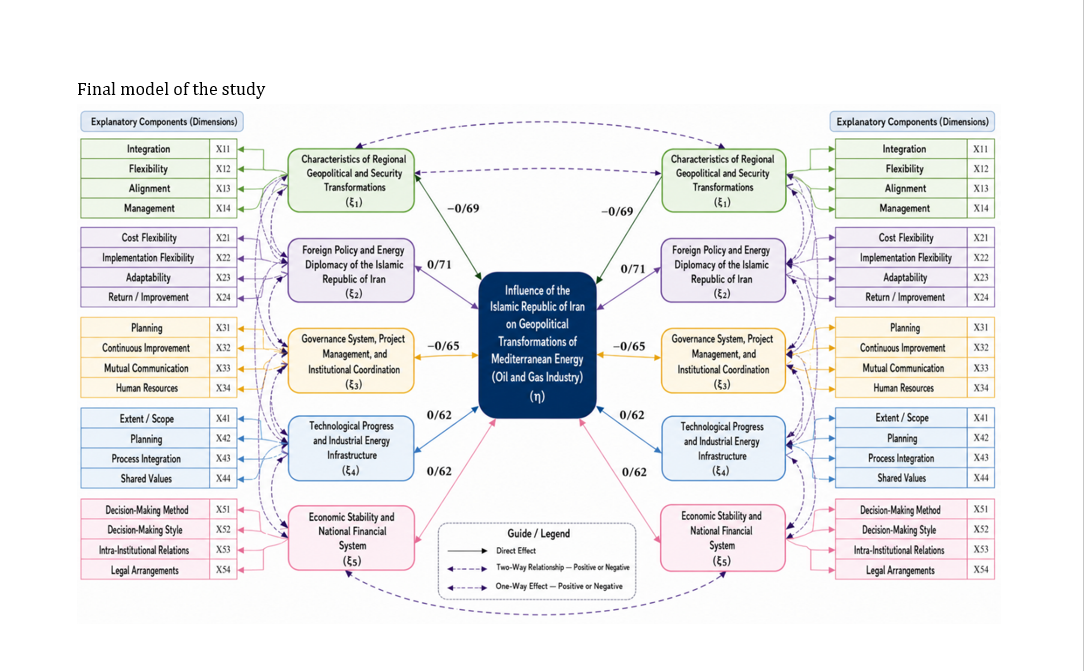
This study aimed to develop and validate a model of the Islamic Republic of Iran’s influence on geopolitical energy transformations in the Mediterranean Sea, focusing on the oil and gas industry. This applied, non-experimental modeling study combined the DPSIR framework with fuzzy cognitive mapping and partial least squares structural equation modeling. Expert/focus-group judgments were converted into a causal matrix and analyzed in FCMapper and MATLAB to build scenarios and a fuzzy cognitive map. Measurement components were assessed in Smart-PLS using path coefficients, t statistics, and fit indices at the 95% confidence level. All measurement paths were statistically significant (t > 1.96). Regional geopolitical and security developments were explained by integration, flexibility, alignment, and management (β = .67–.86; t = 13.01–18.09). Foreign policy and energy diplomacy were explained by cost flexibility, implementation flexibility, adaptability, and recovery/improvement (β = .49–.78; t = 8.46–14.42). Governance, project management, and institutional coordination were explained by planning, continuous improvement, mutual communication, and human resources (β = .67–.86; t = 12.87–18.05). Technological and industrial energy infrastructure was explained by scope, continuous improvement, mutual communication, and human resources (β = .66–.86; t = 12.70–18.00). Economic and financial stability was explained by decision-making method, decision-making style, intra-institutional relations, and legal arrangements (β = .45–.77; t = 7.61–13.77). The validated model indicates that Iran’s foreign policy and energy diplomacy are central strategic levers shaping its influence in Mediterranean energy geopolitics, while governance capacity, technological infrastructure, regional security dynamics, and economic-financial stability function as interdependent conditions for sustainable influence in the oil and gas sector.
Downloads
References
Bakhshandeh, E., & Yeganeh, Y. (2023). Geopolitical transformation in eastern Mediterranean: Restructuring role of Greece and the impact of Abraham Accord. International Studies, 60(2), 231-249.
Bazoobandi, S., & Talebian, H. (2023). The evolvement of Iran-Israel's rivalry in the Red Sea and Eastern Africa. Asian Journal of Middle Eastern and Islamic Studies, 17(4), 341-355.
Fathabadi, M. A., & Kamali, Y. (2023). Russia and China's policies, goals and interests in West Asia and its impact on the Islamic Republic of Iran's interests. Journal of Iran and Central Eurasia Studies, 6(1).
Hao, W., Shah, S. M. A., Nawaz, A., Asad, A., Iqbal, S., Zahoor, H., & Maqsoom, A. (2020). The impact of energy cooperation and the role of the One Belt and Road Initiative in revolutionizing the geopolitics of energy among regional economic powers: An analysis of infrastructure development and project management. Complexity, 2020, 1-16.
Hatipoglu, E., Al-Sarihi, A., & Efird, B. (2023). Geopolitical challenges of renewable energy adoption in MENA. In Handbook on the Geopolitics of the Energy Transition (pp. 498-512). Edward Elgar Publishing.
Lambert, L. A., & Shath, M. (2023). Geopolitical polarization, natural gas, and regional energy (dis-)integration in the Middle East and North Africa. In The Post-American Middle East: How the World Changed Where the War on Terror Failed (pp. 219-246). Springer International Publishing.
Marghelis, A. (2023). Challenges of the World Ocean in a changing strategic and energy security context: The case of the Eastern Mediterranean. In Security and Energy Issues in the Eastern Mediterranean Space.
Mills, R. (2020). A fine balance: The geopolitics of the global energy transition in MENA. In The Geopolitics of the Global Energy Transition (pp. 115-150).
Mitchell, G. (2020). The Eastern Mediterranean Gas Forum: Cooperation in the shadow of competition (The Israeli Institute for Regional Foreign Policies, Issue.
Mousavi, M., Zarei, B., Pishgahifard, Z., Badiee Azandehie, M., & Vasegh, M. (2022). The rotation of Iran-Saudi Arabia relations in two dimensions of geopolitical interaction and confrontation and the grounds for their formation. Human Geography Research, 54(2), 457-478.
Nazari, M., Shafiee, N., & Vaez, N. (2024). China's new role in the Persian Gulf region and its impact on the Islamic Republic of Iran. Strategic Studies, 12(47), 73-106.
Noorali, H., & Ahmadi, S. A. (2023). Iran's new geopolitics: Heartland of the world's corridors. Geojournal, 88(2), 1889-1904.
Omidi, A., & Orhon Ozdag, H. (2023). Analyzing the mutual geopolitical and security complementarity of Iran and Turkey: Border, energy, and water. Journal of Balkan and Near Eastern Studies, 25(5), 923-943.
Pantel, K. (2024). A review on the nexus between energy industry, financial markets, environmental concerns, and geopolitics.
Simbar, R., Rezapour, D., & Azin, S. (2021). Islamic Republic of Iran's policy towards the GCC countries. The Fundamental and Applied Studies of the Islamic World, 2(6), 49-72.
Zomorodi Anbaji, Z., & Haji-Yousefi, A. M. (2021). Geopolitics of energy and Russian military involvement in Syria. Geopolitics Quarterly, 17(61), 116-144.
Downloads
Additional Files
Publication Timeline
- Submitted
- Revised
- Accepted
Issue
Section
License
Copyright (c) 2025 Mohammad Sadegh Rashidi (Author); Emran Alizadeh (Corresponding author); Azita Ragabi (Author)

This work is licensed under a Creative Commons Attribution-NonCommercial 4.0 International License.