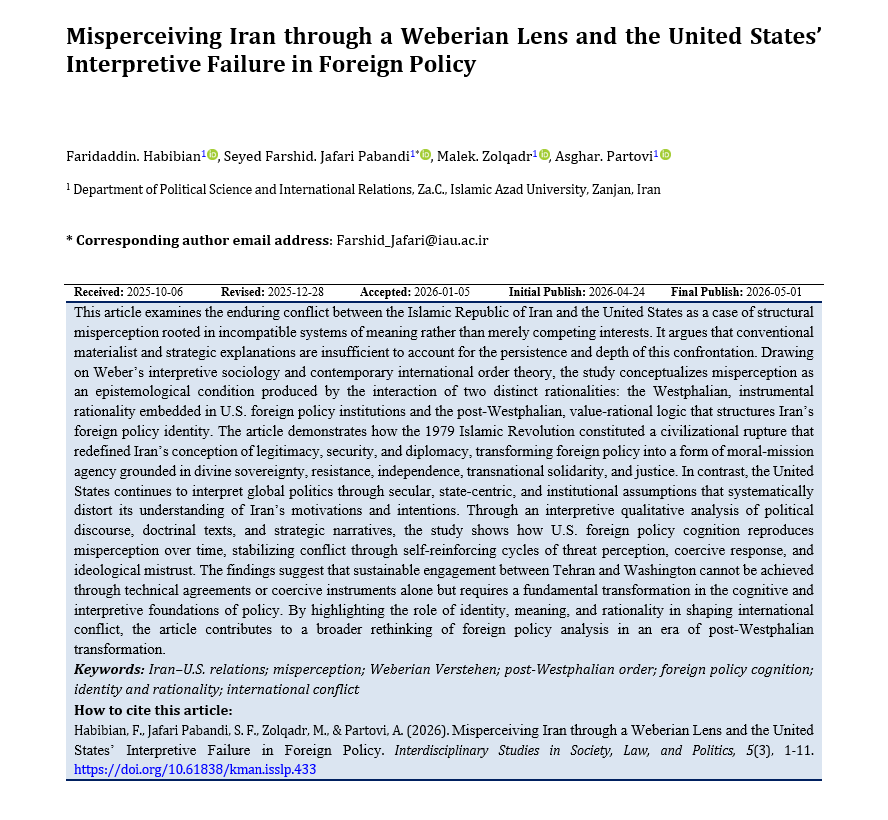
Misperceiving Iran through a Weberian Lens and the United States’ Interpretive Failure in Foreign Policy
Keywords:
Misperception, Foreign Policy of the Islamic Republic of Iran, United States, Weberian Verstehen, Post-Westphalian Order, Justice-centerednessAbstract
This article examines the enduring conflict between the Islamic Republic of Iran and the United States as a case of structural misperception rooted in incompatible systems of meaning rather than merely competing interests. It argues that conventional materialist and strategic explanations are insufficient to account for the persistence and depth of this confrontation. Drawing on Weber’s interpretive sociology and contemporary international order theory, the study conceptualizes misperception as an epistemological condition produced by the interaction of two distinct rationalities: the Westphalian, instrumental rationality embedded in U.S. foreign policy institutions and the post-Westphalian, value-rational logic that structures Iran’s foreign policy identity. The article demonstrates how the 1979 Islamic Revolution constituted a civilizational rupture that redefined Iran’s conception of legitimacy, security, and diplomacy, transforming foreign policy into a form of moral-mission agency grounded in divine sovereignty, resistance, independence, transnational solidarity, and justice. In contrast, the United States continues to interpret global politics through secular, state-centric, and institutional assumptions that systematically distort its understanding of Iran’s motivations and intentions. Through an interpretive qualitative analysis of political discourse, doctrinal texts, and strategic narratives, the study shows how U.S. foreign policy cognition reproduces misperception over time, stabilizing conflict through self-reinforcing cycles of threat perception, coercive response, and ideological mistrust. The findings suggest that sustainable engagement between Tehran and Washington cannot be achieved through technical agreements or coercive instruments alone but requires a fundamental transformation in the cognitive and interpretive foundations of policy. By highlighting the role of identity, meaning, and rationality in shaping international conflict, the article contributes to a broader rethinking of foreign policy analysis in an era of post-Westphalian transformation.
Downloads
References
Adib-Moghaddam, A. (2018). Psycho-nationalist perceptions of Iran in the Western mind: The Westphalian dilemma revisited. Cambridge University Press.
Ahmadi, S. H. (2019). Identity Approaches in the Foreign Policy of the Islamic Republic of Iran. Institute for Political Studies.
Baeidi Nejad, H. (2018). Iran's Foreign Policy: A Balance of Principles and Pragmatism. Routledge.
Boroujerdi, M., & Tehrani, S. (2021). Iran’s Foreign Policy and National Security. Mizan.
Byman, D. (2019). Iran and the United States: A Policy of Containment Revisited. Brookings Institution Press.
Coletsou, A. (2023). Cinematic Representations of Iran After 9/11 and Their Instrumentalization by the American Foreign Policy. Islamophobia Studies Journal, 8(1). https://doi.org/10.13169/islastudj.8.1.0070
Dehghani Firoozabadi, I. (2018). Evolution of the Concepts of Security and Resistance in Iranian Foreign Policy. Strategic Studies Quarterly, 25(2), 71-98.
Fathollahi, A. (2024). Where do national interests stand in the foreign policy equations of the Islamic Republic? Iranian Diplomacy Website.
Fathollahi, A. (2025). Where Does National Interest Fit in the Equations of Foreign Policy in the Islamic Republic of Iran? Iranian Diplomacy Website.
Hajiyousefi, A. (2020a). The Foreign Policy of the Islamic Republic of Iran and the New Regional Order. Foreign Policy Quarterly, 34(1), 125-149.
Hajiyousefi, A. (2020b). Understanding Iran's Foreign Policy in the Post-JCPOA Era. Iranian Review of Foreign Affairs, 9(2), 125-151.
Hajiyousefi, A. (2021). The Foreign Policy of the Islamic Republic of Iran in a Transitioning Global Order. Foreign Policy Quarterly, 35(4), 175-202.
Khosrokhavar, F. (2019). Iranian Identity and Resistance. Cambridge University Press.
Mahmoodi Kia, M. (2023). National Interests and Resistance Strategy in the Foreign Policy of the Islamic Republic of Iran: A Confrontational or Synergistic Approach? Scientific Biannual of Political Science, 19(1), 239-256.
Maloney, S. (2020). The Iranian Dilemma: Containment, Engagement, or Regime Change. Brookings Institution Press.
Mottaghi, I. (2016). Iran and the Evolution of the International Order. University of Tehran Press.
Parsi, T. (2017). Losing an Enemy: Obama, Iran, and the Triumph of Diplomacy. Yale University Press.
Seyed Jalali, A. (2020). Justice and Identity in the Foreign Policy of the Islamic Republic of Iran. Quarterly of Islamic Political Research, 12(3), 111-136.
Shani, G. (2021). Beyond Westphalia: Nations and Civilizations in a Globalizing World. Palgrave Macmillan.
Stachoń, M. (2024). Iranian Cyber Capabilities as a Tool of Domestic and Foreign Policy. Zeszyty Naukowe SGSP, 2(88), 267-290. https://doi.org/10.5604/01.3001.0054.4537
Strategy, U. S. N. S. (2022). National Security Council Document.
Takeyh, R. (2021). The Last Shah: America, Iran, and the Fall of the Pahlavi Dynasty. Yale University Press. https://doi.org/10.2307/j.ctv1b0fw8w
The White, H. (2018). National Security Strategy of the United States of America. https://trumpwhitehouse.archives.gov/wp-content/uploads/2017/12/NSS-Final-12-18-2017-0905.pdf
Walt, S. (2018). The Hell of Good Intentions: America's Foreign Policy Elite and the Decline of U.S. Primacy. Farrar, Straus and Giroux.
Downloads
Additional Files
Publication Timeline
- Submitted
- Revised
- Accepted
Issue
Section
License
Copyright (c) 2025 Faridaddin Habibian (Author); Seyed Farshid Jafari Pabandi (Corresponding author); Malek Zolqadr, Asghar Partovi (Author)

This work is licensed under a Creative Commons Attribution-NonCommercial 4.0 International License.