Foreign Policy of the Gulf Cooperation Council (GCC) Member States Toward Iran’s Nuclear Program
Keywords:
foreign policy, Gulf Cooperation Council, Iran’s nuclear programAbstract
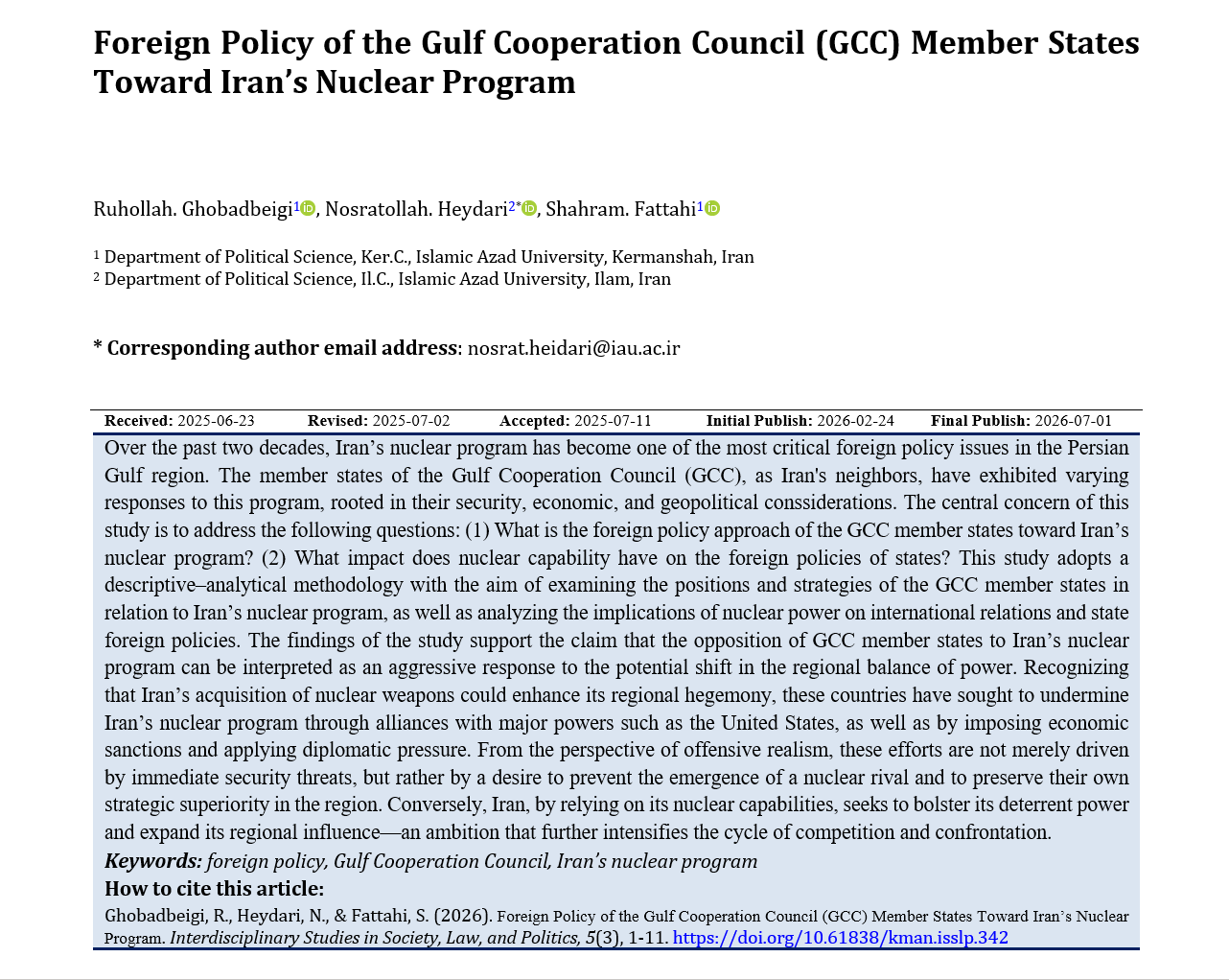
Over the past two decades, Iran’s nuclear program has become one of the most critical foreign policy issues in the Persian Gulf region. The member states of the Gulf Cooperation Council (GCC), as Iran's neighbors, have exhibited varying responses to this program, rooted in their security, economic, and geopolitical considerations. The central concern of this study is to address the following questions: (1) What is the foreign policy approach of the GCC member states toward Iran’s nuclear program? (2) What impact does nuclear capability have on the foreign policies of states? This study adopts a descriptive–analytical methodology with the aim of examining the positions and strategies of the GCC member states in relation to Iran’s nuclear program, as well as analyzing the implications of nuclear power on international relations and state foreign policies. The findings of the study support the claim that the opposition of GCC member states to Iran’s nuclear program can be interpreted as an aggressive response to the potential shift in the regional balance of power. Recognizing that Iran’s acquisition of nuclear weapons could enhance its regional hegemony, these countries have sought to undermine Iran’s nuclear program through alliances with major powers such as the United States, as well as by imposing economic sanctions and applying diplomatic pressure. From the perspective of offensive realism, these efforts are not merely driven by immediate security threats, but rather by a desire to prevent the emergence of a nuclear rival and to preserve their own strategic superiority in the region. Conversely, Iran, by relying on its nuclear capabilities, seeks to bolster its deterrent power and expand its regional influence—an ambition that further intensifies the cycle of competition and confrontation.
Downloads
References
Abdoli, A., & Souri, H. (2020). The Gulf Cooperation Council's Approaches to Iran's Regional Power (2003-2018). Diba Publications.
Barnett, M., & Gause, F. G. (1998). Caravans in Opposite Directions: Society, State, and the Development of Community in the Gulf Cooperation Council. In E. Adler & M. Barnett (Eds.), Security Communities (pp. 161-197). Cambridge University Press. https://doi.org/10.1017/CBO9780511598661.005
Cordesman, A. H. (2003). The Gulf and the Search for Strategic Stability. Westview Press.
Dastneyan, A. (2023). The Gulf Cooperation Council's Strategy Towards Iran's Nuclear Program: A Comparative Study in the Ahmadinejad and Rouhani Eras. Payame Noor University.
Dehghani Firouzabadi, S. J. (2011). Islamic Theory of Foreign Policy: A Framework for Analysis. Foreign Relations Quarterly, 3(1), 7-34.
Dolatkhah, Z., & Emam-Jomehzadeh, S. J. (2012). The World Bank of Nuclear Fuel: Challenges and Foresight. Rahbord Quarterly, 21(1), 89-112.
Ebrahimi, S. (2016). Examining the Impact of the Islamic Republic of Iran's Nuclear Capability on its Relations with the Gulf Cooperation Council Countries. Political Studies Quarterly, 25IS - 97, 45-68.
Elahi, H. (2017). The Persian Gulf and Its Issues. Ghoms Publications.
Eyvazi, M. R. (2011). General Policies of the Fifth Development Plan and Iran's Security Model in the Persian Gulf. Rahbord Quarterly, 20(1), 45-67.
Fulton, J. (2019). China's Relations with the Gulf Monarchies. Routledge. https://doi.org/10.4324/9781315142678
Ghaemi Mehr, M., & Gholami, S. (2022). Foreign Relations of the Gulf Cooperation Council Countries. Andishkadeh Ravabet Beynolmelal (Institute for International Relations).
Gharibabadi, K. (2008). Iran's Nuclear Program: Basic Realities. Ministry of Foreign Affairs.
Jervis, R. (1978). Cooperation under the Security Dilemma. World Politics, 30(2), 167-214. https://doi.org/10.2307/2009958
Khalilinejad, R. (2023). Legal Analysis of Iran's Nuclear Program and the P5+1. Majd Publications.
Mearsheimer, J. J. (2001). The Tragedy of Great Power Politics. W.W. Norton.
Morgenthau, H. J. (1948). Politics Among Nations: The Struggle for Power and Peace. Alfred A. Knopf.
Naeimi Arfa, B. (1991). Behavioral Foundations of the Gulf Cooperation Council. Office of Political Studies.
Nezam al-Marzouk, H. (2021). Security-Political Positions of Arab Countries Towards Iran's Nuclear Program (1990-2020). Ferdowsi University.
Shahabi, S. a.-R. (2009). Views of the Gulf Cooperation Council. Etela'at Publications.
Shakeri, M. (2018). The Impact of the JCPOA on Iran and Turkey's Middle Eastern Policy. Azar Publications.
Simbar, R. (2020). Iran's Policy Towards the Gulf Cooperation Council. Fundamental Studies of the Islamic WorldVL - 2(4), 112-135.
Vaezi, M., & Asadi, A. A. (2010). The Gulf Cooperation Council: Foreign Policy and Internal Developments. Alfehrest.
Walt, S. M. (1987). The Origins of Alliances. Cornell University Press.
Waltz, K. N. (1979). Theory of International Politics. Addison-Wesley.
Downloads
Additional Files
Publication Timeline
- Submitted
- Revised
- Accepted
Issue
Section
License
Copyright (c) 2025 Ruhollah Ghobadbeigi, Nosratollah Heydari, Shahram Fattahi (Author)

This work is licensed under a Creative Commons Attribution-NonCommercial 4.0 International License.