Future Studies of the Islamic Revolution with a Perspective on Contemporary Economic Developments in Iran
DOI:
https://doi.org/10.61838/kman.isslp.478Keywords:
Futures Studies, Islamic Revolution, Relative Deprivation, Rising Expectations, Scenario PlanningAbstract
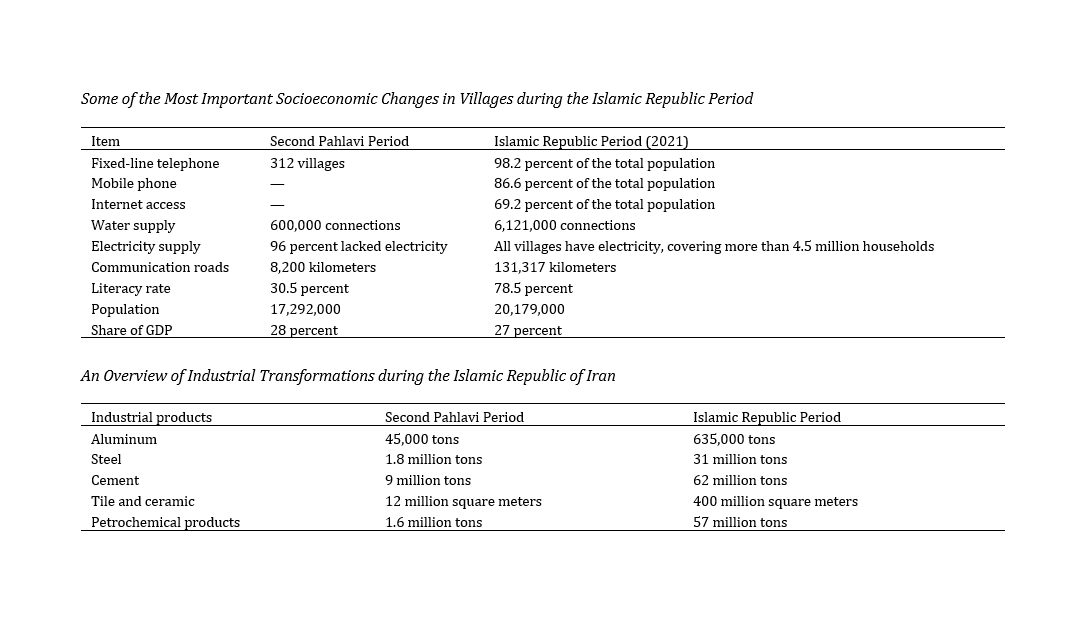
In the effort to conduct future studies on the Islamic Revolution with an emphasis on the economic developments and issues of contemporary Iran, the following question arises: considering the existing economic issues and challenges, what will be the future of the Islamic Revolution? Drawing upon Ted Robert Gurr’s theory of relative deprivation to understand these existing economic transformations and issues, and employing the scenario planning method through the use of library and internet sources, the findings indicate that the existing sense of deprivation and dissatisfaction, although incapable of generating a wave of regime overthrow within the country, constitutes an Achilles’ heel that may provide the grounds for conspiracy formation and foreign intervention in the country. From this perspective, the continuation of economic problems may increase the costs incurred by the political system in governing the country. The desirable scenario in this context is the resolution and elimination of economic problems, which can be achieved through reliance on domestic capacities and increasing endogenous capabilities in the management of the national economy.
Downloads
References
Abrahamian, E. (2005). Iran Between Two Revolutions (A. Golmohammadi & M. E. Fattahi, Trans.). Ney.
Abrahamian, E. (2012). A History of Modern Iran (M. E. Fattahi, Trans.; 8th ed.). Ney.
Behdad, S., & Nomani, F. (2014). Class and Labor in Iran (M. Mottahed, Trans.). Agah.
Beigi Nesvan, H. (1997). Land Reform in the Islamic Republic. Fifteenth of Khordad Quarterly(25).
Ehsani, K. (2006). Rural Society and Agricultural Expansion in Post-Revolutionary Iran: The First Two Decades. Goftogu Quarterly(46).
Foran, J., & Goodwin, J. (1993). Revolutionary Outcomes in Iran and Nicaragua: Coalition Fragmentation, War and the Limits of Social Transformation. In H. T. Rosemary (Ed.), Revolution: Critical Concepts in Political Science. Routledge.
Ghorbani, M. (2019). Forty-Year Record of the Islamic Revolution. Defa.
Gurr, T. R. (1973). The Revolution Change Nexus. Comparative Politics(5), 364.
Hajiani, E. (2012). Foundations, Principles, and Methods of Futures Studies. Imam Sadiq University.
Hajiani, E., & Qassa, M. (2013). Future and Scenario Planning: Classification of Methods and Categorization of Scenarios. Socio-Cultural Strategy, 8(2), 33-62.
Katouzian, M. A. (1993). The Political Economy of Iran (M. R. Nafisi & K. Azizi, Trans.). Markaz.
Khorramshad, M. B., & Moloudi, A. (2022). An Examination of Political and Social Transformations in Iranian Villages after the Islamic Revolution. Strategic Policy Studies, 11(42).
Malekoutian, M. (2016). A Survey of Theories of Revolution. Qomes.
Ministry of Industry, M., & Trade. (2017). Periodic Report on Selected Products: No. 5, Cement.
Ministry of Industry, M., & Trade. (2018). Periodic Report on Selected Products: No. 9, Tile and Ceramic.
Moaddel, M. (2003). Class, Politics, and Ideology in the Iranian Revolution (M. S. Kasraei, Trans.). Center for the Recognition of Islam and Iran.
Naseri, N., & Sheikh Saraei, N. (2017). Futures Studies of the Islamic Revolution of Iran. Scientific Quarterly of Islamic Revolution Studies, 6(21), 129.
Panahi, M. H. (2010). Theories of Revolution: Occurrence, Process, and Consequences. SAMT.
Sattari, S. (2013). Transition Cycles in the History of Iran's Political Economy. Political Studies Quarterly, 6(22).
Sharifzadegan, M. H., & Noorai, H. (2015). An Examination of Industrial Transformations and Industrial Development in Iran for Pathology of Iran's Industrial Development. Journal of Social and Economic History, 4(1), 37-60.
Statistical Center of Iran. (2023). National Statistical Yearbook 2021.
Downloads
Additional Files
Publication Timeline
- Submitted
- Revised
- Accepted
Issue
Section
License
Copyright (c) 2025 Ali Galedarian (Author); Ali Mohammad Haghighi (Corresponding author); Amin Ravanbod (Author)

This work is licensed under a Creative Commons Attribution-NonCommercial 4.0 International License.