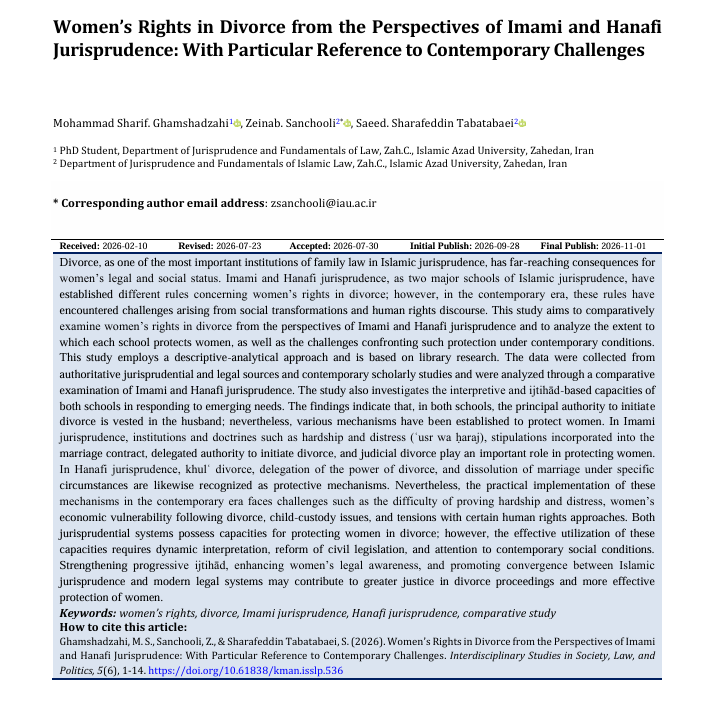
Women’s Rights in Divorce from the Perspectives of Imami and Hanafi Jurisprudence: With Particular Reference to Contemporary Challenges
Keywords:
women’s rights, divorce, Imami jurisprudence, Hanafi jurisprudence, comparative studyAbstract
Divorce, as one of the most important institutions of family law in Islamic jurisprudence, has far-reaching consequences for women’s legal and social status. Imami and Hanafi jurisprudence, as two major schools of Islamic jurisprudence, have established different rules concerning women’s rights in divorce; however, in the contemporary era, these rules have encountered challenges arising from social transformations and human rights discourse. This study aims to comparatively examine women’s rights in divorce from the perspectives of Imami and Hanafi jurisprudence and to analyze the extent to which each school protects women, as well as the challenges confronting such protection under contemporary conditions. This study employs a descriptive-analytical approach and is based on library research. The data were collected from authoritative jurisprudential and legal sources and contemporary scholarly studies and were analyzed through a comparative examination of Imami and Hanafi jurisprudence. The study also investigates the interpretive and ijtihād-based capacities of both schools in responding to emerging needs. The findings indicate that, in both schools, the principal authority to initiate divorce is vested in the husband; nevertheless, various mechanisms have been established to protect women. In Imami jurisprudence, institutions and doctrines such as hardship and distress (ʿusr wa ḥaraj), stipulations incorporated into the marriage contract, delegated authority to initiate divorce, and judicial divorce play an important role in protecting women. In Hanafi jurisprudence, khulʿ divorce, delegation of the power of divorce, and dissolution of marriage under specific circumstances are likewise recognized as protective mechanisms. Nevertheless, the practical implementation of these mechanisms in the contemporary era faces challenges such as the difficulty of proving hardship and distress, women’s economic vulnerability following divorce, child-custody issues, and tensions with certain human rights approaches. Both jurisprudential systems possess capacities for protecting women in divorce; however, the effective utilization of these capacities requires dynamic interpretation, reform of civil legislation, and attention to contemporary social conditions. Strengthening progressive ijtihād, enhancing women’s legal awareness, and promoting convergence between Islamic jurisprudence and modern legal systems may contribute to greater justice in divorce proceedings and more effective protection of women.
Downloads
References
Al-Amili, Z. a.-D. Masalik al-Afham fi Sharh Shara'i al-Islam (Vol. 1). Basirati Publications.
Al-Hilli, J. i. H. (1991). Shara'i al-Islam (2nd ed.). Dar al-Zahra.
Al-Jaziri, A. a.-R. (2003). Al-Fiqh ala al-Madhahib al-Arba'a (Vol. 4). Dar al-Kutub al-Ilmiyya.
Al-Tusi, M. i. H. (1967). Al-Mabsut fi Fiqh al-Imamiyya (Vol. 3-4). Al-Maktaba al-Murtadawiyya li-Ihya al-Athar al-Jafariyya.
Alaei Novin, F. (2012). An Examination of Women's Right to Divorce in Imami Jurisprudence and Positive Law. https://civilica.com/doc/1956029
Allahmoradi, O., & Ahadi, S. (2015). Judicial Authority to Grant Divorce in Cases of the Husband's Recalcitrance Without Conditioning It on the Wife's Hardship. Biannual Journal of Family Jurisprudence and Law (Nedaye Sadegh)(6).
Araki, M. A. (1998). Kitab al-Nikah (1st ed.). Noor Negar.
Barikloo, A. (2011). Legal Foundations for Protecting the Income of a Divorced Wife During Marriage. Family Research Quarterly, 7(28).
Bojnourdi, M. H. (1998). Al-Qawaid al-Fiqhiyya. Al-Hadi Publishing.
Darvishi Hoveyda, Y. (2004). Women's Financial Rights After Divorce. Judiciary Law Journal(46), 130-134.
Diani, A. (2000). Family Law: Marriage and Its Dissolution (1st ed.). Amir Danesh.
Fahimi, F. (2006). Women's Financial Rights: A Comparative Study in Islamic Law, Iranian Law, and the Convention on the Elimination of Discrimination Against Women (1st ed.). University of Qom Press.
Feyz, A. (1997). Principles of Jurisprudence and Legal Theory (9th ed.). University of Tehran Press.
Hakimi, M. R. (2003). In Defense of Women's Rights. Astan Quds Razavi Research Foundation.
Hedayatnia, F. (2004). Evaluation of Family Laws: Part One. Quarterly Journal of the Women's Social and Cultural Council, 7(25), 84-95.
Hedayatnia Ganji, F. (2006). The Wife's Financial Rights: Remuneration, Consolatory Payment, and Adjustment of the Dowry (1st ed.). Research Institute for Islamic Sciences and Culture, Research Deputy of the Islamic Propagation Office of Qom Seminary.
Hosseini Shirazi, S. M. (1988). Al-Fiqh (Vol. 58). Dar al-Ilm.
Jafari Langroudi, M. J. (1997). Family Law (2nd ed.). Ganj-e Danesh Library.
Katouzian, N. (1999). Civil Family Law: Marriage and Divorce. Bahman Borna Institute.
Katouzian, N. (2016). Civil Law Course: Family (Vol. 2). Enteshar Joint Stock Company.
Lotfi, A. (2010). A Series of Jurisprudential and Legal Discussions on Family Law (1st ed., Vol. 2). Khorsandi Publications.
Makarem Shirazi, N. (1990). Silsilat al-Qawaid al-Fiqhiyya (2nd ed.). Amir al-Mu'minin School.
Mehrpour, H. (2000). Studies on Women's Rights from the Perspective of Domestic Law, Jurisprudential Foundations, and International Standards (1st ed.). Ettela'at Institute.
Mohaghegh Damad, S. M. (2008). A Jurisprudential Examination of Family Law: Marriage and Its Dissolution. Center for the Publication of Islamic Sciences.
Mohaghegh Damad, S. M. (2018). A Jurisprudential Examination of Family Law: Marriage and Its Dissolution (19th ed.). Center for the Publication of Islamic Sciences.
Mohammadi, M. (2001). Women's Rights and Duties from the Perspective of Islam: Financial Independence and Obedience to the Husband. Ravaq-e Andisheh(3).
Mokhtari Afrakati, N., & Dari, M. (2015). An Examination of the Grounds and Foundations of the Wife's Right to Divorce from the Perspective of Imami Jurisprudence and Iranian Civil Law Second International Conference on Law and Sustainable Development of Civil Society, Shiraz. https://civilica.com/doc/471781
Motahhari, M. (1995). The System of Women's Rights in Islam (21st ed.). Sadra Publications.
Mousavi Bojnourdi, S. M. (1993). Al-Qawaid al-Fiqhiyya (2nd ed.). Miad Publishing.
Nouri, Y. (2006). Women's Rights in Islam and the World. Navid Noor.
Safaei, S. H. (1990). Family Law: Marriage and Its Dissolution. University of Tehran Press.
Safaei, S. H., & Emami, A. (1999). Family Law (7th ed., Vol. 1). University of Tehran Press.
Safaei, S. H., & Rahimi, H. (2016). Civil Liability: Non-Contractual Obligations (9th ed.). SAMT.
Shobeiri Zanjani, M. (1901). Kitab al-Nikah (Vol. 25). Ray Pardaz Research Institute.
Downloads
Additional Files
Publication Timeline
- Submitted
- Revised
- Accepted
Issue
Section
License
Copyright (c) 2025 Mohammad Sharif Ghamshadzahi (Author); Zeinab Sanchooli (Corresponding author); Saeed Sharafeddin Tabatabaei (Author)

This work is licensed under a Creative Commons Attribution-NonCommercial 4.0 International License.