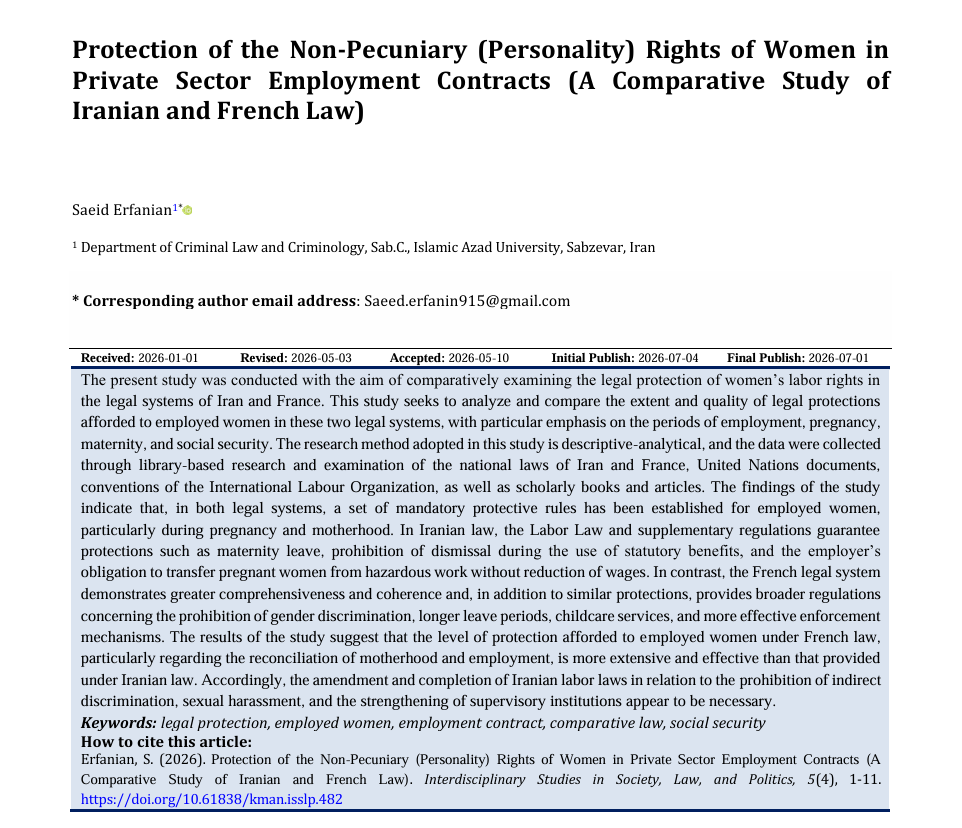
Protection of the Non-Pecuniary (Personality) Rights of Women in Private Sector Employment Contracts (A Comparative Study of Iranian and French Law)
DOI:
https://doi.org/10.61838/kman.isslp.482Keywords:
legal protection, employed women, employment contract, comparative law, social securityAbstract
The present study was conducted with the aim of comparatively examining the legal protection of women’s labor rights in the legal systems of Iran and France. This study seeks to analyze and compare the extent and quality of legal protections afforded to employed women in these two legal systems, with particular emphasis on the periods of employment, pregnancy, maternity, and social security. The research method adopted in this study is descriptive-analytical, and the data were collected through library-based research and examination of the national laws of Iran and France, United Nations documents, conventions of the International Labour Organization, as well as scholarly books and articles. The findings of the study indicate that, in both legal systems, a set of mandatory protective rules has been established for employed women, particularly during pregnancy and motherhood. In Iranian law, the Labor Law and supplementary regulations guarantee protections such as maternity leave, prohibition of dismissal during the use of statutory benefits, and the employer’s obligation to transfer pregnant women from hazardous work without reduction of wages. In contrast, the French legal system demonstrates greater comprehensiveness and coherence and, in addition to similar protections, provides broader regulations concerning the prohibition of gender discrimination, longer leave periods, childcare services, and more effective enforcement mechanisms. The results of the study suggest that the level of protection afforded to employed women under French law, particularly regarding the reconciliation of motherhood and employment, is more extensive and effective than that provided under Iranian law. Accordingly, the amendment and completion of Iranian labor laws in relation to the prohibition of indirect discrimination, sexual harassment, and the strengthening of supervisory institutions appear to be necessary.
Downloads
References
Ahmadi, S., & Roosta, L. (2014). The work culture of women and men and their comparison. Nashriyeh-ye Zanan, 1(4).
Ahmadi, S. M. (2015). An analysis of the historical development of women’s political participation in Islam, Iran, and the West. Pajouheshnameh-ye Zanan, 3(13).
Araqi, S. E. (2016). Labor Law. Ketab-e No.
Atefi, G., & Zarei, P. (2015). A study of women’s employment from the perspective of Islam and the West.
Bagheri, S. (2016). Analysis of socio-economic factors affecting women’s employment in Iran. Zanan-e Olgousaz, 5(19).
Bostan, H. (2011). Islam and International Humanitarian Law. Research Institute of Hawzah and University.
Ebrahimi, T. (2013). Women’s employment in the legal system governing the Islamic Republic of Iran and its comparison with international documents. Farhangi-Tarbiyati Zanan va Khanevadeh, 8(25).
Ghamat, J., & Saberi Qomi, P. (2012). Iran’s accession to the Convention on the Elimination of Discrimination against Women: Opportunities and threats. Motaleat-e Ravabet-e Beynolmelal, 5(18), 179-212.
Hedayatnia, F. (2016). Women’s employment and family interest in the Civil Code. Motaleat-e Rahbordi-ye Zanan(34).
Hennette-Vauchez, S., & Valentin, V. (2014). L'affaire Baby Loup ou la nouvelle laïcité. LGDJ.
Jahangiri, S., & Gorouhsi, N. (2019). Women’s rights in Islam and the Convention on the Elimination of All Forms of Discrimination against Women. Rahbord-e Siyasi, 3(8), 1-22.
Karamzehi, A., & Fanaei, R. (2017). A comparative study of women’s financial rights in Iran and France.
Katouzian, N. (2006). Family Law. Sherkat-e Sahami Enteshar.
Khorsandian, M. A. (2013). The legal status of spouses’ employment in Iranian statutory laws and the proposed Family Protection Bill. Fiqh va Hoquq-e Khanevadeh, 16(54).
Laufer, J. (2018). Professional equality between men and women in France: Progress and hesitation. French Politics, 16(3), 254-274.
Nikookar, R. (2013). Labor Law. Dadban.
Ravadrad, A. (2014). The role of women’s employment in development. Faslnameh-ye Takhasosi-ye Oloum-e Ejtemaei, 2(17).
Rezaei, A. (2018). Women’s Labor Law. Jangal.
Safaei, S. H., & Emami, A. (2013). Concise Family Law (35th ed.). Mizan Legal Foundation.
Supiot, A. (2016). Critique du droit du travail. Seuil.
Tavassoli Naeini, M., & Zakeri, E. (2017). General employment policies for women from the perspective of the laws of the Islamic Republic of Iran. Faslnameh-ye Elmi-Takhasosi-ye Hoquq-e Omoumi, 9(13).
Vasiljevic, S. (2013). Equality between men and women: Challenges to Croatian legislation. https://ssrn.com/abstract=2249
Waquet, P. (2010). Le droit du travail et les libertés du salarié. Dalloz.
Downloads
Additional Files
Publication Timeline
- Submitted
- Revised
- Accepted
Issue
Section
License
Copyright (c) 2025 Saeid Erfanian (Corresponding author)

This work is licensed under a Creative Commons Attribution-NonCommercial 4.0 International License.