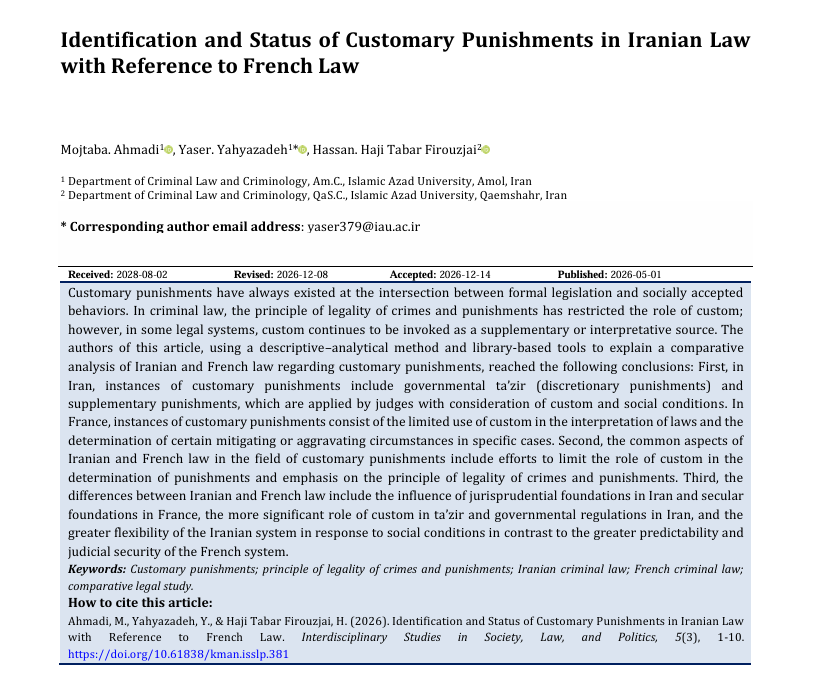
Identification and Status of Customary Punishments in Iranian Law with Reference to French Law
Keywords:
Customary punishments, principle of legality of crimes and punishments, Iranian criminal law, French criminal law, comparative legal studyAbstract
Customary punishments have always existed at the intersection between formal legislation and socially accepted behaviors. In criminal law, the principle of legality of crimes and punishments has restricted the role of custom; however, in some legal systems, custom continues to be invoked as a supplementary or interpretative source. The authors of this article, using a descriptive–analytical method and library-based tools to explain a comparative analysis of Iranian and French law regarding customary punishments, reached the following conclusions: First, in Iran, instances of customary punishments include governmental ta’zir (discretionary punishments) and supplementary punishments, which are applied by judges with consideration of custom and social conditions. In France, instances of customary punishments consist of the limited use of custom in the interpretation of laws and the determination of certain mitigating or aggravating circumstances in specific cases. Second, the common aspects of Iranian and French law in the field of customary punishments include efforts to limit the role of custom in the determination of punishments and emphasis on the principle of legality of crimes and punishments. Third, the differences between Iranian and French law include the influence of jurisprudential foundations in Iran and secular foundations in France, the more significant role of custom in ta’zir and governmental regulations in Iran, and the greater flexibility of the Iranian system in response to social conditions in contrast to the greater predictability and judicial security of the French system.
Downloads
References
Ancel, M. (1973). France. The American Journal of Comparative Law, 22(1), 1-28. https://doi.org/10.2307/839123
Ansari, M. (2010). Criminal Law in Islamic Iran: A Historical Overview. University of Tehran Press.
Ansari, M. (2018). Islamic criminal law and customary practices in Iran. Mizan Publications.
Azizi, M. (2020). Criminal law and customary punishments in Iran. Mizan Publishing.
Benoît, L. (2017). La place des usages et coutumes dans le droit pénal français. Dalloz.
Dupont, F. (2018). Les peines et la coutume: Une analyse comparative. Revue de droit pénal et de criminologie, 44(2), 41-60.
Dupont, J. (2018). La place de la coutume en droit pénal français. Éditions Dalloz.
Ebrahimi, M. (2020). Customary Punishments and Human Rights Challenges in Iran. Pars Legal Studies.
Eslami Panah, A. (2017). The role of custom as a source of law. Private Law Studies, 47(2), 193-211.
Garapon, A. (2005). La justice face à la société. Presses Universitaires de France.
Gay, V. (2024). The Customary Atlas of Ancien Régime France. Explorations in Economic History, 93(1), 1-37. https://doi.org/10.1016/j.eeh.2024.101588
Hassani, A. (2015). Principles of Criminal Law in Iran. University of Tehran Press.
Jafari Langroudi, M. J. (2014). Legal dictionary. Ganj Danesh Publications.
Karimi, S. (2017). Judicial Practices and the Role of Custom in Iranian Criminal Law. Shiraz Legal Studies.
Kharazi, A. (2017). General criminal law. Mizan Publications.
Khomeini, R. (1984). Islamic Penal Code and its Implementation. Islamic Studies Foundation.
Kim, M. (2021). Custom, Law, and Monarchy: A Legal History of Early Modern France. Oxford University Press. https://doi.org/10.1093/oso/9780192845498.001.0001
Mahdavi, R. (2018). Customary Law and Penal Code in Contemporary Iran. Islamic Research Foundation.
Mahmoudi, H. (2019). Comparative analysis of Iranian and French criminal law. University of Tehran Press.
Merle, R., & Vitu, A. (1984). Traité de droit criminel (Vol. 1). Cujas.
Mohammadi, A. (2018). Discretion in Iranian Penal Law: Opportunities and Risks. Islamic Legal Research Center.
Najafi, R. (2019). International Obligations and Criminal Law in Iran. University of Tehran Press.
Pourjafar, M. (2020). Justice and customary sanctions in Iranian criminal law. Tehran University Press.
Pourjafar, M., & Karimi, H. (2019). Criminal law and customary sanctions in Iran. Tehran University Press.
Pourjavady, R. (2012). Modernization of Iranian Legal System: From Constitutional Revolution to Islamic Republic. Majd Publication.
Rezvani, H. (2019). Islamic Penal Code and the Application of Customary Practices. Majd Publications.
Sadeghi, R. (2020). Customary punishments in contemporary Iranian criminal law. Tehran University Press.
Shadlou, H. (2019). The role of discretionary punishments in the Iranian criminal justice system. Jangal Publications.
Shafiei, H. (2016). Legal Certainty and Customary Punishments in Iran. Ferdowsi University Press.
Shafiei, R. (2017). Legal principles of punishments in Iranian criminal law. Mizan Publications.
Shafiei, R. (2019). Criminal law and customary punishments in contemporary Iran. Mizan Publications.
Shahbazi, A. (2002). Ancient Iranian Legal Traditions. Shiraz University Press.
Downloads
Additional Files
Publication Timeline
- Submitted
- Revised
- Accepted
Issue
Section
License
Copyright (c) 2026 Mojtaba Ahmadi, Yaser Yahyazadeh, Hassan Haji Tabar Firouzjai (Author)

This work is licensed under a Creative Commons Attribution-NonCommercial 4.0 International License.