A Comparative Study of the Status of the Prohibition of Violence against Women in Hanafi Jurisprudence and International Instruments
Keywords:
violence against women, Hanafi jurisprudence, international human rights instruments, comparative lawAbstract
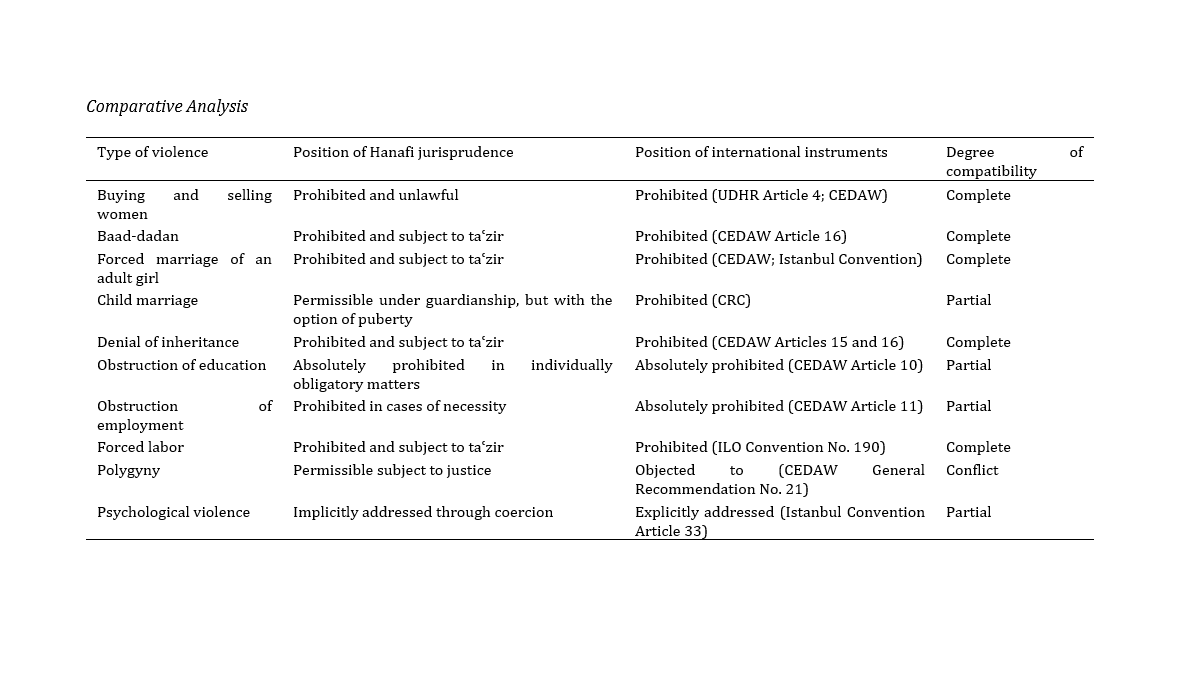
Violence against women is one of the most significant human rights challenges in contemporary societies and assumes complex dimensions in Islamic societies, particularly in regions influenced by Hanafi jurisprudence. As the most widely followed school of Islamic jurisprudence, Hanafi fiqh forms the basis of the legal systems of numerous countries, and its position on violence against women has a direct impact on policymaking and legislation in these countries. The central problem of this study is to examine the position of Hanafi jurisprudence regarding the principal manifestations of violence against women and to determine the extent to which these positions are consistent with, or divergent from, the standards of international human rights instruments. This study was conducted using a descriptive-analytical method and a comparative approach, with reference to authoritative Hanafi jurisprudential texts and international instruments, including the Convention on the Elimination of All Forms of Discrimination against Women, the Universal Declaration of Human Rights, the Convention on the Rights of the Child, the International Labour Organization Violence and Harassment Convention, 2019 (No. 190), the Beijing Declaration and Platform for Action, and the Istanbul Convention (Convention on the Elimination of All Forms of Discrimination against Women [CEDAW], 1979; Council of Europe, 2011; International Labour Organization [ILO], 2019; United Nations, 1948, 1989, 1995). The findings of the study indicate that Hanafi jurisprudence adopts positions in important cases such as the prohibition of forced marriage, the prohibition of the buying and selling of women, the unlawfulness of baad-dadan, the prohibition of forced labor, women’s financial independence, and the prohibition of unlawful interference with women’s inheritance, which fully overlap with international instruments. Conversely, in matters such as child marriage, polygyny, and certain restrictions based on the institution of guardianship, differences can be observed between the two systems; these differences arise from divergences in definitions and approaches rather than from a conflict in fundamental objectives. The conclusion is that the internal capacities of Hanafi jurisprudence, including the principles of negating harm, removing hardship, and requiring consent, provide a broad possibility for alignment with international standards concerning the prohibition of violence against women.
Downloads
References
Al-Ayni, A. M. M. i. A. i. M. i. A. i. H. B. a.-D. (2009). Al-Binayah fi Sharh al-Hidayah. Dar al-Kutub al-Ilmiyyah.
Al-Haddadi al-Abadi al-Zabidi al-Yamani al-Hanafi, A. B. i. A. i. M. (2006). Al-Jawharah al-Nayyirah ala Mukhtasar al-Quduri fi Furu' al-Hanafiyyah. Dar al-Kutub al-Ilmiyyah.
Al-Haskafi, M. i. A. (2002). Al-Taysir fi al-Fiqh al-Hanafi. Dar al-Kalim al-Tayyib.
Al-Hilli, H. i. Y. i. M. (1993). Tadhkirat al-Fuqaha, Volume 4. Al al-Bayt Institute for Revival of Heritage.
Al-Hurr al-Amili, M. i. H. (1988). Wasa'il al-Shi'ah, Volume 27. Al al-Bayt Institute for Revival of Heritage.
Al-Kasani al-Hanafi, A. a.-D. A. B. i. M. u. i. A. (1986). Bada'i al-Sana'i fi Tartib al-Shara'i. Dar al-Kutub al-Ilmiyyah.
Al-Majlisi, M. B. i. M. T. (1983). Bihar al-Anwar. Al-Wafa Foundation.
Al-Mawsili al-Hanafi, A. A. i. M. i. M. (1937). Al-Ikhtiyar li-Ta'lil al-Mukhtar. Al-Halabi Press.
Al-Quduri, A. i. M. (2006). Sharh Mukhtasar al-Quduri: Hanafi Jurisprudence. Dar Ibn Kathir.
Al-Sarakhsi, M. i. A. i. A. S. (1993). Al-Mabsut. Dar al-Ma'rifah.
Al-Shaybani, M. i. a.-H. (2012). Al-Asl al-Ma'ruf bi-al-Mabsut. Alam al-Kutub.
Al-Suyuti, A. a.-R. i. A. B. (1993). Al-Durr al-Manthur fi al-Tafsir al-Ma'thur. Dar al-Fikr.
An-Na'im, A. A. (1990). Toward an Islamic Reformation: Civil Liberties, Human Rights, and International Law. Syracuse University Press.
Baderin, M. A. (2003). International Human Rights and Islamic Law. Oxford University Press.
Charlesworth, H., & Chinkin, C. (2000). The Boundaries of International Law: A Feminist Analysis. Manchester University Press.
Cook, R. J. (1994). Human Rights of Women: National and International Perspectives. University of Pennsylvania Press.
Council of Europe. (2011). Convention on Preventing and Combating Violence against Women and Domestic Violence (Council of Europe Treaty Series, Issue.
Freeman, M. A., Chinkin, C., & Rudolf, B. (2012). The UN Convention on the Elimination of All Forms of Discrimination Against Women: A Commentary. Oxford University Press.
Ibn Abidin, M. A. (1992). Radd al-Muhtar ala al-Durr al-Mukhtar. Dar al-Fikr.
Ibn al-Humam, M. i. A. a.-W. (2000). Al-Tahbir Sharh al-Tahrir fi Usul al-Fiqh. Maktabat al-Rushd.
Ibn Nujaym al-Hanafi al-Misri, Z. a.-D. Al-Bahr al-Ra'iq Sharh Kanz al-Daqa'iq. Al-Matba'ah al-Ilmiyyah.
International Labour Organization. (2019). Violence and Harassment Convention, No. 190.
Mayer, A. E. (2012). Islam and Human Rights: Tradition and Politics (5th ed.). Westview Press.
Morsink, J. (1999). The Universal Declaration of Human Rights: Origins, Drafting, and Intent. University of Pennsylvania Press.
Peters, J. S., & Wolper, A. (1995). Women's Rights, Human Rights: International Feminist Perspectives. Routledge.
Sosa, L. A. (2020). The Istanbul Convention: A New International Standard for Addressing Violence against Women. Cambridge University Press.
Tabatabaei, S. M. H. (1996). Tafsir al-Mizan, Volume 4. Islamic Publications Office of the Society of Seminary Teachers of Qom.
Tomasevski, K. (1993). Women and Human Rights. Zed Books.
Trebilcock, A. (2020). Violence and Harassment in the World of Work: A Guide to Convention No. 190.
Unicef. (2007). The Convention on the Rights of the Child.
United Nations. (1995). Beijing Declaration and Platform for Action.
Waltz, S. (2004). Universal human rights: The contribution of Muslim states. Human Rights Quarterly, 26(4), 799-844.
Welchman, L. (2007). Women and Muslim Family Laws in Arab States: A Comparative Overview of Textual Development and Advocacy. Amsterdam University Press.
Downloads
Additional Files
Publication Timeline
- Submitted
- Revised
- Accepted
Issue
Section
License
Copyright (c) 2025 Mohammad Maroof Kheirkhah (Author); Karim Salehi (Corresponding author); Mohammad Reza Niyazi (Author)

This work is licensed under a Creative Commons Attribution-NonCommercial 4.0 International License.