Globalization of Human Rights and Reform of the System for the Protection of Women’s Rights in the Arab States of the Persian Gulf: A Comparative Study of Qatar, Oman, Kuwait, the United Arab Emirates, Bahrain, and Saudi Arabia
Keywords:
globalization of human rights, women’s rights, Arab states of the Persian Gulf, Convention on the Elimination of All Forms of Discrimination against WomenAbstract
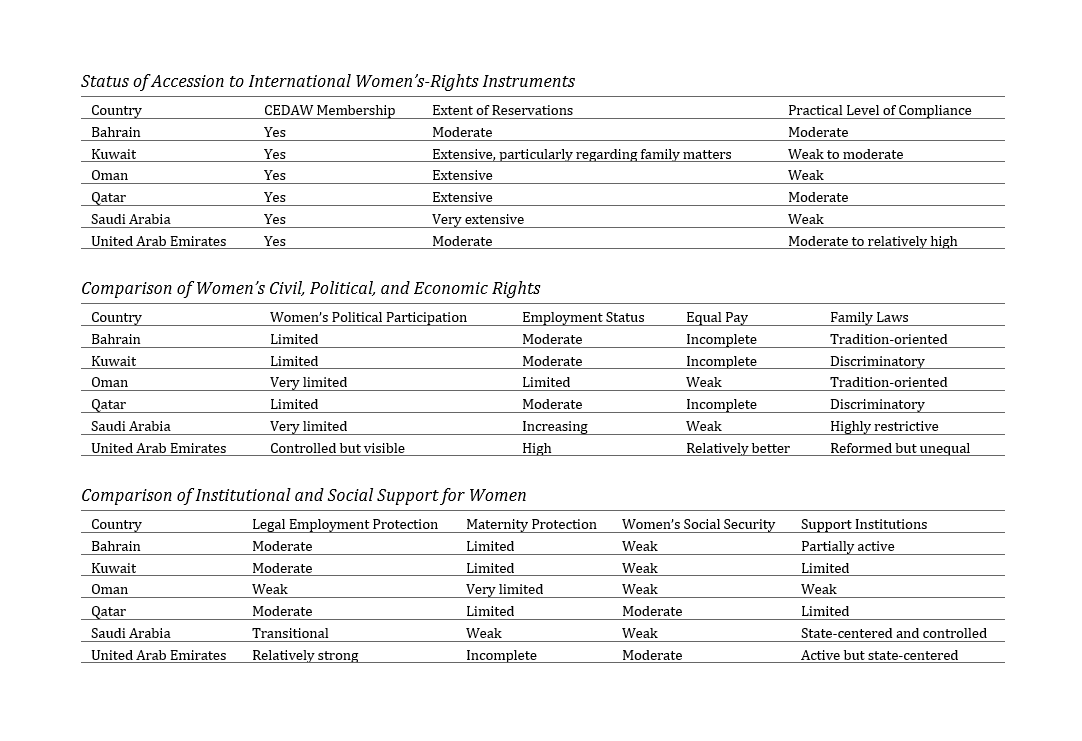
Adopting a review-based comparative approach and drawing on Persian, Arabic, and English sources, the present study examines the impact of the globalization of human rights on the reform of women’s rights protection systems in six Arab states of the Persian Gulf: Qatar, Oman, Kuwait, the United Arab Emirates, Bahrain, and Saudi Arabia. The findings indicate that, despite their accession to the Convention on the Elimination of All Forms of Discrimination against Women, the countries under study have restricted the scope of their obligations through extensive reservations, particularly in matters relating to family, marriage, and nationality. This situation has resulted in a form of “symbolic acceptance” of global standards on women’s rights. Reforms undertaken in these countries have primarily focused on the economic sphere, employment, and women’s professional empowerment and have largely been aligned with economic development requirements, labor market needs, and national development programs. By contrast, fundamental areas of gender inequality, including personal status laws, guardianship, divorce, inheritance, and child custody, remain substantially influenced by patriarchal structures and traditional jurisprudential interpretations. A comparative analysis of the countries under study reveals three distinct patterns: a minimal and tradition-oriented model in Oman and Saudi Arabia; an intermediate and symbolic model in Kuwait, Qatar, and Bahrain; and a controlled-transition model in the United Arab Emirates. A common feature of all three patterns is the existence of a structural gap between governments’ formal commitments, legal reforms, and women’s lived realities. Accordingly, the principal challenge confronting women’s rights in the Arab states of the Persian Gulf lies not in the absence of laws and legal instruments, but rather in weak institutional commitment, ineffective implementation mechanisms, and the lack of a localized theoretical framework for the interpretation and application of human rights. Therefore, reconstructing the system for the protection of women’s rights requires a transition from symbolic reforms to structural reforms, a fundamental reconsideration of personal status laws, the strengthening of independent civil society institutions, and the development of an indigenous discourse on women’s rights grounded in human dignity, equality, and gender justice.
Downloads
References
Abedi, M., & Amini, A. (2021). Women's Right to Divorce: Religious Ruling and Human Rights Necessity. Human Rights, 16(31), 217-256. https://doi.org/10.22096/hr.2021.134952.1239
Al-Aqayleh, Z. M. (2009). Working Women's Rights: A Comparative Study between Islamic Sharia and Positive Laws. Muhammad Deifallah Huwaiti Journal, 31(13), 408-430.
Al-Asadi, M. H., & Jamil, A. M. (2022). Women in Modern Progressive Arab Thought: A Study of the Woman Question in the Thought of Qasim Amin. Journal of the University of Duhok, 26(1), 976-982. https://doi.org/10.26682/chjuod.2023.26.1.71
Al-Awadi, S., Ezzat, M., & Fadl, M. A. (2017). Labor Market Transformations and Their Implications for Working Women's Rights in Tunisia, Egypt, and Bahrain.
Al-Dardour, R. A. (2014). Civil and Political Rights of Emirati Women: A Comparative Study. Journal of Gulf and Arabian Peninsula Studies, 40(153), 227-285.
Al-Masaeed, A. (2024). Women's Rights in the Transitional Justice Process. Journal of Modern Legal Studies, 3(2), 140-163. https://doi.org/10.70411/MJLS.3.2.2025191
Ali, H. (2019). Reservations to the CEDAW Convention: Arab Countries as a Model. Imam Ja'far al-Sadiq Journal for Humanities and Social Sciences(54), 1-29. https://doi.org/10.33193/JALHSS.54.2020.129
Ashour, A. (2022). Women's Rights between International Reference Frameworks and National Legislation. Al-Ma'rifa Journal for Studies and Research(5), 53-65.
Astaraki, Z. (2009). Examining Factors Affecting Women's Social Participation Islamic Azad University]. Tehran.
Awqati, B. N., & Al-Azzawi, T. (2022). Effective Political Participation of Iraqi Women: Between International Measures and National Elections.
Ben Brik, A. (2025). Women's Empowerment Policy in Qatar. In Social Welfare in Qatar (pp. 207-239). Springer. https://doi.org/10.1007/978-981-96-3157-5_8
Boumaraf, L. (2017). Women's Political Rights: A Comparative Study between Sharia and Law. International Forum: Women's Empowerment from an International Perspective between the Universality of Texts and the Specificity of Arab Societies,
Dorsey, J. M. (2014). Women's Sporting Rights Put Saudi Arabia and Iran on the Defensive.
Elneil, S., Delanerolle, G., Pathiraja, V. M., & Mudalige, T. (2025). Beyond the Veil of Homogeneity: Addressing the Variability of Women's Health and Policy Gaps in the Middle East. https://doi.org/10.20944/preprints202509.0052.v1
Fallahi, A. (2021). Women's Rights in Tahar al-Haddad's Maqasid-Based Reading. Studies in Jurisprudence and Principles, 4(1), 159-180.
Garrett, S. (2001). Sociology of Gender. Ney.
Ghezelsofloo, M. T. (2000). Globalization: Confrontation and Coexistence. Political-Economic Information Quarterly(11-12), 148.
Gholami, S. (2018). Nongovernmental Organizations and Human Rights. Mizan.
Gillis, E. (2017). Ahead of the Boston Women's March: A Look Back 47 Years Ago.
Goudarzi, M., & Kaffash Neyri, M. (2019). Globalization of Human Rights: Culture of Peace and International Relations. International Human Rights, 14(1), 19-42.
Jafari, M., & Khajvand, M. (2022). Women's Specific Rights in the Execution of Punishments. Comparative Criminal Jurisprudence, 2(1), 71-78. https://doi.org/10.22034/jccj.2022.353013.1060
Jahangiri, S., & Garousi, N. (2019). Women's Rights in Islam and the Convention on the Elimination of All Forms of Discrimination against Women. Political Strategy, 3(8).
Jalali, M., & Mousavi, S. F. (2013). Women's Political Rights from the Perspective of Islam and International Human Rights Instruments. Women and Culture, 4(15), 59-69.
Kalaivani, R. (2025). Periyar: A Crusader of Women's Rights. International Journal of Latest Technology in Engineering, Management & Applied Science, 14(8), 1545-1547. https://doi.org/10.51583/IJLTEMAS.2025.1408000192
Kazem, D. (2017). Workers' Rights in International Law.
Khalaf, K. I. (2022). Legal Protection of Women's Right to Decent Work: A Human Rights Study. Journal of the Institute, 14, 559-572. https://doi.org/10.61353/ma.0140559
Kodoth, P. (2025). Paternalist Governance, Tacit Accommodations: The Dynamics of Informality in Women's Labour Mobility to the Middle East. Sociological Bulletin, 74(4). https://doi.org/10.1177/00380229251349569
Landman, T. (2005). Protecting Human Rights: A Comparative Study. Georgetown University Press.
Mahadew, R. (2025). Women's Rights. In Mauritius and African Human Rights Law (pp. 141-176). Springer. https://doi.org/10.1007/978-3-032-08832-1_7
Makhlouf, N., & Bouderhem, F. (2017). Political Participation and Political Empowerment of Women: Obstacles, Challenges, and Mechanisms for Addressing Them in the Arab World.
Malekshah, A. (2025). Human Rights Violations in Domestic Violence against Women. Jurisprudential Human Rights Research, 2(3), 95-112.
Mansour, R. (2020). Women and Political Participation in Arab Countries: Achievements and Challenges. Journal of Social Studies, 10(3), 25-48.
Mansouri Moghadam, M., & Lari Monfared, F. (2021). Examining the Political and Social Status of Women in Arab Countries of the Persian Gulf, 2002-2020: The Case of Bahrain. Fundamental and Applied Studies of the Islamic World, 3(1), 45-68.
Mehdiyeva, J. (2025). Marital Dissolution in a Transnational Context: A Case Study of Iranian Expatriate Community in Qatar Hamad bin Khalifa University]. https://doi.org/10.13140/RG.2.2.36402.88005
Mehrpour, H. (2009). International Mechanisms and Their Deterrent Effect on Human Rights Violations. Foreign Relations Quarterly, 1(4), 7-42.
Miawad, N. (2017). Shadow Reports as a Mechanism for Protecting Human Rights: An Applied Study of the Egyptian Case in the Universal Periodic Review Utrecht University]. https://doi.org/10.13140/RG.2.2.15587.17444
Mojab, S. (2013). Women in Iraq: Past Meets Present. The Middle East Journal, 67(1), 147-148.
Montazeri, S. H. (2017). A Look at Women's Rights from the Perspective of International Law: A Case Study of the Convention on the Elimination of Discrimination against Women. Studies on the Protection of Women's Rights, 3(9), 1-20.
Mousavi, S. M. (2016). Examining the Performance of the United Nations in the Field of Women's Rights. Studies on the Protection of Women's Rights, 1(3), 25-44.
Movahedian, H., Esmaeili, M., & Roshan, M. (2023). Assessment of Women's Financial Rights in Islamic Family Law: A Comparative Study of Iran, Egypt, Morocco, and Tunisia. Legal Civilization, 6(15), 21-52.
Muhammad, A. S. N. a.-D. (2019). Constitutional and Legislative Reforms for the Protection of Women's Political Rights. Journal of the College of Law for Legal and Political Sciences, 31(13), 622-652.
Noruzi, S., & Ghorbani, M. (2017). Analysis of Women's Political Participation in the Middle East: The Cases of Kuwait and Saudi Arabia. Women and Society, 8(31), 145-168.
Pahlavani, E., & Golestani, M. (2016). Examining the Impact of Globalization on the Political Culture of Women in Persian Gulf Countries: The Cases of the Islamic Republic of Iran and Saudi Arabia. Cultural and Political Studies of the Persian Gulf, 3(8), 87-137.
Qotrunnada, M. H., & Hakim, A. R. (2025). Critical Discourse Analysis of the Narrative of Women's Emancipation in Arab Patriarchal Culture. LINGUA: Jurnal Bahasa Sastra dan Pengajarannya, 21(2), 226-240. https://doi.org/10.30957/lingua.v21i2.1039
Raei, M. (2012). International Human Rights Law: Instruments, Sources, and Mechanisms. Mizan.
Rafiei, M. T., & Dabbaghi, M. (2014). Globalization and Women's Rights: Opportunities and Challenges. Strategic Studies of Globalization, 5(14), 17-38.
Ramezani, P., & Mashhadi, A. (2015). Examining the Role of Nongovernmental Organizations in Promoting Human Rights in Developing Countries: The Case of Iran. Second International Conference on Law and Sustainable Development of Civil Society, Shiraz.
Sabri, S. (2023). A Review on Women's Rights Struggle in the Kurdistan Region of Iraq. International Journal of Social Sciences and Education, 10(1), 151-164. https://doi.org/10.23918/ijsses.v10i1p151
Safari, V., Ayati, S. M. R., & Arabian, A. (2023). A Comparative Study of Women's Rights in the Scriptures of Divine Religions. Quranic Studies, 14(54), 155-167.
Samadi Rad, M. (2006). Women's Political and Social Participation in Iran. Agah.
Secretariat of the National, C. (2008). National Human Development Report of the Islamic Republic of Iran.
Sharif, A. M. (2023). Arab Women's Rights under Globalization: The Cultural Specificity of Society. Journal of Humanities and Applied Studies.
Sharif Shahi, M., & Jalali, M. (2012). The Role of Human Rights Nongovernmental Organizations in the Development of International Law. Comparative Law Research, 16(2), 99-126.
Sheibani, D., & Majedi, M. (2016). Examining Cultural and Social Factors Affecting Women's Social Participation. First International Conference on New Research in Educational Sciences, Psychology, and Social Studies in Iran,
Shenhav, S. (2020). Religious Law, Family Law, and Women's Human Rights. Human Rights, 15(1), 127-143.
Shokoohi, A. (2021). Feminist Resistance in Contemporary Kuwait.
Talbi, S. (2019). Applications of the Obligation to Eliminate Discrimination against Women in Arab Countries. First Annual International Conference on Human Rights in Arab Constitutional Systems: Reality and Aspirations, Egypt.
Tétreault, M. A., Meyer, K., & Rizzo, H. (2009). Women's Rights in the Middle East: A Longitudinal Study of Kuwait. International Political Sociology, 3(2), 218-237. https://doi.org/10.1111/j.1749-5687.2009.00072.x
Tripp, A. M. (2020). Contrasting Women's Rights in the Maghreb and the Middle East Constitutions. In Double-Edged Politics on Women's Rights in the MENA Region (pp. 205-227). Springer. https://doi.org/10.1007/978-3-030-27735-2_8
Waheedi, S. (2022). Litigating Women's Rights in Gulf Monarchial Systems. Arab Law Quarterly, 36(4-5), 1-30. https://doi.org/10.1163/15730255-bja10117
Wellman, C. (2019). Can Women's Rights Be Human Rights? Human Rights, 14(1), 189-203.
Downloads
Additional Files
Publication Timeline
- Submitted
- Revised
- Accepted
Issue
Section
License
Copyright (c) 2025 Mohamad Ali Kefaeifar (Author); Fatemeh Sadat Mousavi (Corresponding author); Mashallah Heidarpour (Author)

This work is licensed under a Creative Commons Attribution-NonCommercial 4.0 International License.