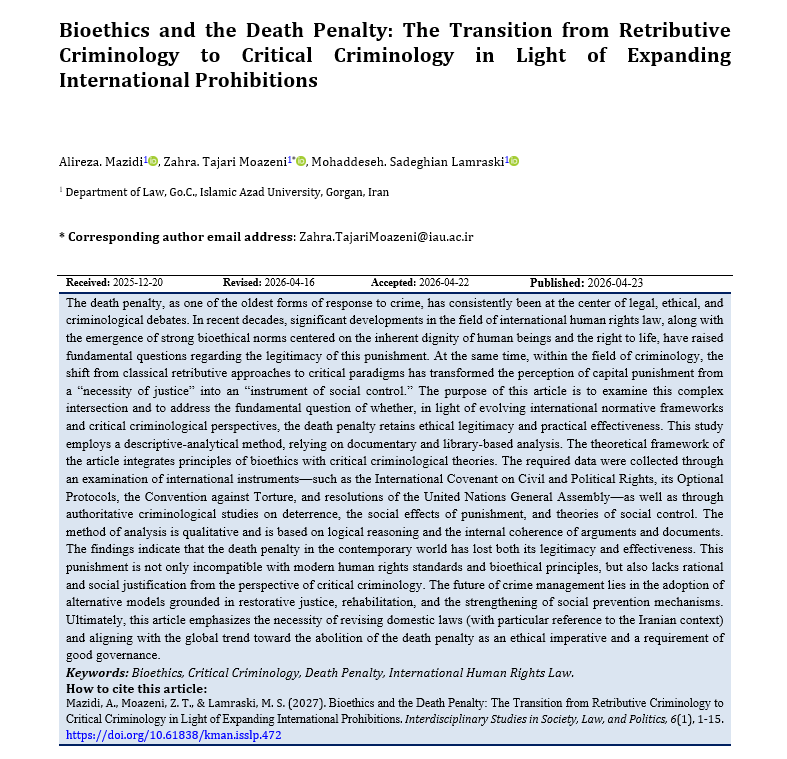
Bioethics and the Death Penalty: The Transition from Retributive Criminology to Critical Criminology in Light of Expanding International Prohibitions
Keywords:
Bioethics, Critical Criminology, Death Penalty, International Human Rights LawAbstract
The death penalty, as one of the oldest forms of response to crime, has consistently been at the center of legal, ethical, and criminological debates. In recent decades, significant developments in the field of international human rights law, along with the emergence of strong bioethical norms centered on the inherent dignity of human beings and the right to life, have raised fundamental questions regarding the legitimacy of this punishment. At the same time, within the field of criminology, the shift from classical retributive approaches to critical paradigms has transformed the perception of capital punishment from a “necessity of justice” into an “instrument of social control.” The purpose of this article is to examine this complex intersection and to address the fundamental question of whether, in light of evolving international normative frameworks and critical criminological perspectives, the death penalty retains ethical legitimacy and practical effectiveness. This study employs a descriptive-analytical method, relying on documentary and library-based analysis. The theoretical framework of the article integrates principles of bioethics with critical criminological theories. The required data were collected through an examination of international instruments—such as the International Covenant on Civil and Political Rights, its Optional Protocols, the Convention against Torture, and resolutions of the United Nations General Assembly—as well as through authoritative criminological studies on deterrence, the social effects of punishment, and theories of social control. The method of analysis is qualitative and is based on logical reasoning and the internal coherence of arguments and documents. The findings indicate that the death penalty in the contemporary world has lost both its legitimacy and effectiveness. This punishment is not only incompatible with modern human rights standards and bioethical principles, but also lacks rational and social justification from the perspective of critical criminology. The future of crime management lies in the adoption of alternative models grounded in restorative justice, rehabilitation, and the strengthening of social prevention mechanisms. Ultimately, this article emphasizes the necessity of revising domestic laws (with particular reference to the Iranian context) and aligning with the global trend toward the abolition of the death penalty as an ethical imperative and a requirement of good governance.
Downloads
References
Dulmer, H. (2020). The Global Trend of Death Penalty Abolition: A Diffusive Analysis. Punishment and Society, 22(5), 582-606. https://doi.org/10.1177/1462474520916254
Fatemi Khah, A., Heidari, M. A., & Tavakkoli, A. R. (2022). The Right to Life and Its Deprivation from the Perspective of Islam and International Law. Medical Law Journal, 16(Special Issue), 1-17.
Frost, N. A., & Clear, T. R. (2021). The Death Penalty in Decline: A History of Abolition and Retention in the United States. Annual Review of Criminology, 4, 295-313. https://doi.org/10.1146/annurev-criminol-061020-022108
Hood, R., & Deva, S. (2022). Confronting Capital Punishment in Asia: Human Rights, Politics, and Public Opinion. Oxford University Press.
Jafari, M. (2020). Introduction to Criminal Law Science (3rd ed.). Mizan.
Johnson, D. T., & Zimring, F. E. (2020). The Next Frontier: National Development, Political Change, and the Death Penalty in Asia. Oxford University Press.
Kaleck, W., & Singh, J. (2023). Strategic Litigation Against the Death Penalty: Global Experiences and Lessons. Human Rights Law Review, 23(1), ngac032. https://doi.org/10.1093/hrlr/ngac032
Liu, S., & Halliday, T. C. (2021). The Politics of Death: Judicial Independence and the Death Penalty in Authoritarian Regimes. Law and Society Review, 55(2), 189-215. https://doi.org/10.1111/lasr.12545
Miao, M. (2020). The Death Penalty in China: Policy, Practice, and Reform. Columbia Journal of Asian Law, 33(2), 1-48. https://doi.org/10.7916/cjal.v33i2.6134
Nowak, M. (2022). The Absolute Prohibition of Torture and Inhuman Punishment: Is the Death Penalty Included? Journal of International Human Rights, 20(4), 511-534. https://doi.org/10.1163/15718158-20040003
Rayejian Asli, M. (2023). General Criminology (2nd ed.). Negah-e Moaser.
Sabouri Pour, M. (2019). Rationality in the Commission of Crime (1st ed.). Mizan.
Sabouri Pour, M. (2023). General Principles of Criminal Law (1st ed.). Mizan.
Schabas, W. A. (2022). The Abolition of the Death Penalty in International Law (5th ed.). Cambridge University Press.
Smit, D. V. (2023). The Death Penalty: A Worldwide Perspective (6th ed.). Oxford University Press.
Tahmasbi, J. (2024). Criminal Procedure (4th ed., Vol. 3). Mizan.
Moratorium on the Use of the Death Penalty, (2022). https://digitallibrary.un.org/record/3997979
Wang, Z. (2023). Public Opinion and the Death Penalty in Asia: A Comparative Study of China, Japan, and Taiwan. Asian Journal of Criminology, 18(1), 67-85. https://doi.org/10.1007/s11417-022-09385-4
Zamani, S. G., & Feyz, M. J. (2024). The Necessity or Possibility of the Divine Nature of Human Dignity. 88(127), 343-362.
Zhong, L. Y., & Liu, J. (2020). Capital Punishment in China: A Populist Instrument of Social Governance. The China Quarterly, 241, 1-22. https://doi.org/10.1017/S0305741019000860
Downloads
Additional Files
Publication Timeline
- Submitted
- Revised
- Accepted
Issue
Section
License
Copyright (c) 2025 Alireza Mazidi (Author); Zahra Tajari Moazeni (Corresponding author); Mohaddeseh Sadeghian Lamraski (Author)

This work is licensed under a Creative Commons Attribution-NonCommercial 4.0 International License.