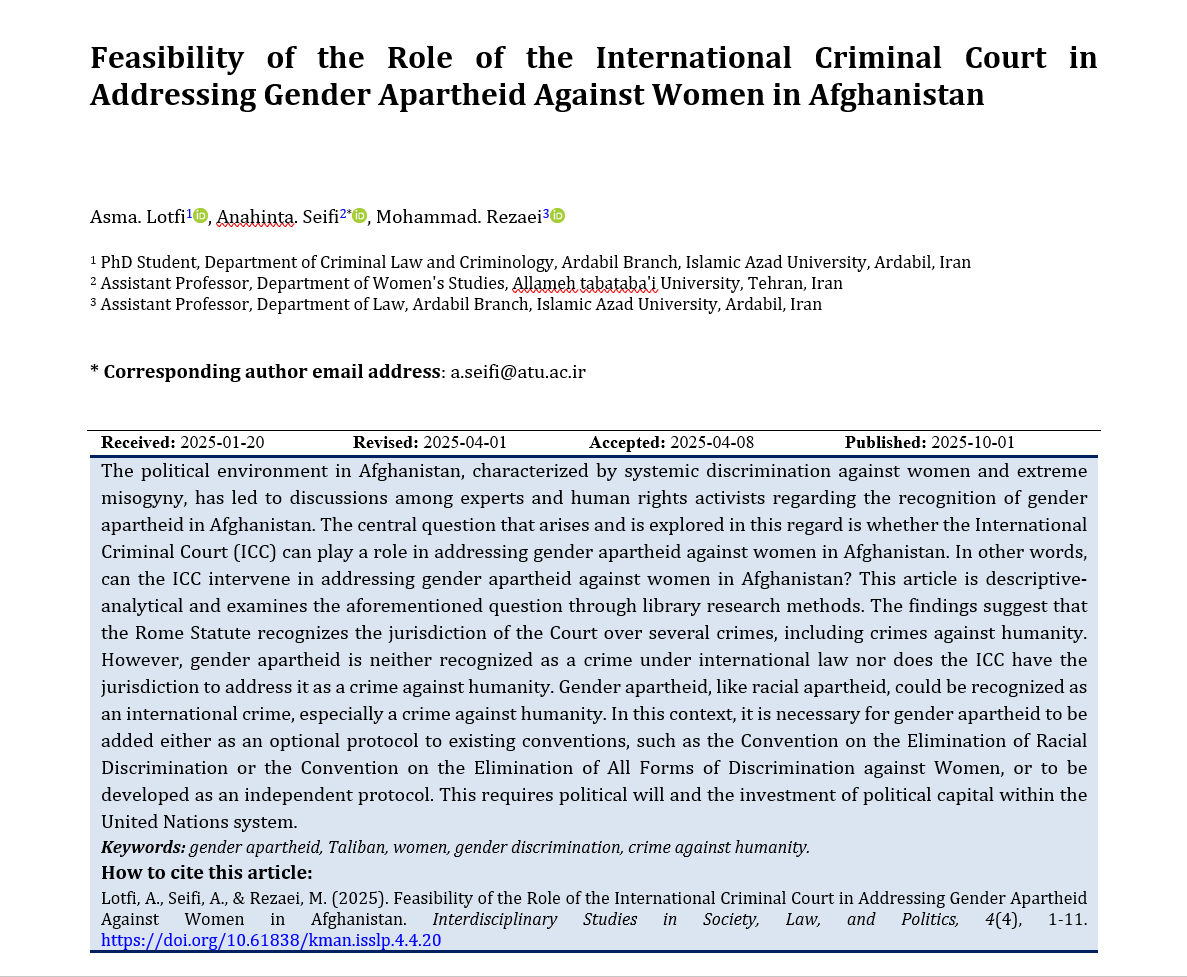
Feasibility of the Role of the International Criminal Court in Addressing Gender Apartheid Against Women in Afghanistan
DOI:
https://doi.org/10.61838/kman.isslp.4.4.20Keywords:
gender apartheid, Taliban, women, gender discrimination, crime against humanityAbstract
The political environment in Afghanistan, characterized by systemic discrimination against women and extreme misogyny, has led to discussions among experts and human rights activists regarding the recognition of gender apartheid in Afghanistan. The central question that arises and is explored in this regard is whether the International Criminal Court (ICC) can play a role in addressing gender apartheid against women in Afghanistan. In other words, can the ICC intervene in addressing gender apartheid against women in Afghanistan? This article is descriptive-analytical and examines the aforementioned question through library research methods. The findings suggest that the Rome Statute recognizes the jurisdiction of the Court over several crimes, including crimes against humanity. However, gender apartheid is neither recognized as a crime under international law nor does the ICC have the jurisdiction to address it as a crime against humanity. Gender apartheid, like racial apartheid, could be recognized as an international crime, especially a crime against humanity. In this context, it is necessary for gender apartheid to be added either as an optional protocol to existing conventions, such as the Convention on the Elimination of Racial Discrimination or the Convention on the Elimination of All Forms of Discrimination against Women, or to be developed as an independent protocol. This requires political will and the investment of political capital within the United Nations system.
Downloads
References
Andre, P., & Haddadi, M. (2005). Complementarity Jurisdiction and Concurrent Jurisdiction in the Statute of the International Criminal Court. Islamic Law Journal, 2(6), 163-183.
Anisi, F. (2004). Afghan Refugee Women: Doubts and Realities. Payam-e Zan Magazine, 13(7), 28-29.
Babakhani, M., & Ghasemi, A. (2016). Pornography from the Perspective of International Documents and Iranian Law. New Research in Humanities Journal, 3(14), 36-59.
Cassese, A. (2013). Cassese's International Criminal Law (3rd ed.). Oxford University Press.
Dadashzadeh, A. R., & Habibi, J. (2008). Analysis and Examination of the Principle of Universal Jurisdiction in Criminal Laws. Journal of Islamic Jurisprudence and Law Research, 4(12), 207-218.
Hosseini, M. M. (2018). Violence Against Women in Afghanistan from the Perspective of Domestic and International Law Faculty of Law, Qom University].
Kamminga, M. T. (1992). Interstate Accountability for Violations of Human Rights (1st ed.). University of Pennsylvania Press.
Khavari, A., & Simber. (2022). A comparative study of the political-social rights of women in the Islamic Republic of Afghanistan (2001-2021) and the Islamic Emirate of Afghanistan (2021-present) and its alignment with Islamic views and international laws. Journal of Research and Development in Comparative Law, 5(16), 144-169.
Mirjafari, S. H., Zarneshan, S., & Rahmatifar, S. (2023). Universal Jurisdiction of Iranian Courts in International Criminal Law. Public Law Studies Journal, 53(3), 1654-1675.
Momeni, M. (2017). Evaluation of Iranian Criminal Jurisdiction and the International Criminal Court over Crimes Committed by ISIS in Syria and Iraq. Comparative Law Research Journal, 21(1), 163-190.
Pourbafrani, H. (2003). Principle of Universal Jurisdiction in International Criminal Law and Iran. Judiciary Law Journal, 42(67), 61-86.
Rasouli, M., & Mohammadi, S. B. (2023). Afghanistan's Judicial Criminal Policy Regarding Sexual Assault Crimes Against Women. Bimonthly Findings in Criminal Law and Criminology(7).
Downloads
Additional Files
Publication Timeline
- Submitted
- Revised
- Accepted
Issue
Section
License
Copyright (c) 2025 Asma Lotfi (Author); Anahinta Seifi (Corresponding author); Mohammad Rezaei (Author)

This work is licensed under a Creative Commons Attribution-NonCommercial 4.0 International License.