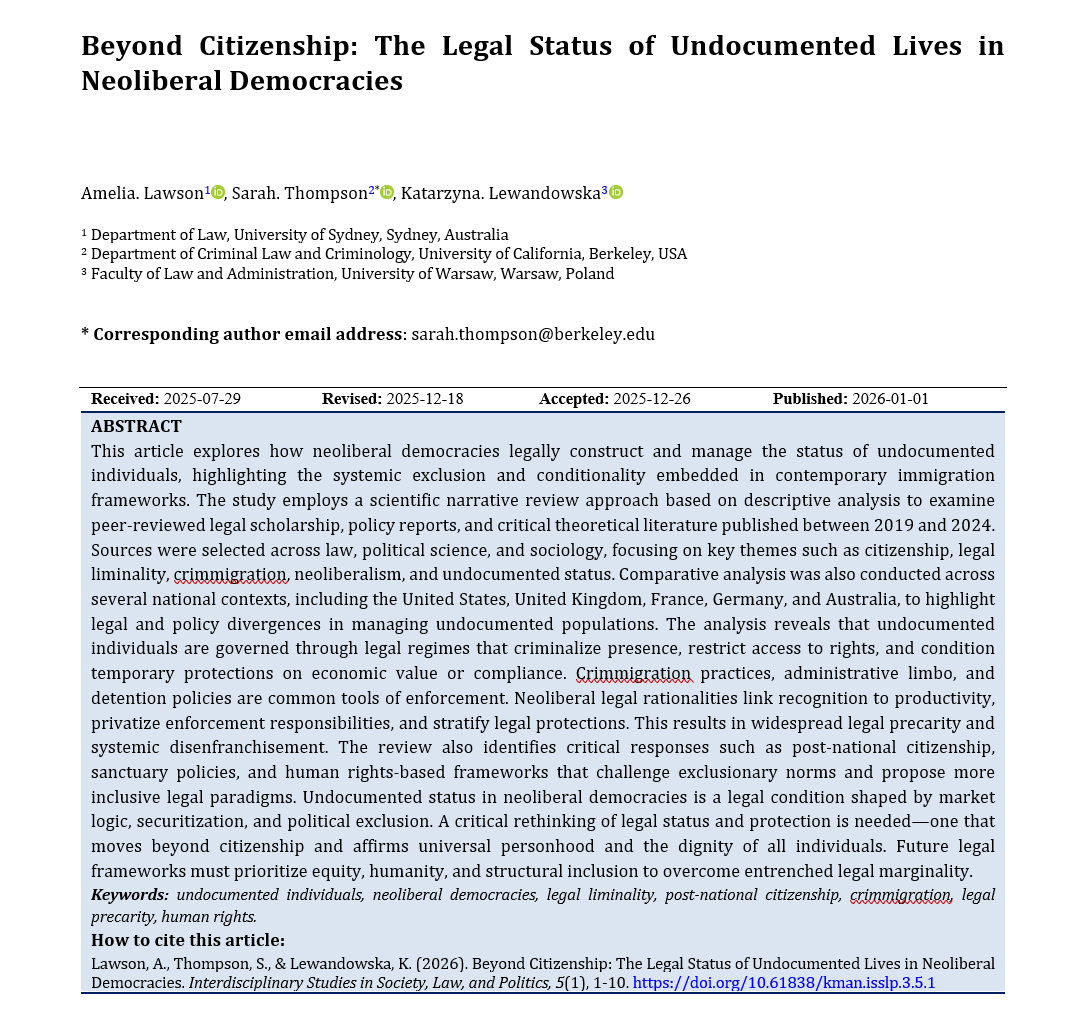
Beyond Citizenship: The Legal Status of Undocumented Lives in Neoliberal Democracies
DOI:
https://doi.org/10.61838/kman.isslp.456Keywords:
undocumented individuals, neoliberal democracies, legal liminality, post-national citizenship, crimmigration, legal precarity, human rightsAbstract
This article explores how neoliberal democracies legally construct and manage the status of undocumented individuals, highlighting the systemic exclusion and conditionality embedded in contemporary immigration frameworks. The study employs a scientific narrative review approach based on descriptive analysis to examine peer-reviewed legal scholarship, policy reports, and critical theoretical literature published between 2019 and 2024. Sources were selected across law, political science, and sociology, focusing on key themes such as citizenship, legal liminality, crimmigration, neoliberalism, and undocumented status. Comparative analysis was also conducted across several national contexts, including the United States, United Kingdom, France, Germany, and Australia, to highlight legal and policy divergences in managing undocumented populations. The analysis reveals that undocumented individuals are governed through legal regimes that criminalize presence, restrict access to rights, and condition temporary protections on economic value or compliance. Crimmigration practices, administrative limbo, and detention policies are common tools of enforcement. Neoliberal legal rationalities link recognition to productivity, privatize enforcement responsibilities, and stratify legal protections. This results in widespread legal precarity and systemic disenfranchisement. The review also identifies critical responses such as post-national citizenship, sanctuary policies, and human rights-based frameworks that challenge exclusionary norms and propose more inclusive legal paradigms. Undocumented status in neoliberal democracies is a legal condition shaped by market logic, securitization, and political exclusion. A critical rethinking of legal status and protection is needed—one that moves beyond citizenship and affirms universal personhood and the dignity of all individuals. Future legal frameworks must prioritize equity, humanity, and structural inclusion to overcome entrenched legal marginality.
Downloads
References
Altman, T. (2024). Civil Society Silos. Migration and Society, 7(1), 78-93. https://doi.org/10.3167/arms.2024.070108
Esien, E. B. (2022). Transnational Network and Information Flow in African Refugees and Undocumented Migrants’ International Migration Process. Ilomata International Journal of Social Science, 3(2), 117-132. https://doi.org/10.52728/ijss.v3i2.465
Gasztold, B. (2019). In Pursuit of the American DREAM, or Mirage? Undocumented Youth in YA Fiction. Ad Americam, 20, 15-28. https://doi.org/10.12797/adamericam.20.2019.20.02
Hendricks, M. J. (2022). National Identity and Immigration: Threat From Undocumented Immigrants in the United States. 183-202. https://doi.org/10.1037/0000294-010
J, D. P., & Karunakar, M. (2024). The Biopolitics of Disability. Journal of Literary Studies, 40. https://doi.org/10.25159/1753-5387/16432
Kim, N. R. (2022). A Study on the Protection of Fundamental Right of Undocumented Immigrant Children: Focused on the European Countries. European Constitutional Law Association, 29, 217-248. https://doi.org/10.21592/eucj.2022.39.217
Lopez, W. D. (2021). Leisy J. Abrego and Genevieve Negrón-Gonzales (Eds.), We Are Not Dreamers: Undocumented Scholars Theorize Undocumented Life in the United States (Durham, NC: Duke University Press, 2020, $26.95). Pp. 264. isbn 978 1 4780 1083 8. Journal of American Studies, 55(5), 1241-1242. https://doi.org/10.1017/s0021875821001018
Martínez, R. A. (2024). Transnational DREAMer Narratives. 49(1), 79-100. https://doi.org/10.1525/azt.2024.49.1.79
Masias, A., & Mixon, J. (2022). Living Undocumented. 93-97. https://doi.org/10.4324/9781003169468-14
Mavelli, L. (2022). Introduction: The Neoliberal Value of Citizenship. 1-24. https://doi.org/10.1093/oso/9780192857583.003.0001
Moise, A. (2023). “My Nine-Digit American-Dream”: Undocumentedness and Unwelcomeness in Do You Know Who I Am?. East-West Cultural Passage, 23(1), 61-73. https://doi.org/10.2478/ewcp-2023-0006
Nair, P. (2023). With Strings Attached. Romanic Review, 114(2), 420-435. https://doi.org/10.1215/00358118-10604276
Opperdoes, M., Greenbrook, J. T. V., Danielsson, L., Elden, H., & Ascher, H. (2020). Navigating Contrasting Liminalities: Women’s Experience of Childbearing While Undocumented in Sweden. European journal of public health, 30(Supplement_5). https://doi.org/10.1093/eurpub/ckaa166.946
Qraini, E. T., & Awad, Y. (2020). Of Basement Kitchens and Filthy Lodges: Spaces in Desai’s the Inheritance of Loss and Hage’s Cockroach. Advances in Language and Literary Studies, 11(2), 28. https://doi.org/10.7575/aiac.alls.v.11n.2p.28
Ramos‐Sánchez, L. (2020). The Psychological Impact of Immigration Status on Undocumented Latinx Women: Recommendations for Mental Health Providers. Peace and Conflict Journal of Peace Psychology, 26(2), 149-161. https://doi.org/10.1037/pac0000417
Roberts, M. (2020). Globalization and Neoliberalism: Structural Determinants of Global Mental Health? Humanity & Society, 45(4), 471-508. https://doi.org/10.1177/0160597620951949
Ruszczyk, S. P. (2021). Moral Career of Migrant Il/Legality: Undocumented Male Youths in New York City and Paris Negotiating Deportability and Regularizability. Law & Society Review, 55(3), 496-519. https://doi.org/10.1111/lasr.12571
Downloads
Additional Files
Publication Timeline
- Submitted
- Revised
- Accepted
Issue
Section
License

This work is licensed under a Creative Commons Attribution-NonCommercial 4.0 International License.