The Politics of Legal Time: Statutes of Limitations in Transitional Justice
DOI:
https://doi.org/10.61838/kman.isslp.464Keywords:
transitional justice, legal time, statutes of limitations, political justice, imprescriptibility, post-conflict law, victims' rights, reconciliation, accountability, legal temporalityAbstract
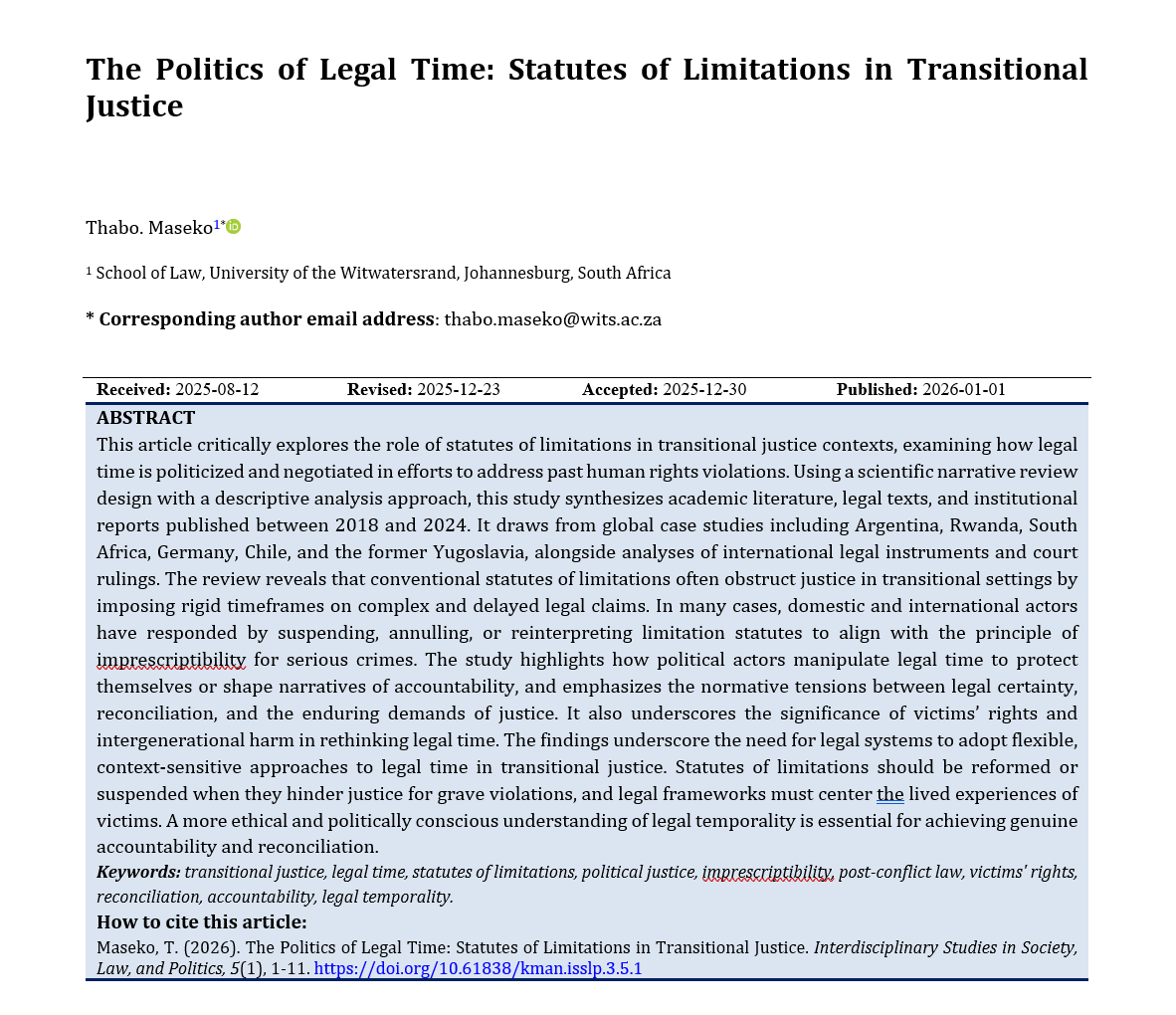
This article critically explores the role of statutes of limitations in transitional justice contexts, examining how legal time is politicized and negotiated in efforts to address past human rights violations. Using a scientific narrative review design with a descriptive analysis approach, this study synthesizes academic literature, legal texts, and institutional reports published between 2018 and 2024. It draws from global case studies including Argentina, Rwanda, South Africa, Germany, Chile, and the former Yugoslavia, alongside analyses of international legal instruments and court rulings. The review reveals that conventional statutes of limitations often obstruct justice in transitional settings by imposing rigid timeframes on complex and delayed legal claims. In many cases, domestic and international actors have responded by suspending, annulling, or reinterpreting limitation statutes to align with the principle of imprescriptibility for serious crimes. The study highlights how political actors manipulate legal time to protect themselves or shape narratives of accountability, and emphasizes the normative tensions between legal certainty, reconciliation, and the enduring demands of justice. It also underscores the significance of victims’ rights and intergenerational harm in rethinking legal time. The findings underscore the need for legal systems to adopt flexible, context-sensitive approaches to legal time in transitional justice. Statutes of limitations should be reformed or suspended when they hinder justice for grave violations, and legal frameworks must center the lived experiences of victims. A more ethical and politically conscious understanding of legal temporality is essential for achieving genuine accountability and reconciliation.
Downloads
References
Balatska, O. (2024). The Quintessence of the Legal Nature of the Right to Access to Justice Within the State’s Legal System. Uzhhorod National University Herald Series Law, 1(85), 20-25. https://doi.org/10.24144/2307-3322.2024.85.1.2
Balieva, Z. Y., & Ayupova, Z. K. (2024). The Administrative Justice of the Republic of Kazakhstan as an Instrument and Support of the Hearing State. Bulletin of Institute of Legislation and Legal Information of the Republic of Kazakhstan, 2(77), 99-110. https://doi.org/10.52026/2788-5291_2024_77_2_99
Bohgutskyi, P. (2023). Legal Features of the Military Justice System of Ukraine: Theoretical and Applied Aspect. Information and Law(3(46)), 215-223. https://doi.org/10.37750/2616-6798.2023.3(46).287256
Chaudhary, P. N., Barbate, V. A., & Adv. Owi Prakash Chaudhary Dr. Prakash, N. C. (2022). Issue of Pendency of Cases in Indian Courts and Way Forward. Ymer Digital, 21(02), 281-287. https://doi.org/10.37896/ymer21.02/29
Dimyati, K., Ridho, M., Wardiono, K., Absori, A., & Budiono, A. (2022). Developing Islamic Legal Philosophy-Based Assurance of Justice. Wisdom, 24(4), 193-203. https://doi.org/10.24234/wisdom.v24i4.808
Elmayanti, E., Deliana, E., & Rasudin, N. (2020). Settlement of Criminal Matters Through Malay Customary Institutions With the Concept of Restorative Justice in Lipat Kain Kampar Kiri of Kampar Regency. Jurnal Hukum Volkgeist, 4(2), 180-189. https://doi.org/10.35326/volkgeist.v4i2.417
Gardner, J. (2021). Nicholas McBride, the Humanity of Private Law Part II: Evaluation, Oxford: Hart Publishing, 2020, 224 Pp, Hb £70.00. Modern Law Review, 84(5), 1179-1183. https://doi.org/10.1111/1468-2230.12618
Hushchenkov, Y. (2024). The Phenomenon of Justice as a Legal Value: Scientific Discourse of Modern Understanding. Visnik Nacional’nogo Universitetu «lvivska Politehnika» Seria Uridicni Nauki, 11(41), 79-84. https://doi.org/10.23939/law2024.41.079
Khandanyan, R. (2024). Autonomous and Sectoral Perception of the Concept of "Justice" and Its Relation to Judicial Control. Edelweiss Applied Science and Technology, 8(5), 829-833. https://doi.org/10.55214/25768484.v8i5.1747
Kyed, H. M. (2024). Legal Pluralism in Myanmar. https://doi.org/10.1093/acrefore/9780190277727.013.830
Lagus, W., Asasriwarni, A., & Zulfan. (2024). Sharia Legal Framework: A Comparative Analysis of Religious Courts in Brunei Darussalam and Indonesia. Reformasi Hukum, 28(3), 266-280. https://doi.org/10.46257/jrh.v28i3.1073
Malets, M., & Нємцев, А. (2024). Administrative Process as a Leading Field of Law in Relation to the International Legal Systems of the EU and the USA. Visnik Nacional’nogo Universitetu «lvivska Politehnika» Seria Uridicni Nauki, 11(43), 144-152. https://doi.org/10.23939/law2024.43.144
Nikolaichuk, S. (2022). Electronic Justice in Ukraine: Problems and Prospects. International Scientific Journal Internauka Series Juridical Sciences(11(57)). https://doi.org/10.25313/2520-2308-2022-11-8393
Prianto, Y., Jonatan, F., Saputra, V., & Sitorus, L. M. (2024). Pengaruh Filsafat Hukum Terhadap Dinamika Pembentukan Hukum Modern. Ranah Research Journal of Multidisciplinary Research and Development, 7(2), 737-743. https://doi.org/10.38035/rrj.v7i2.1274
Santamaría-Jerez, B. A., & Bermúdez-Santana, D. M. (2024). La Inteligencia Artificial Y La Aplicabilidad en La Administración De Justicia: Avances, Desafíos Y Puntos De Vista. Remca, 7(2), 241-251. https://doi.org/10.62452/8xc51q73
Saputra, A. H. (2022). Transcendental Legal Principles in Restorative Justice a Review of Critical Legal Theory Studies. Journal of Transcendental Law, 4(1), 16-30. https://doi.org/10.23917/jtl.v4i1.18415
Silaban, R., & Poernomo, G. (2024). The Role of Justice Collaborators in Narcotics Crime Prosecution. Indonesian Journal of Innovation Studies, 26(1). https://doi.org/10.21070/ijins.v26i1.987
Sitepu, R. I., & Hasnda, N. A. (2024). Analysis of the Implementation of E-Litigation With Artificial Intelligence Approach in Procedural Justice and Access to Justice in Pretrial Proceedings. Perspektif Hukum, 45-71. https://doi.org/10.30649/ph.v24i1.275
Tanjung, M. A. (2023). Legal Pluralism and Indigenous Justice Systems: An Anthropological Analysis. Armada, 3(2), 84-91. https://doi.org/10.59613/armada.v3i2.2838
Ulum, M., & Hefni, W. (2019). Supremasi Sistem Peradilan Pidana Anak Di Indonesia. Al-Jinayah Jurnal Hukum Pidana Islam, 5(1), 232-264. https://doi.org/10.15642/aj.2019.5.1.232-264
Varghese, S. (2022). Access to Justice: How Far It Is a Human Right? Glslawjournal, 4(1), 33-36. https://doi.org/10.69974/glslawjournal.v4i1.57
Verma, A. K., Higginson, A., Saran, A., Adona, J., Taremwa, R. B., Kachero, B., Beveridge, E., Zhen, L., & White, H. (2023). Access to Justice Evidence and Gap Map - Studies of the Effectiveness of Justice Sector Intervention in Low and Middle–income Countries. https://doi.org/10.51744/cswp8
Downloads
Additional Files
Publication Timeline
- Submitted
- Revised
- Accepted
Issue
Section
License

This work is licensed under a Creative Commons Attribution-NonCommercial 4.0 International License.