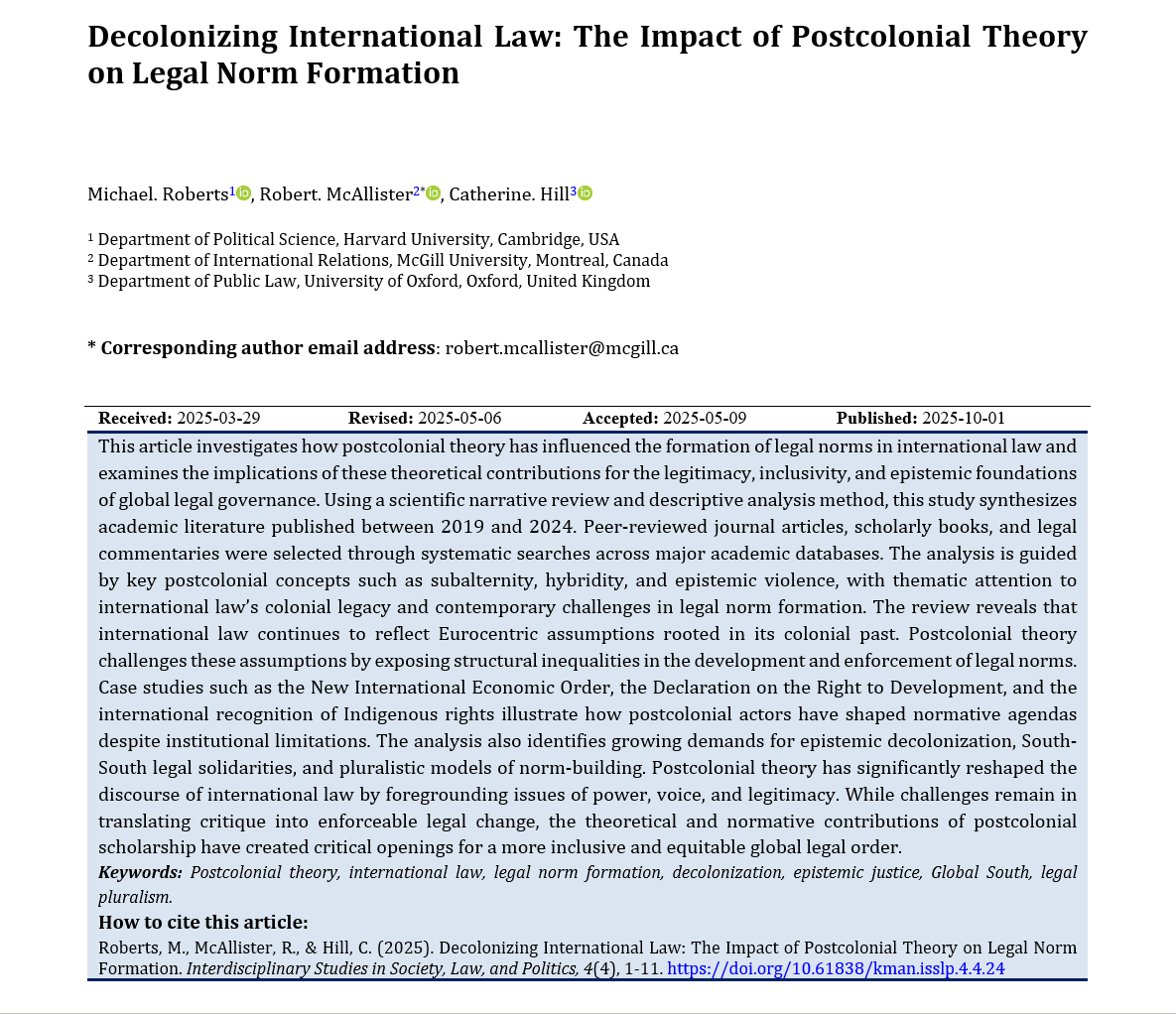
Decolonizing International Law: The Impact of Postcolonial Theory on Legal Norm Formation
DOI:
https://doi.org/10.61838/kman.isslp.4.4.24Keywords:
Postcolonial theory, international law, legal norm formation, decolonization, epistemic justice, Global South, legal pluralismAbstract
This article investigates how postcolonial theory has influenced the formation of legal norms in international law and examines the implications of these theoretical contributions for the legitimacy, inclusivity, and epistemic foundations of global legal governance. Using a scientific narrative review and descriptive analysis method, this study synthesizes academic literature published between 2019 and 2024. Peer-reviewed journal articles, scholarly books, and legal commentaries were selected through systematic searches across major academic databases. The analysis is guided by key postcolonial concepts such as subalternity, hybridity, and epistemic violence, with thematic attention to international law’s colonial legacy and contemporary challenges in legal norm formation. The review reveals that international law continues to reflect Eurocentric assumptions rooted in its colonial past. Postcolonial theory challenges these assumptions by exposing structural inequalities in the development and enforcement of legal norms. Case studies such as the New International Economic Order, the Declaration on the Right to Development, and the international recognition of Indigenous rights illustrate how postcolonial actors have shaped normative agendas despite institutional limitations. The analysis also identifies growing demands for epistemic decolonization, South-South legal solidarities, and pluralistic models of norm-building. Postcolonial theory has significantly reshaped the discourse of international law by foregrounding issues of power, voice, and legitimacy. While challenges remain in translating critique into enforceable legal change, the theoretical and normative contributions of postcolonial scholarship have created critical openings for a more inclusive and equitable global legal order.
Downloads
References
Aminuddin, M. F. (2022). Poskolonial Dan Developmentalisme: Telaah Kritis. Global Focus, 2(1), 4-16. https://doi.org/10.21776/ub.jgf.2022.002.01.1
Biswas, S. (2024). 14. Postcolonialism. 247-263. https://doi.org/10.1093/hepl/9780192866455.003.0014
Chimni, B. S. (2024). The Status of the Individual in International Law. 231-250. https://doi.org/10.1093/oso/9780198898917.003.0011
Christie, G. (2019). 9. Postcolonial Theory and Aboriginal Law. 384-402. https://doi.org/10.3138/9781442625501-011
Dzah, G. E. K. (2019). Theorising the Right to Environment: An Africological Typology. African Journal of International and Comparative Law, 27(1), 25-49. https://doi.org/10.3366/ajicl.2019.0258
Elmuradov, A. (2021). Postcolonial/Decolonial Critique and the Theory of International Relations. MGIMO Review of International Relations, 14(3), 23-38. https://doi.org/10.24833/2071-8160-2021-3-78-23-38
Felsch, M. (2023). The Scientific Shortcomings of Postcolonial Theory. International Studies, 60(1), 113-130. https://doi.org/10.1177/00208817221142485
Getachew, A. (2019). A Political Theory of Decolonization. 14-36. https://doi.org/10.23943/princeton/9780691179155.003.0002
Lim, C. L. (2024). Aims and Methods of Postcolonial International Law. 185-222. https://doi.org/10.1163/9789004696167_006
Loshkariov, I. D. (2022). Postcolonialism in International Studies: Two Faces of Theory. Vestnik Rudn International Relations, 22(4), 659-670. https://doi.org/10.22363/2313-0660-2022-22-4-659-670
Lustig, D. (2020). Back to Informal Empire? , 144-178. https://doi.org/10.1093/oso/9780198822097.003.0006
Maluwa, T. (2020). Reassessing Aspects of the Contribution of African States to the Development of International Law Through African Regional Multilateral Treaties. Michigan Journal of International Law(41.2), 327. https://doi.org/10.36642/mjil.41.2.reassessing
Moran, C. F. (2023a). The Authority of International Criminal Law. https://doi.org/10.1017/9781108678629
Moran, C. F. (2023b). Postcolonialism and Bias in International Criminal Law. 94-111. https://doi.org/10.1017/9781108678629.007
Routh, S. (2024). Postcolonialism and Labour Law. 47-62. https://doi.org/10.1093/oxfordhb/9780192870360.013.5
Sabaratnam, M. (2019). 10. Postcolonial and Decolonial Approaches. 160-176. https://doi.org/10.1093/hepl/9780198825548.003.0010
Sabaratnam, M. (2022). 11. Postcolonial and Decolonial Approaches. 162-178. https://doi.org/10.1093/hepl/9780192898142.003.0011
Saksena, P. (2023). Epilogue. 201-208. https://doi.org/10.1093/oso/9780192866585.003.0007
Shahabuddin, M. (2021). Minorities and the Making of Postcolonial States in International Law. https://doi.org/10.1017/9781108678773
Sharma, P. (2024). Under Siege: The Role of Settler Colonialism in Targeting Healthcare Systems. Indian Journal of Medical Ethics, 9(3), 207-209. https://doi.org/10.20529/ijme.2024.038
Willey‐Sthapit, C. (2023). Epistemic Justice in International Social Work Research: Postcolonial Theory and Analytic Strategies. International Journal of Social Welfare, 33(2), 471-481. https://doi.org/10.1111/ijsw.12613
Yildiz, E. Ç. (2023). Postcolonial Approaches to International Human Rights Law: The TWAIL Case. Public and Private International Law Bulletin, 43(1), 353-369. https://doi.org/10.26650/ppil.2023.43.1181972
Downloads
Additional Files
Publication Timeline
- Submitted
- Revised
- Accepted
Issue
Section
License

This work is licensed under a Creative Commons Attribution-NonCommercial 4.0 International License.