Reimagining Legal Aid: A Political Critique of Access to Justice in Privatized Welfare States
DOI:
https://doi.org/10.61838/kman.isslp.459Keywords:
legal aid, access to justice, neoliberalism, privatized welfare, social citizenship, inequality, legal empowermentAbstract
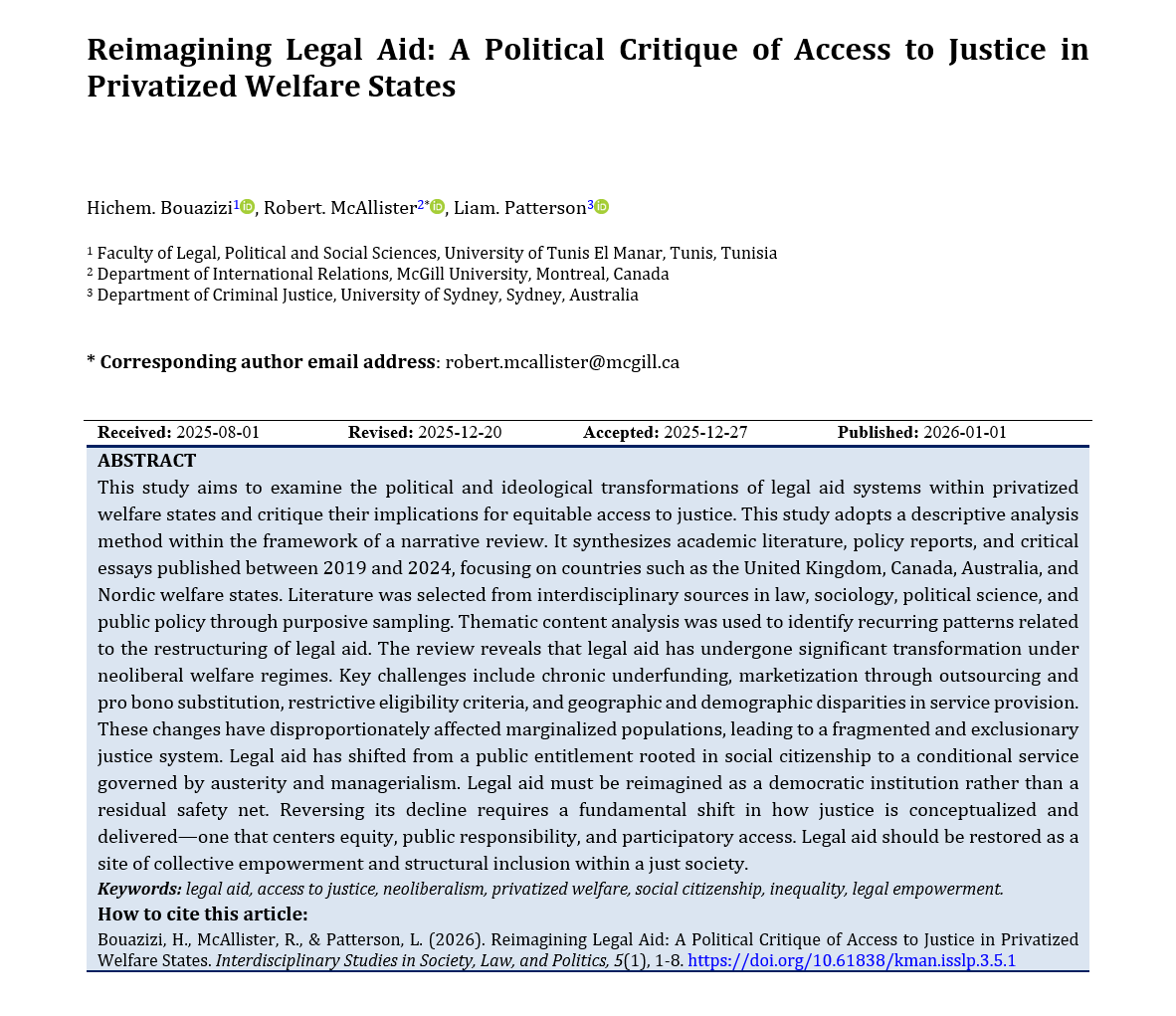
This study aims to examine the political and ideological transformations of legal aid systems within privatized welfare states and critique their implications for equitable access to justice. This study adopts a descriptive analysis method within the framework of a narrative review. It synthesizes academic literature, policy reports, and critical essays published between 2019 and 2024, focusing on countries such as the United Kingdom, Canada, Australia, and Nordic welfare states. Literature was selected from interdisciplinary sources in law, sociology, political science, and public policy through purposive sampling. Thematic content analysis was used to identify recurring patterns related to the restructuring of legal aid. The review reveals that legal aid has undergone significant transformation under neoliberal welfare regimes. Key challenges include chronic underfunding, marketization through outsourcing and pro bono substitution, restrictive eligibility criteria, and geographic and demographic disparities in service provision. These changes have disproportionately affected marginalized populations, leading to a fragmented and exclusionary justice system. Legal aid has shifted from a public entitlement rooted in social citizenship to a conditional service governed by austerity and managerialism. Legal aid must be reimagined as a democratic institution rather than a residual safety net. Reversing its decline requires a fundamental shift in how justice is conceptualized and delivered—one that centers equity, public responsibility, and participatory access. Legal aid should be restored as a site of collective empowerment and structural inclusion within a just society.
Downloads
References
Ana, A. (2020). Hope as Master Frame in Feminist Mobilization: Between Liberal NGO-ization and Radical-Intersectional Street Politics. 185-202. https://doi.org/10.1007/978-3-030-41694-2_12
Balaji, R. (2024). Analytical Utility of Periodizing Capitalist History: Neoliberalism, Social Welfare Spending, and Income Inequality in the United States. Capital & Class, 49(1), 49-78. https://doi.org/10.1177/03098168241232383
Biswas, S. D., & Sambo, C. G. (2024). The Politics of Welfare in the Global South. 1-20. https://doi.org/10.1093/9780197698716.003.0001
Hooijer, G., & King, D. (2021). The Critics of Welfare. 53-70. https://doi.org/10.1093/oxfordhb/9780198828389.013.4
Kim, J. B. (2021). Cripping the Welfare Queen. Social Text, 39(3), 79-101. https://doi.org/10.1215/01642472-9034390
Lilius, J., & Lapintie, K. (2020). Subsidised Housing? The Paradoxical Imaginaries of Finnish Non-Profit Rental Housing. Critical Housing Analysis, 7(1), 130-139. https://doi.org/10.13060/23362839.2020.7.1.509
Parsell, C., Vincent, E., Klein, E., Clarke, A., & Walsh, T. (2020). Introduction to the Special Issue on Welfare Conditionality in Australia. Australian Journal of Social Issues, 55(1), 4-12. https://doi.org/10.1002/ajs4.102
Portella, E. (2024). Feminism Beyond Welfare: Care, Socialisation and the Politics of the State. Feminist Theory. https://doi.org/10.1177/14647001241297569
Verovšek, P. J. (2021). The Work of Politics: Making a Democratic Welfare State. Contemporary Political Theory, 21(S1), 15-18. https://doi.org/10.1057/s41296-020-00462-w
Downloads
Additional Files
Publication Timeline
- Submitted
- Revised
- Accepted
Issue
Section
License

This work is licensed under a Creative Commons Attribution-NonCommercial 4.0 International License.