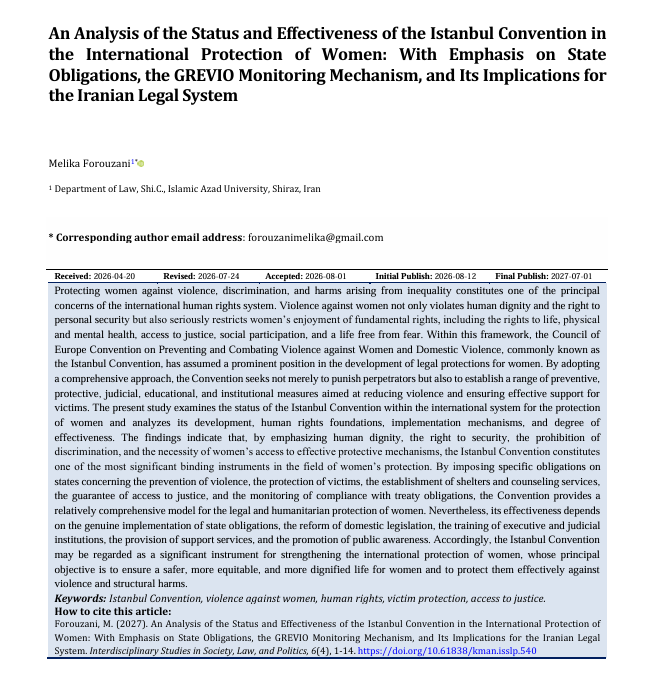
An Analysis of the Status and Effectiveness of the Istanbul Convention in the International Protection of Women: With Emphasis on State Obligations, the GREVIO Monitoring Mechanism, and Its Implications for the Iranian Legal System
Keywords:
Istanbul Convention, violence against women, human rights, victim protection, access to justiceAbstract
Protecting women against violence, discrimination, and harms arising from inequality constitutes one of the principal concerns of the international human rights system. Violence against women not only violates human dignity and the right to personal security but also seriously restricts women’s enjoyment of fundamental rights, including the rights to life, physical and mental health, access to justice, social participation, and a life free from fear. Within this framework, the Council of Europe Convention on Preventing and Combating Violence against Women and Domestic Violence, commonly known as the Istanbul Convention, has assumed a prominent position in the development of legal protections for women. By adopting a comprehensive approach, the Convention seeks not merely to punish perpetrators but also to establish a range of preventive, protective, judicial, educational, and institutional measures aimed at reducing violence and ensuring effective support for victims. The present study examines the status of the Istanbul Convention within the international system for the protection of women and analyzes its development, human rights foundations, implementation mechanisms, and degree of effectiveness. The findings indicate that, by emphasizing human dignity, the right to security, the prohibition of discrimination, and the necessity of women’s access to effective protective mechanisms, the Istanbul Convention constitutes one of the most significant binding instruments in the field of women’s protection. By imposing specific obligations on states concerning the prevention of violence, the protection of victims, the establishment of shelters and counseling services, the guarantee of access to justice, and the monitoring of compliance with treaty obligations, the Convention provides a relatively comprehensive model for the legal and humanitarian protection of women. Nevertheless, its effectiveness depends on the genuine implementation of state obligations, the reform of domestic legislation, the training of executive and judicial institutions, the provision of support services, and the promotion of public awareness. Accordingly, the Istanbul Convention may be regarded as a significant instrument for strengthening the international protection of women, whose principal objective is to ensure a safer, more equitable, and more dignified life for women and to protect them effectively against violence and structural harms.
Downloads
References
Azari, H., & Babazadeh, Z. (2021). A New Approach to Identifying the Human Rights of Women Victims of Sexual Violence under the Convention on Preventing and Combating Violence against Women and Domestic Violence (Istanbul Convention). Quarterly Journal of Criminal Law Research, 10(37), 193-219. https://doi.org/10.22054/jclr.2022.54311.2159
Bölükbaşı, Ö. (2022). The Istanbul Convention in General and Its Comparison with Law No. 6284. Journal of Law and Economics Research, 14(2), 109-134. https://doi.org/10.53881/hiad.1051072
Çamurcu, M. H. (2021). The Istanbul Convention: Its Impact on Domestic Law in Türkiye and Social Reactions. Ankara Bar Review, 79(4), 63-106. https://doi.org/10.30915/abd.1090725
Durmuş, M. T. (2021). The President's Authority over International Treaties and a Legal Analysis of Türkiye's Withdrawal from the Istanbul Convention. Selçuk University Faculty of Law Journal, 29(3), 1969-2007. https://doi.org/10.15337/suhfd.929925
Keleş, E., & Sallan Gül, S. (2025). The Views of Actors Combating Violence against Women on Law No. 6284: The Case of Erzurum. Ankara Bar Review, 83(1), 661-717. https://doi.org/10.30915/abd.1588888
Kocaağalar, F. (2025). The Role of Law No. 6284 in Türkiye's System for the Protection of Women. Namık Kemal University Journal of the Vocational School of Social Sciences, 7(1), 29-45. https://doi.org/10.56493/nkusbmyo.1625075
Mahmoudi, A., & Miri Balajorshori, S. M. (2021). Combating Domestic Violence against Women in the Case Law of the European Court of Human Rights. Ghazavat Quarterly, 21(105), 43-66. https://www.ghazavat.org/article_704792.html
Mashhadi, A., & Karami, M. (2020). Protecting Women against Violence in Light of the 2011 Istanbul Convention on Preventing and Combating Violence against Women. Public Law Studies, 50(2), 737-755. https://doi.org/10.22059/jplsq.2018.250813.1658
Mashhadi, A., Shakibnejad, E., & Karami, M. (2020). Reflections on the Effectiveness of the Convention on the Elimination of All Forms of Discrimination against Women and the 2011 Istanbul Convention in Preventing and Combating Violence against Women. Human Rights Research Quarterly(19), 107-136.
Miri Balajorshori, S. M., & Mahmoudi, A. (2022). Combating Domestic Violence against Women with Reference to the Case Law of the European Court of Human Rights. International Studies Journal, 19(2), 55-75. https://doi.org/10.22034/isj.2022.357174.1893
Mowlaverdi, S. (2017). International Standards on Women's Rights (3rd ed.). University of Tehran Press.
Downloads
Additional Files
Publication Timeline
- Submitted
- Revised
- Accepted
Issue
Section
License
Copyright (c) 2025 Melika Forouzani (Corresponding author)

This work is licensed under a Creative Commons Attribution-NonCommercial 4.0 International License.