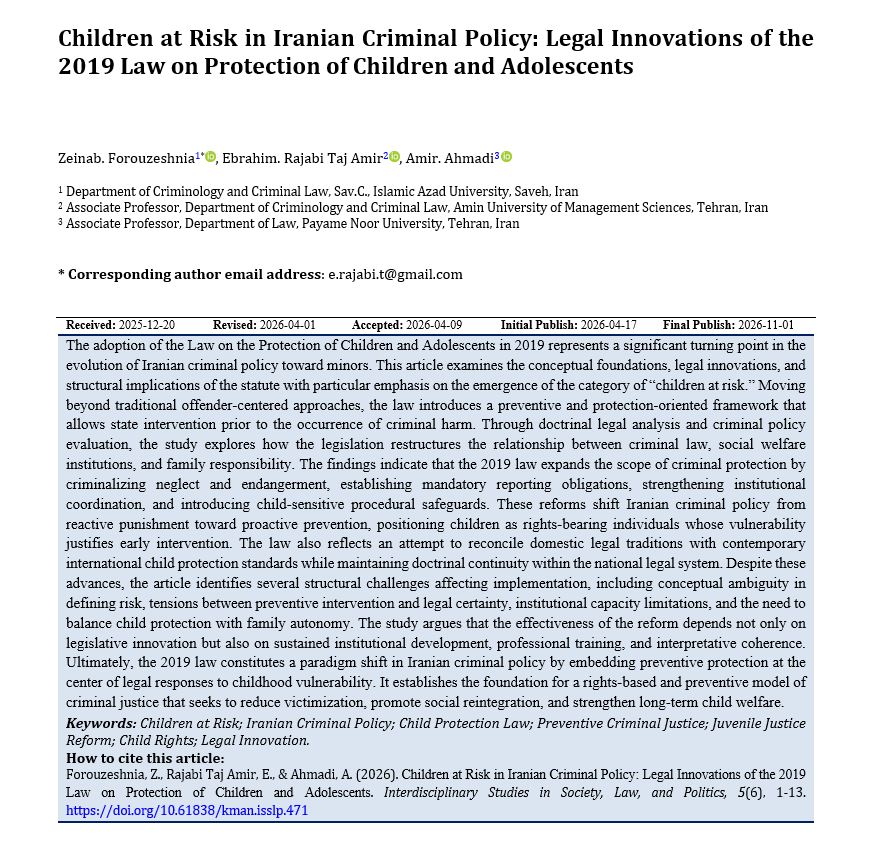
Children at Risk in Iranian Criminal Policy: Legal Innovations of the 2019 Law on Protection of Children and Adolescents
Keywords:
Children at Risk, Iranian Criminal Policy, Child Protection Law, Preventive Criminal Justice, Juvenile Justice Reform, Child Rights, Legal InnovationAbstract
The adoption of the Law on the Protection of Children and Adolescents in 2019 represents a significant turning point in the evolution of Iranian criminal policy toward minors. This article examines the conceptual foundations, legal innovations, and structural implications of the statute with particular emphasis on the emergence of the category of “children at risk.” Moving beyond traditional offender-centered approaches, the law introduces a preventive and protection-oriented framework that allows state intervention prior to the occurrence of criminal harm. Through doctrinal legal analysis and criminal policy evaluation, the study explores how the legislation restructures the relationship between criminal law, social welfare institutions, and family responsibility. The findings indicate that the 2019 law expands the scope of criminal protection by criminalizing neglect and endangerment, establishing mandatory reporting obligations, strengthening institutional coordination, and introducing child-sensitive procedural safeguards. These reforms shift Iranian criminal policy from reactive punishment toward proactive prevention, positioning children as rights-bearing individuals whose vulnerability justifies early intervention. The law also reflects an attempt to reconcile domestic legal traditions with contemporary international child protection standards while maintaining doctrinal continuity within the national legal system. Despite these advances, the article identifies several structural challenges affecting implementation, including conceptual ambiguity in defining risk, tensions between preventive intervention and legal certainty, institutional capacity limitations, and the need to balance child protection with family autonomy. The study argues that the effectiveness of the reform depends not only on legislative innovation but also on sustained institutional development, professional training, and interpretative coherence. Ultimately, the 2019 law constitutes a paradigm shift in Iranian criminal policy by embedding preventive protection at the center of legal responses to childhood vulnerability. It establishes the foundation for a rights-based and preventive model of criminal justice that seeks to reduce victimization, promote social reintegration, and strengthen long-term child welfare.
Downloads
References
Ashworth, A. (2015). Sentencing and Criminal Justice (6 ed.). Cambridge University Press.
Braithwaite, J. (2002). Restorative Justice and Responsive Regulation. Oxford University Press.
Cyr, K. (2022). Child Vulnerability and Victimization Risk. Journal of Child Protection Studies, 14(1), 45-63.
Duff, R. A. (2001). Punishment, Communication, and Community. Oxford University Press.
Fattah, E. A. (1991). Understanding Criminal Victimization. Prentice Hall.
Garland, D. (2001). The Culture of Control: Crime and Social Order in Contemporary Society. University of Chicago Press.
Hopkins Burke, R. (2016). Youth Justice: Theory and Practice. Routledge.
Katouzian, N. (2021). General Criminal Law (28th ed.). Ganj-e Danesh Publications.
Lansdown, G., & Vaghri, Z. (2016). Interpretation of Article 1 of the Convention on the Rights of the Child. International Journal of Children’s Rights, 24(3), 569-587.
Mohaghegh Damad, S. M. (2025). Jurisprudential rules in criminal law. Islamic Sciences Publishing.
Packer, H. L. (1968). The Limits of the Criminal Sanction. Stanford University Press.
Sabzavarinezhad, H., & Sabzavarinezhad, A. (2025). General Criminal Law (Vol. 3). Majd Publications.
Saki, M. R. (2024). General Criminal Law: Four Books in One Volume. Khorsandi.
Samim, R. (2024). Criminal protection of public property in Afghan criminal law. The 6th International Conference on Modern Studies in Humanities and Social Sciences,
Sattari, B. (2025). Comprehensive Description of General Criminal Law (7th ed.). Arshad Publications.
Taghizadeh Zanouqi, M. (2020). The Evolution of Child Protection Law in Iran: A Critical Analysis of the 2019 Act. Iranian Journal of Criminal Law Studies, 12(2), 89-115.
Tobin, J. (2019). The UN Convention on the Rights of the Child: A Commentary. Oxford University Press.
Walklate, S. (2007). Imagining the Victim of Crime. Open University Press.
Wemmers, J.-A. (2017). Victims in the Criminal Justice System. Routledge.
Zedner, L. (2007). Pre-crime and Post-criminology? Theoretical Criminology, 11(2), 261-281.
Zehr, H. (2015). The Little Book of Restorative Justice. Good Books.
Downloads
Additional Files
Publication Timeline
- Submitted
- Revised
- Accepted
Issue
Section
License
Copyright (c) 2025 Zeinab Forouzeshnia (Author); Ebrahim Rajabi Taj Amir (Corresponding author); Amir Ahmadi (Author)

This work is licensed under a Creative Commons Attribution-NonCommercial 4.0 International License.