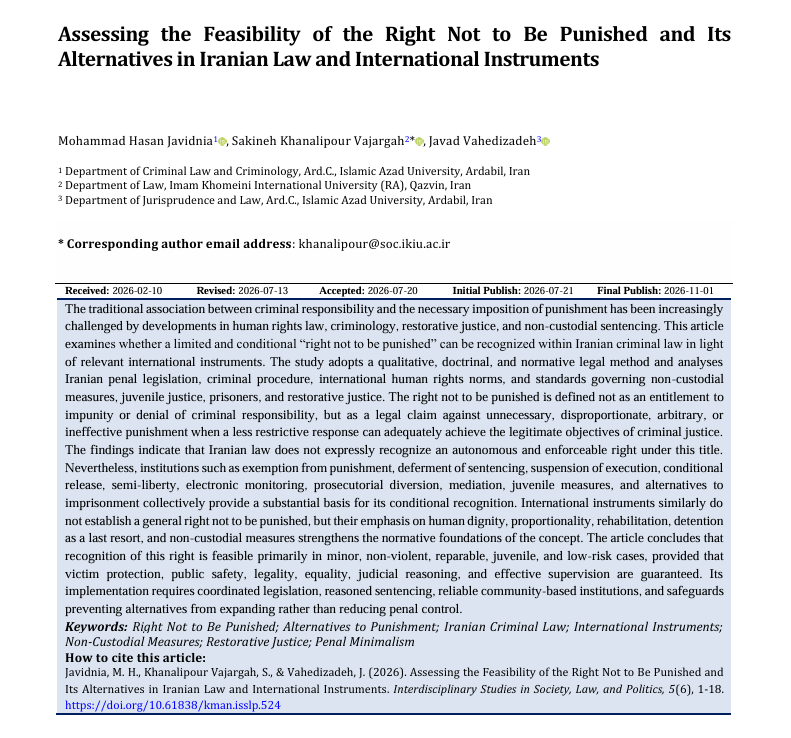
Assessing the Feasibility of the Right Not to Be Punished and Its Alternatives in Iranian Law and International Instruments
Keywords:
Right Not to Be Punished, Alternatives to Punishment, Iranian Criminal Law, International Instruments, Non-Custodial Measures, Restorative Justice, Penal MinimalismAbstract
The traditional association between criminal responsibility and the necessary imposition of punishment has been increasingly challenged by developments in human rights law, criminology, restorative justice, and non-custodial sentencing. This article examines whether a limited and conditional “right not to be punished” can be recognized within Iranian criminal law in light of relevant international instruments. The study adopts a qualitative, doctrinal, and normative legal method and analyses Iranian penal legislation, criminal procedure, international human rights norms, and standards governing non-custodial measures, juvenile justice, prisoners, and restorative justice. The right not to be punished is defined not as an entitlement to impunity or denial of criminal responsibility, but as a legal claim against unnecessary, disproportionate, arbitrary, or ineffective punishment when a less restrictive response can adequately achieve the legitimate objectives of criminal justice. The findings indicate that Iranian law does not expressly recognize an autonomous and enforceable right under this title. Nevertheless, institutions such as exemption from punishment, deferment of sentencing, suspension of execution, conditional release, semi-liberty, electronic monitoring, prosecutorial diversion, mediation, juvenile measures, and alternatives to imprisonment collectively provide a substantial basis for its conditional recognition. International instruments similarly do not establish a general right not to be punished, but their emphasis on human dignity, proportionality, rehabilitation, detention as a last resort, and non-custodial measures strengthens the normative foundations of the concept. The article concludes that recognition of this right is feasible primarily in minor, non-violent, reparable, juvenile, and low-risk cases, provided that victim protection, public safety, legality, equality, judicial reasoning, and effective supervision are guaranteed. Its implementation requires coordinated legislation, reasoned sentencing, reliable community-based institutions, and safeguards preventing alternatives from expanding rather than reducing penal control.
Downloads
References
Abdollahi, H., & Nikkhah Sarnaghi, R. (2025). The Right Not to Be Punished: Foundations, Principles, Scope, and Effects. Eleventh International Conference on Islamic Sciences, Religious Research, and Law, Tehran.
Al Weswasi, E., & Bäckman, O. (2025). The Effects of Replacing Incarceration with Electronic Monitoring on Crime, Mortality, and Labor Market Exclusion. Journal of quantitative criminology, 41(2), 135-172. https://doi.org/10.1007/s10940-024-09595-2
Amadeh, G. (2025). Leniency Institutions in the Prosecutor's Office. Judiciary, Press and Publications Center.
Amanab, J. N., Seifi, A., & Fani, R. (2022). A Jurisprudential and Legal Feasibility Study of Abolishing the Death Penalty for the Crime of Disrupting the Economic System in Iranian Law with Emphasis on Judicial Practice. Jurisprudence and Foundations of Islamic Law, 15(3).
Ashouri, M., Chavoshi, M. S., & Kousha, J. (2024). State Responsibility for Violation of the Right to Life: An Evaluation of the Case Law of the European Court of Human Rights. Iranian Review of International Politics, 12(2).
Bazgir, S., & Safari-Kakeroudi, A. (2022). Pathology of the Use of Electronic Handcuffs and Ankle Monitors in Home Imprisonment. Police Criminological Research, 3(8), 175-198. https://doi.org/10.22034/CR.2023.1266675.1063
Bouffard, J. A., & Butler, H. D. (2024). Evaluating the Effectiveness of Electronic Monitoring with Probationers. Corrections: Policy, Practice and Research, 9(5). https://doi.org/10.1080/23774657.2024.2350940
Creswell, J. W., & Poth, C. N. (2024). Qualitative Inquiry and Research Design: Choosing among Five Approaches (5th ed.). SAGE.
Elahimanesh, M., & Moradi Ojqaz, M. (2025). The Right Not to Be Punished: A New Approach in Applying Penal Responses. Research and Development in Criminal Law and Criminology, 2(3), 58-104. https://doi.org/10.22034/jclc.2025.2049454.1138
Gauke, D. (2025). Independent Sentencing Review: Final Report.
Gholami, H., & Masoumi, V. (2024). The Republican Tradition and the Principle of the Minimality of Criminal Law from the Perspective of Pettit and Braithwaite. State Studies(38), 237-274.
Golestanrou, S. (2023). The Jurisprudence of Execution in Islam. Ketab Ava Publications.
Hawkes, A. L., Sellbom, M., & Gilmour, F. E. (2024). Under Surveillance: Does Global Positioning System Monitoring of Offenders Reduce Recidivism? Criminology & Criminal Justice, 24(4), 862-881. https://doi.org/10.1177/17488958231188414
Hosseini, S. H., Mahmoudi Janki, F., & Pakzad, B. (2023). The Right Not to Be Punished: What It Is and Its Existence. Journal of Legal Research, 87(123), 95-117.
Mehrabi, A., & Allahverdi Meygouni, F. (2022). Behavioral Economics and the Problem of Punishment Perception: From Choice Architecture to Critique of Behavioral Paternalism. Criminal Law Teachings, 19(23), 297-330.
Mirali, M. J. (2023). Feasibility of Non-Implementation of Execution in the Present Era with a Focus on the Position of Islam from the Perspective of Human Rights. Contemporary Islamic Studies Research, 1(6), 32-60.
Momeni, M. (2021). Research Methodology in Law: Theoretical and Practical Principles.
Momeni Moghadam, B., Haji Tabar Firouzjai, H., & Yahyazadeh, Y. (2024). Persuading Public Opinion in Implementing Prison-Reduction Policies Based on Alternative Punishments. Comparative Research in Jurisprudence, Law, and Politics, 6(5), 269-283.
Moradipasand, G., Bashiriyeh, T., & Gholami Don, H. (2021). A Comparative Study of Manifestations of Penalism in Legal Systems and Its Impact on De-Penalizing Models. Azad Legal Research, 14(51), 197-215. https://doi.org/10.30495/ALR.2021.683844
Movahedi, A., Najafi Tavana, A., Ashouri, M., & Zakaeian, P. (2024). The Position of the Principle of Minimality of Criminal Law in Criminal Policy. Criminal Law Research(48), 205-236.
Movahedi, A., Najafi Tavana, A., Ashouri, M., & Zakaeian, P. (2025). Identifying the Theoretical Foundations Governing the Principle of Minimality of Criminal Law. Teachings of Jurisprudence and Criminal Law(15), 124-144.
Neumann, M., Schüttler, H., & Klatt, T. (2026). A Study on the Impact of Open Doors: Investigating the Influence of Short Leave and Open Prison on Recidivism Rates. Journal of Experimental Criminology, 1-32. https://doi.org/10.1007/s11292-026-09741-9
Penal Reform, I., & Thailand Institute of, J. (2025). Global Prison Trends 2025.
Pourbakhsh, S. M. A. (2022). Research Methodology in Legal Science.
Reichert, J., Wang, J., Maranville, R., Ott Hill, E., & Gruschow, K. (2025). Recidivism Outcomes of Illinois Prison Work Release Program Participants. Justice, Opportunities, and Rehabilitation, 64(6), 400-422. https://doi.org/10.1080/2997965X.2025.2518976
Rezaei, F. (2025). Evaluating the Effectiveness of Alternatives to Imprisonment in Reducing Prison Population with Emphasis on Jurisprudential Foundations and the Goals of Correction and Resocialization of Offenders. Proceedings of the Sixteenth International and National Conference on Management, Accounting, and Law Studies,
Roberts, J. V., Bild, J., & Cumbo, E. (2025). Sentencing Academy Response to Independent Sentencing Review.
Shepherd, J. (2025). Justice without Bars: Expanding Community Sentencing to Reduce Reoffending.
Shiri, A. (2024). Criminal Policymaking on Electronic Monitoring. Public Policy Quarterly, 10(3), 99-111. https://doi.org/10.22059/jppolicy.2024.98677
Shojaei, K., Gholami Don, H., & Moazzenzadegan, H. A. (2023). Strategies for Reducing the Prison Population: A Study of U.S. Law and the Possibility of Applying Strategies in Iran's Criminal Justice System. Comparative Law Research, 27(4), 98-137.
Tavajohi, A. (2022). Leniency Institutions in the Islamic Penal Code Adopted in 2013. Judiciary, Press and Publications Center.
Downloads
Additional Files
Publication Timeline
- Submitted
- Revised
- Accepted
Issue
Section
License
Copyright (c) 2025 Mohammad Hasan Javidnia (Author); Sakineh Khanalipour Vajargah (Corresponding author); Javad Vahedizadeh (Author)

This work is licensed under a Creative Commons Attribution-NonCommercial 4.0 International License.