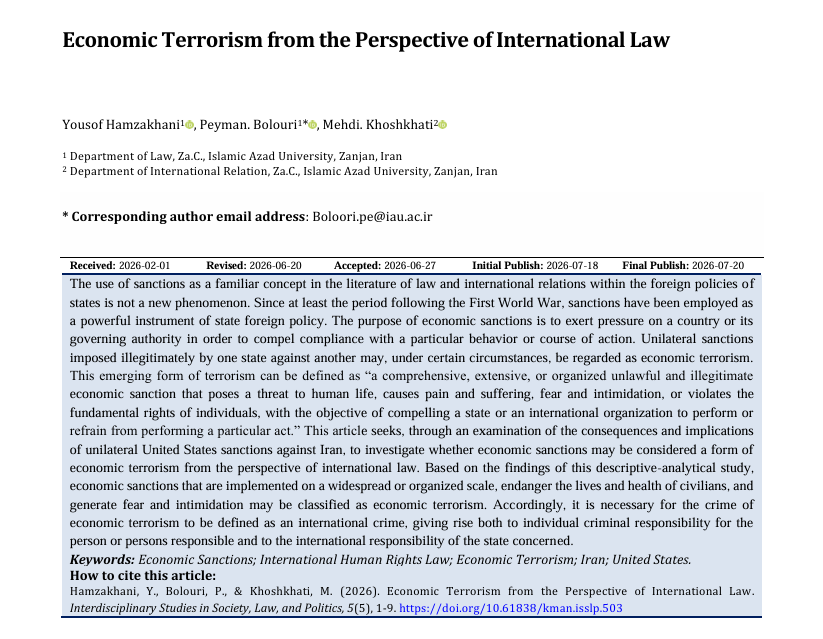
Economic Terrorism from the Perspective of International Law
Keywords:
Economic Sanctions, International Human Rights Law, Economic Terrorism, Iran, United StatesAbstract
The use of sanctions as a familiar concept in the literature of law and international relations within the foreign policies of states is not a new phenomenon. Since at least the period following the First World War, sanctions have been employed as a powerful instrument of state foreign policy. The purpose of economic sanctions is to exert pressure on a country or its governing authority in order to compel compliance with a particular behavior or course of action. Unilateral sanctions imposed illegitimately by one state against another may, under certain circumstances, be regarded as economic terrorism. This emerging form of terrorism can be defined as “a comprehensive, extensive, or organized unlawful and illegitimate economic sanction that poses a threat to human life, causes pain and suffering, fear and intimidation, or violates the fundamental rights of individuals, with the objective of compelling a state or an international organization to perform or refrain from performing a particular act.” This article seeks, through an examination of the consequences and implications of unilateral United States sanctions against Iran, to investigate whether economic sanctions may be considered a form of economic terrorism from the perspective of international law. Based on the findings of this descriptive-analytical study, economic sanctions that are implemented on a widespread or organized scale, endanger the lives and health of civilians, and generate fear and intimidation may be classified as economic terrorism. Accordingly, it is necessary for the crime of economic terrorism to be defined as an international crime, giving rise both to individual criminal responsibility for the person or persons responsible and to the international responsibility of the state concerned.
Downloads
References
Abdollahi, M. (2009). Terrorism, Human Rights, and Humanitarian Law (1st ed.). Shahr-e Danesh Institute for Legal Studies and Research.
Aghabakhshi, A. (2005). Dictionary of Political Science (3rd ed.). Tondar Publications.
Ali Daei Ahmadi, M., & Bazar, V. (2020). Feasibility of Prosecuting U.S. Officials Who Imposed Sanctions against the Islamic Republic of Iran before the International Criminal Court. International Criminal Law Quarterly, 1(1), 70-90.
Elliott, J. M., & Reginald, R. (1999). Dictionary of Political and Strategic Terms (M. H. Raeeszadeh, Trans.). Moein Publishing.
Farrall, J. (2007). United Nations and the Rule of Law. Cambridge University Press.
Gharibabadi, K. (2018). Unilateral Sanctions and International Law (1st ed.). University of Judicial Sciences and Administrative Services Press.
Heydar Gholizadeh, J., Jalali, M., & Raeisi, L. (2025). Unilateral Sanctions as an Instance of Economic Terrorism in International Law. Public Law Studies Quarterly, 1(2), 1362.
Kadkhodaei, A., & Saed, N. (2011). Terrorism and Countering It. World Assembly for Islamic Peace Publications.
Kondoch, B. (2001). The Limits of Economic Sanctions under International Law: The Case of Iraq. The Yearbook of International Peace Operations, 267-295.
Marossi, A. Z., & Bassett, M. R. (2015). Economic Sanctions under International Law. Asser Press.
Mohammadi, M. (2017). Examining the Identity-Building Factors of Extremist Fundamentalism in Pakistan Based on Constructivist Theory. Regional Studies Quarterly, 5(16), 77-104.
Momtaz, J. (2008). Compatibility of Security Council Economic Sanctions with Human Rights and International Humanitarian Law. Law Quarterly, 38(4), 341-349.
Naji Rad, M. A. (2008). Globalization of Terrorism (1st ed.). Printing and Publishing Center of the Ministry of Foreign Affairs.
Nezhendi Manesh, H. (2019). Illegitimate Economic Sanctions as Economic Terrorism. International Conference on the Global Economy and Sanctions, Tehran.
Nezhendi Manesh, H. (2020). Legal Feasibility of Characterizing the Assassination of General Soleimani and Others as a Crime against Humanity. Comparative Research Quarterly of Islamic and Western Law, 7(2), 248.
Popovski, W., & Turner, N. (2008). Legality and Legitimacy in International Order. United Nations University.
Savari, H. (2003). Combating Terrorism and International Law: Risks and Opportunities. Legal Journal, Journal of the International Legal Services Office of the Islamic Republic of Iran(29), 331-334.
Schmid, A. (1983). Political Terrorism: A Research Guide to Concepts, Theories, Data Bases and Literature. Transaction Books.
Vakil, A. S., & Tahsili, Z. (2013). Iran and International Sanctions (1st ed.). Majd Publications.
Zakerhossein, M. H. (2021). Prosecuting Economic Sanctions as a Crime against Humanity. Public Law Studies Quarterly(2), 575-594.
Zamani, S. G. (2016). Twenty-One Essays on International Human Rights Law (1st ed.). Khorsandi Publications.
Zamani, S. G., Farahi, H., & Shahbari, A. (2016). Unilateral Sanctions against Iran from the Perspective of International Criminal Law: Crime against Humanity. Journal of Criminal Law and Criminology Research, 1(7), 87-106.
Zamani, S. G., & Gharibabadi, K. (2017). Sanctions as a Violation of States' International Obligations to Protect Human Rights. Medical Law Quarterly, 11(40), 113-134.
Zarif, M. J., & Mirzaei, S. (1996). U.S. Unilateral Sanctions against Iran. Foreign Policy, 11(1), 92-106.
Ziaei, S. Y., & Mohammadi Motlagh, A. (2014). Sanctions against Natural Persons from the Perspective of International Law with Emphasis on Sanctions against Some Iranian Nationals. Judicial Law Journal, 78(88), 151-186.
Downloads
Additional Files
Publication Timeline
- Submitted
- Revised
- Accepted
Issue
Section
License
Copyright (c) 2025 Yousof Hamzakhani (Author); Peyman Bolouri (Corresponding author); Mehdi KhoshKhati (Author)

This work is licensed under a Creative Commons Attribution-NonCommercial 4.0 International License.