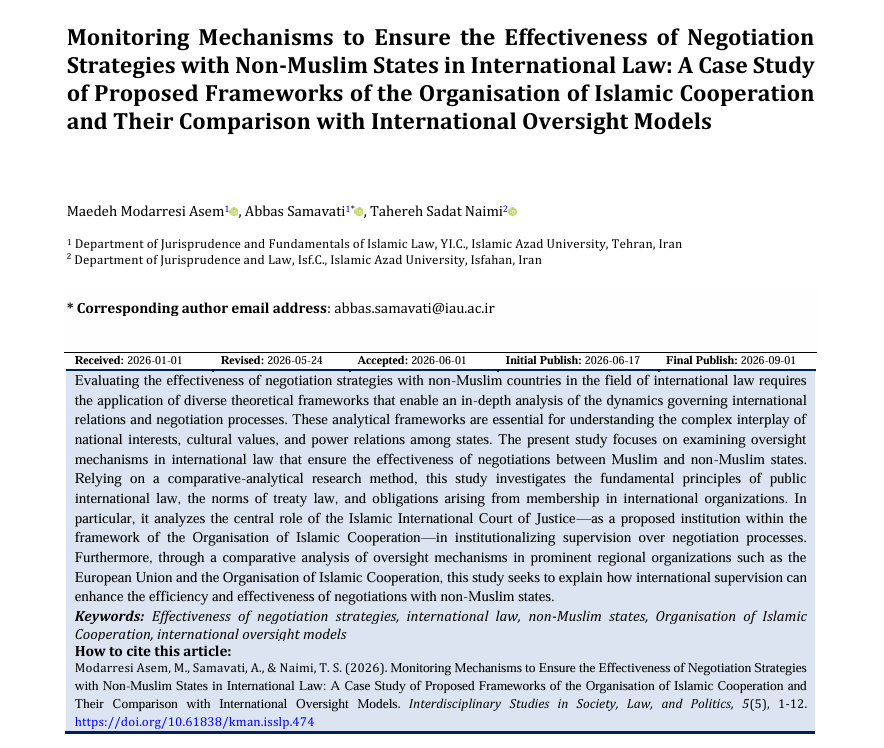
Monitoring Mechanisms to Ensure the Effectiveness of Negotiation Strategies with Non-Muslim States in International Law: A Case Study of Proposed Frameworks of the Organisation of Islamic Cooperation and Their Comparison with International Oversight Models
Keywords:
Effectiveness of negotiation strategies, international law, non-Muslim states, Organisation of Islamic Cooperation, international oversight modelsAbstract
Evaluating the effectiveness of negotiation strategies with non-Muslim countries in the field of international law requires the application of diverse theoretical frameworks that enable an in-depth analysis of the dynamics governing international relations and negotiation processes. These analytical frameworks are essential for understanding the complex interplay of national interests, cultural values, and power relations among states. The present study focuses on examining oversight mechanisms in international law that ensure the effectiveness of negotiations between Muslim and non-Muslim states. Relying on a comparative-analytical research method, this study investigates the fundamental principles of public international law, the norms of treaty law, and obligations arising from membership in international organizations. In particular, it analyzes the central role of the Islamic International Court of Justice—as a proposed institution within the framework of the Organisation of Islamic Cooperation—in institutionalizing supervision over negotiation processes. Furthermore, through a comparative analysis of oversight mechanisms in prominent regional organizations such as the European Union and the Organisation of Islamic Cooperation, this study seeks to explain how international supervision can enhance the efficiency and effectiveness of negotiations with non-Muslim states.
Downloads
References
Ahmad, A. (2018). The Organization of Islamic Cooperation and International Law. In A. Reinisch (Ed.), International Organizations and the Idea of Autonomy (pp. 32-48). Routledge.
Amiri, H. (2019). Law of International Treaties and Intergovernmental Organizations. Jangal Publications.
Cohen, R. (1997). Negotiating Across Cultures: International Communication in an Interdependent World (Rev. ed.). United States Institute of Peace Press.
Cortright, D., & Lopez, G. A. (2002). Smart Sanctions: Targeting Economic Statecraft. Rowman & Littlefield Publishers.
Craig, P., & de Búrca, G. (2015). EU Law: Text, Cases, and Materials (6 ed.). Oxford University Press.
Dehghani Firouzabadi, S. J. (2016). Foreign Policy of the Islamic Republic of Iran. SAMT Publications.
Dehghani Firouzabadi, S. J. (2017). Theories of International Relations. SAMT Publications.
Emami, K., & Shahbazi, A. (2021). International Commercial Arbitration in Light of Islamic Jurisprudence. Khorsandi Publications.
Fawzi, Y. (2019). Developments in the Organization of Islamic Cooperation and Its Role in the New Global Order. Foreign Policy Quarterly, 33(2), 223-248.
Ghari Seyed Fatemi, S. M. (2016). Human Rights in the Contemporary World. Shahr-e Danesh Publications.
Ghari Seyed Fatemi, S. M. (2019). Regional Human Rights Systems. Ettela'at Publications.
Ghasemi, F. (2019). The African Union and the Organization of Islamic Cooperation: A Comparative Study in Institution-Building. Imam Sadiq University Press.
Ghasemi, F. (2019). International Organizations: Function and Effectiveness. Mizan Publications.
Ghavam, A. (2021). Principles of Foreign Policy and International Politics. SAMT Publications.
Gorji Azandariani, A. (2016). Economic Sanctions in International Law and Islamic Jurisprudence. Research Institute for Culture and Islamic Thought.
Gorji Azandariani, A. (2017). Apostasy in International Law and Islamic Jurisprudence. Research Institute for Culture and Islamic Thought.
Krasner, S. D. (1999). Sovereignty: Organized Hypocrisy. Princeton University Press.
Mehrpour, H. (2022). The International Human Rights System. Ettela'at Publications.
Mirmohammadi, S. M. (2020). Smart Sanctions in International Law. Khorsandi Publications.
Motamedi, N. (2020). The World Trade Organization and Settlement of Trade Disputes. Institute for Legal Studies and Research of Shahr-e Danesh.
Mousavi Bojnordi, S. H. (2018). Jurisprudential Rules, Volume 3: Rules of Transactions and International Matters. Majd Publications.
Omidi, J. (2016). Peaceful Settlement of International Disputes. Mizan Publications.
Research Institute for, H., & Cultural, S. (2018). Dialogue Among Civilizations and Cultural Diplomacy. Research Institute for Humanities and Cultural Studies.
Research Institute of, H., & University. (2019). Women and Family in Islam and International Instruments. Research Institute of Hawza and University Press.
Salimi, H. (2021). The Islamic World and the International System. Elmi va Farhangi Publications.
Schreuer, C. (2012). The ICSID Convention: A Commentary (2 ed.). Cambridge University Press.
Shaw, M. N. (2017). International Law (8 ed.). Cambridge University Press.
Simbar, R. (2018). International Organizations and Global Issues. University of Tehran Press.
Wendt, A. (1999). Social Theory of International Politics. Cambridge University Press.
Zamani, S. G. (2021). Periodic Reporting in the European Union: A Model for the Organization of Islamic Cooperation. Legal Research Quarterly, 24(77), 139-164.
Ziaei Bigdeli, M. (2019). Public International Law (45 ed.). Ganj Danesh Publications.
Ziaei Bigdeli, M. (2020). Public International Law. Ganj Danesh Publications.
Ziaei Bigdeli, M. (2021). Contemporary Issues in International Law. Ganj Danesh Publications.
Downloads
Additional Files
Publication Timeline
- Submitted
- Revised
- Accepted
Issue
Section
License
Copyright (c) 2025 Maedeh Modarresi Asem (Author); Abbas Samavati (Corresponding author); Tahereh Sadat Naimi (Author)

This work is licensed under a Creative Commons Attribution-NonCommercial 4.0 International License.