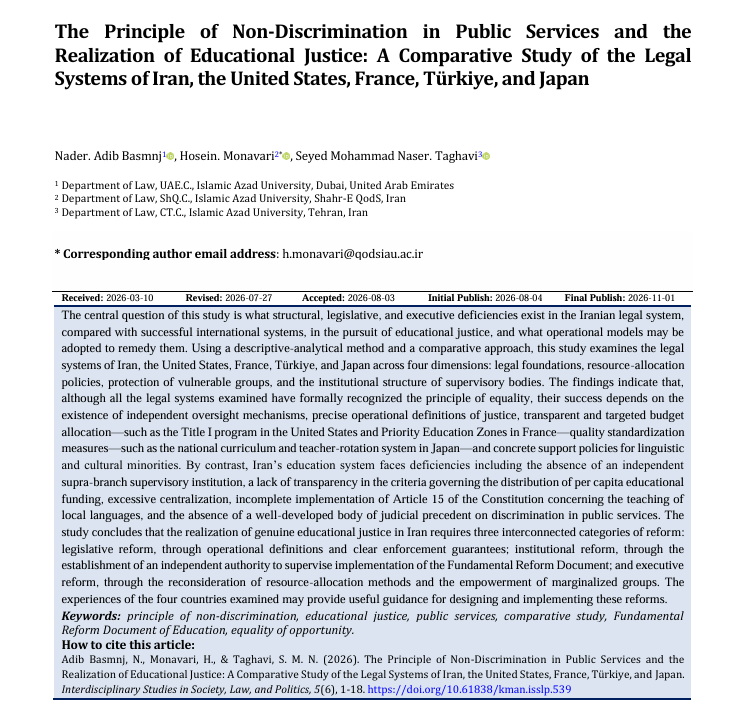
The Principle of Non-Discrimination in Public Services and the Realization of Educational Justice: A Comparative Study of the Legal Systems of Iran, the United States, France, Türkiye, and Japan
Keywords:
principle of non-discrimination, educational justice, public services, comparative study, Fundamental Reform Document of Education, equality of opportunityAbstract
The central question of this study is what structural, legislative, and executive deficiencies exist in the Iranian legal system, compared with successful international systems, in the pursuit of educational justice, and what operational models may be adopted to remedy them. Using a descriptive-analytical method and a comparative approach, this study examines the legal systems of Iran, the United States, France, Türkiye, and Japan across four dimensions: legal foundations, resource-allocation policies, protection of vulnerable groups, and the institutional structure of supervisory bodies. The findings indicate that, although all the legal systems examined have formally recognized the principle of equality, their success depends on the existence of independent oversight mechanisms, precise operational definitions of justice, transparent and targeted budget allocation—such as the Title I program in the United States and Priority Education Zones in France—quality standardization measures—such as the national curriculum and teacher-rotation system in Japan—and concrete support policies for linguistic and cultural minorities. By contrast, Iran’s education system faces deficiencies including the absence of an independent supra-branch supervisory institution, a lack of transparency in the criteria governing the distribution of per capita educational funding, excessive centralization, incomplete implementation of Article 15 of the Constitution concerning the teaching of local languages, and the absence of a well-developed body of judicial precedent on discrimination in public services. The study concludes that the realization of genuine educational justice in Iran requires three interconnected categories of reform: legislative reform, through operational definitions and clear enforcement guarantees; institutional reform, through the establishment of an independent authority to supervise implementation of the Fundamental Reform Document; and executive reform, through the reconsideration of resource-allocation methods and the empowerment of marginalized groups. The experiences of the four countries examined may provide useful guidance for designing and implementing these reforms.
Downloads
References
Aksit, N. (2007). Educational Reform in Turkey. International Journal of Educational Development, 27(2), 129-137.
Ansari, B. (2016). International Human Rights Documents: The Charter of the United Nations, the International Bill of Human Rights, World Conferences, and the Prohibition of Discrimination (1st ed.). Khorsandi.
Çöker, B. (2020). Girls' Education in Turkey: An Analysis of Education Policies from a Feminist Perspective. European Journal of Education Studies, 7(9).
Crawford, J. (2004). Educating English Learners: Language Diversity in the Classroom (5th ed.). Bilingual Education Services.
Darling-Hammond, L. (2010). Teacher Education and the American Future. Journal of Teacher Education, 61, 35-47. https://doi.org/10.1177/0022487109348024
Dubet, F., Duru-Bellat, M., & Vérétout, A. (2010). Les inégalités scolaires entre l'amont et l'aval: Organisation scolaire et emprise des diplômes. Sociologie, 1(2).
Fraser, N. (2008). Scales of Justice: Reimagining Political Space in a Globalizing World. Columbia University Press.
Freire, P. (1970). Pedagogy of the Oppressed. Herder and Herder.
Hashemi, M. (2024). Constitutional Law of the Islamic Republic of Iran (18th ed.). Mizan.
Helot, C., & Young, A. (2002). Bilingualism and Language Education in French Primary Schools: Why and How Should Migrant Languages Be Valued? International Journal of Bilingual Education and Bilingualism, 5(2), 96-112.
Kariya, T. (2012). Education Reform and Social Class in Japan: The Emerging Incentive Divide. Routledge.
Kariya, T., & Rappleye, J. (2020). Education, Equality, and Meritocracy in a Global Age: The Japanese Approach.
Kluger, R. (1975). Simple Justice: The History of Brown v. Board of Education and Black America's Struggle for Equality. Knopf.
Kozol, J. (1991). Savage Inequalities. Crown Publishing.
Okano, K., & Tsuchiya, M. (1999). Education in Contemporary Japan: Inequality and Diversity. Cambridge University Press.
Okçabol, R. (2008). Secondary Education in Turkey. In Education in Turkey (Vol. 26, pp. 83-105).
Orfield, G. (2001). Schools More Separate: Consequences of a Decade of Resegregation.
Orfield, G., & Eaton, S. E. (1996). Dismantling Desegregation: The Quiet Reversal of Brown v. Board of Education. The New Press.
Orfield, G., & Frankenberg, E. (2014). Increasingly Segregated and Unequal Schools as Courts Reverse Policy. Educational Administration Quarterly, 50(5), 718-734.
Rawls, J. (1971). A Theory of Justice. Harvard University Press.
Saito, Y. (2009). Education in Japan: Past and Present. In Policy and Practice of Early Childhood Education and Care across Countries (pp. 14).
Siegel-Hawley, G., & Frankenberg, E. (2011). Magnet School Student Outcomes: What the Research Says [Research Brief No. 6].
Tarman, B. (2010). Global Perspectives and Challenges on Teacher Education in Turkey. International Journal of Arts & Sciences, 3(17), 78-96.
Tomaševski, K. (2001). Human Rights Obligations: Making Education Available, Accessible, Acceptable and Adaptable.
Tsuneyoshi, R., Okano, K. H., & Boocock, S. S. (2011). Minorities and Education in Multicultural Japan. Routledge.
Van Zanten, M., Norcini, J. J., Boulet, J. R., & Simon, F. (2008). Overview of Accreditation of Undergraduate Medical Education Programmes Worldwide. Medical Education, 42(9), 930-937.
Yell, M. L., Collins, J. C., Losinski, M., & Couvillon, M. A. (2021). Special Education Law: Programming and Placement.
Zamani, G., & Zahiri, F. (2022). Gender and the Prohibition of Discrimination in Education: The Approach of the International Human Rights System (1st ed.). Shahr-e Danesh Legal Research Institute.
Ziaei Bigdeli, M. R. (2025). Public International Law (84th ed.). Ganj-e Danesh.
Downloads
Additional Files
Publication Timeline
- Submitted
- Revised
- Accepted
Issue
Section
License
Copyright (c) 2025 Nader Adib Basmnj (Author); Hosein Monavari (Corresponding author); Seyed Mohammad Naser Taghavi (Author)

This work is licensed under a Creative Commons Attribution-NonCommercial 4.0 International License.