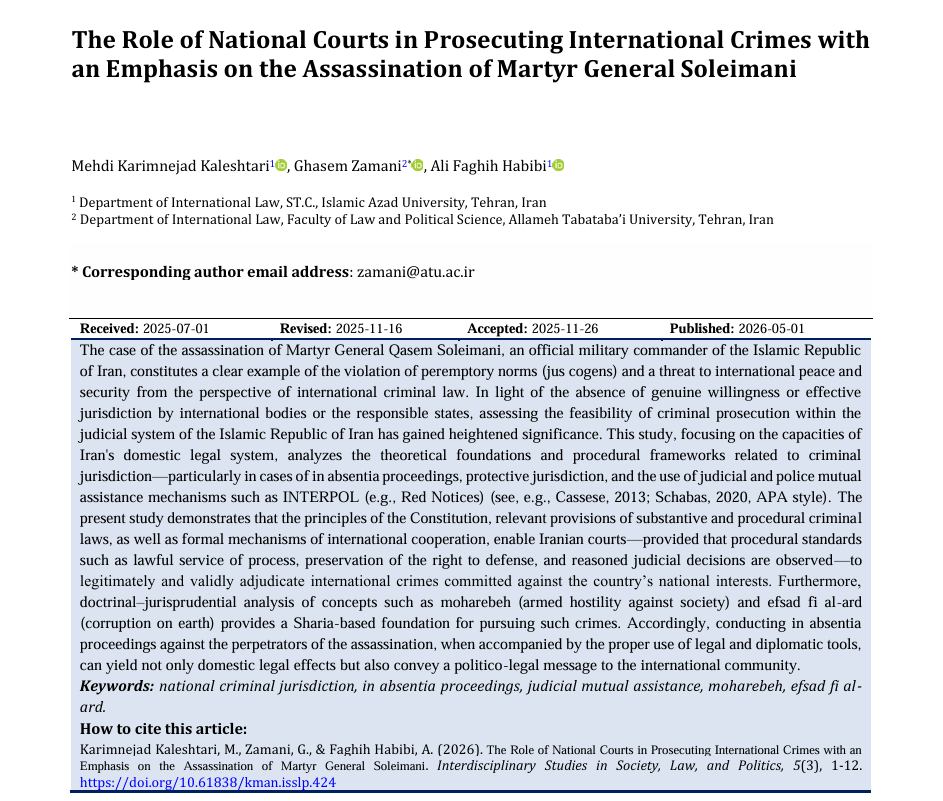
The Role of National Courts in Prosecuting International Crimes with an Emphasis on the Assassination of Martyr General Soleimani
Keywords:
national criminal jurisdiction, in absentia proceedings, judicial mutual assistance, moharebeh, efsad fi al-ardAbstract
The case of the assassination of Martyr General Qasem Soleimani, an official military commander of the Islamic Republic of Iran, constitutes a clear example of the violation of peremptory norms (jus cogens) and a threat to international peace and security from the perspective of international criminal law. In light of the absence of genuine willingness or effective jurisdiction by international bodies or the responsible states, assessing the feasibility of criminal prosecution within the judicial system of the Islamic Republic of Iran has gained heightened significance. This study, focusing on the capacities of Iran's domestic legal system, analyzes the theoretical foundations and procedural frameworks related to criminal jurisdiction—particularly in cases of in absentia proceedings, protective jurisdiction, and the use of judicial and police mutual assistance mechanisms such as INTERPOL (e.g., Red Notices) (see, e.g., Cassese, 2013; Schabas, 2020, APA style). The present study demonstrates that the principles of the Constitution, relevant provisions of substantive and procedural criminal laws, as well as formal mechanisms of international cooperation, enable Iranian courts—provided that procedural standards such as lawful service of process, preservation of the right to defense, and reasoned judicial decisions are observed—to legitimately and validly adjudicate international crimes committed against the country’s national interests. Furthermore, doctrinal–jurisprudential analysis of concepts such as moharebeh (armed hostility against society) and efsad fi al-ard (corruption on earth) provides a Sharia-based foundation for pursuing such crimes. Accordingly, conducting in absentia proceedings against the perpetrators of the assassination, when accompanied by the proper use of legal and diplomatic tools, can yield not only domestic legal effects but also convey a politico-legal message to the international community.
Downloads
References
Abdollahi, F. (2021). The Right to Objection and Appeal in Criminal In Absentia Proceedings. Criminal Law Research Journal, 11(3), 89-108.
Ahmadi, H. (2019). Collection of Criminal Laws. Dadgostar Publications.
Asgari, A. (2022). The Chain of Discovery and Preservation of Evidence in Iranian Criminal Procedure Law with an Emphasis on International Documents. Contemporary Criminal Law Quarterly, 14(1), 75-90.
Callamard, A. (2020). Report of the Special Rapporteur on extrajudicial, summary or arbitrary executions: Use of armed drones for targeted killings.
Constitution of the Islamic Republic of Iran. (2017). Constitution of the Islamic Republic of Iran. Research Center of the Islamic Consultative Assembly.
Fazaeli, M. M. (2020). The Assassination of General Soleimani from the Perspective of International Law on the Use of Force. Comparative Research on Islamic and Western Law, 7(2), 151-188.
Gadimi, A., Ebrahimi, S. N., & Safaei, A. (2023). Judicial Strategies and Possibility of Filing a Lawsuit in the Case of the Assassination of the Quds Force Commander in Domestic Courts. Security Outlook, 16(60), 47-75.
Hamidi, A. (2019). The Principle of Personal Jurisdiction Based on Nationality in Iranian Criminal Law. New Achievements in Human Sciences Studies, 2(14), 28-54.
Hosseini, M. (2020). Criminal Jurisdiction in International Crimes. Jungle Publications.
International Court of, J. (2002). Arrest Warrant of 11 April 2000 (Democratic Republic of the Congo v. Belgium), Judgment. I.C.J. Reports, 3. https://doi.org/10.18356/9789211553925c001
Interpol. (2012). Rules on the Processing of Data (RPD) (as amended).
Jahanbakhsh, M. (2022). Establishment of Specialized Branches for Transnational Crimes in Revolutionary Courts. Journal of Judicial Innovation, 9(1), 30-45.
Khaleghi, A. (2025). Legal-Historical Analysis of the Jurisdiction of the Islamic Revolutionary Courts. Judicial Law Journal.
Kohkan, M. R., Davari, P., & Sangari, E. (2022). Verification of Legal Justifications for the Assassination of Martyrs Soleimani and Fakhrizadeh. Criminal Law Research Journal.
Kousha, J., Alizadeh, A., & Yekta, A. (2024). Legal Examination of the Assassination of General Soleimani from the Perspective of International Documents. Judicial Excellence Journal, 15(1), 31-66.
Koushki, G., & Alizadeh Seresht, N. (2015). A Look at the Scope of Security Crimes in Light of the Revolutionary Court's Jurisdiction. Criminal Law Research, 4(12), 99-124.
Mahmoudi, R. (2020). Mutual Legal Assistance in Iranian Criminal Law and International Instruments. Criminal Law and Criminology Studies Quarterly, 12(2), 125-146.
Mégret, F. (2010). Why would states ever prosecute the ICC's core crimes? In State Sovereignty and International Criminal Law: Versailles to Rome (pp. 191-216). Oxford University Press.
Mirmohammadsadeghi, M. (2020). The Role of the Principles of Transparency and Access to Justice in Protecting Victims of Human Rights Violations. Public Law Notes, 3(2), 40-56.
Narimani, A. (2022). The Requirement for Written Reasoning in In Absentia Judgments: Jurisprudential and Legal Analysis. Journal of Law and Judicial Policy, 13(2), 63-81.
Nasiri, R. (2021). Specialized Challenges of the Islamic Revolutionary Court in Dealing with Crimes Against Humanity. International Criminal Law Journal, 11(3), 98-110.
Noorbaha, R. (2019). Foundations of General Criminal Law.
Nouri, H. R. (2019). International Judicial Cooperation in Terrorism Cases: Challenges and Solutions. Comparative Law Quarterly, 6(3), 85-102.
Pourezat, A. A., Mohammadzadeh, A., Pirannezhad, A., Mokhtarianpour, M., & Pendar, M. (2022). A Comprehensive Model of Citizen Participation: A Case Study of Tehran City.
Rahimi, A. (2021). Judicial Protection of Victims of International Crimes in National Courts. Law Studies Quarterly.
Rezaei, H., & Mahdavi Sabet, M. A. (2021). The Origin and Legitimacy of Applying the Principle of Universal Jurisdiction in National Courts for the Prosecution of International Crimes. Criminal Law and Criminology Research, 9(17), 31-49.
Rome Statute of the International Criminal Court. (1998). Rome Statute of the International Criminal Court.
Rostami, S. (2019). Examining the Scope of Application of the Principle of Universal Jurisdiction in the Iranian Legal System. Advocate Journal, 9(19), 137-156.
Safaei, S. H. (2013). Principles of Fair Trial in the Iranian Legal System.
Sanei, A. (2019). In Absentia Proceedings in Iranian Law: Foundations and Challenges. Journal of Criminal Procedure Law, 10(4), 175-193.
Schabas, W. A. (2017). An introduction to international criminal law and procedure. Cambridge University Press.
Shirzadi, M. (2021). Territorial Jurisdiction in Iranian Criminal Law. Legal Research Journal, 25(2), 75-102.
Sobhkhiz, M. (2023). Mechanisms of In Absentia Proceedings in Political Crimes: A Case Analysis of the Assassination of General Soleimani. Criminal Law and Criminology Quarterly, 12(3), 345-372.
Soleimani, H. (2021). The Position of Interpol and Red Notice in International Criminal Cooperation. International Law Research Journal, 9(2), 55-72.
Torabi, M., Jafari, M. J., & Ghasemi, M. R. (2019). Examining Violations of Criminal Law Principles in the Criminalization of Rebellion (Baqy) and Spreading Corruption on Earth (Efsad-fil-Arz). Jurisprudence and Civilization History Quarterly, 16(60), 15-24.
United Nations General Assembly. (2005). Basic Principles and Guidelines on the Right to a Remedy and Reparation for Victims of Gross Violations of International Human Rights Law and Serious Violations of International Humanitarian Law.
United Nations Human Rights Committee. (2018). General Comment No. 36 on Article 6 of the International Covenant on Civil and Political Rights, on the Right to Life.
Ziaei, S. Y., & Hakimihas, S. (2016). Legal Conditions for the Exercise of Universal Jurisdiction in International Law. Public Law Research, 18(53), 97-122.
Downloads
Additional Files
Publication Timeline
- Submitted
- Revised
- Accepted
Issue
Section
License
Copyright (c) 2025 Mehdi Karimnejad Kaleshtari (Author); Ghasem Zamani (Corresponding author); Ali Faghih Habibi (Author)

This work is licensed under a Creative Commons Attribution-NonCommercial 4.0 International License.