Water at the Center of Central Asian Geopolitics: Security, Conflict, and the Reconfiguration of Regional Power
Keywords:
water geopolitics, water security, Central Asia, hydro, hegemony, water conflicts, reconfiguration of regional powerAbstract
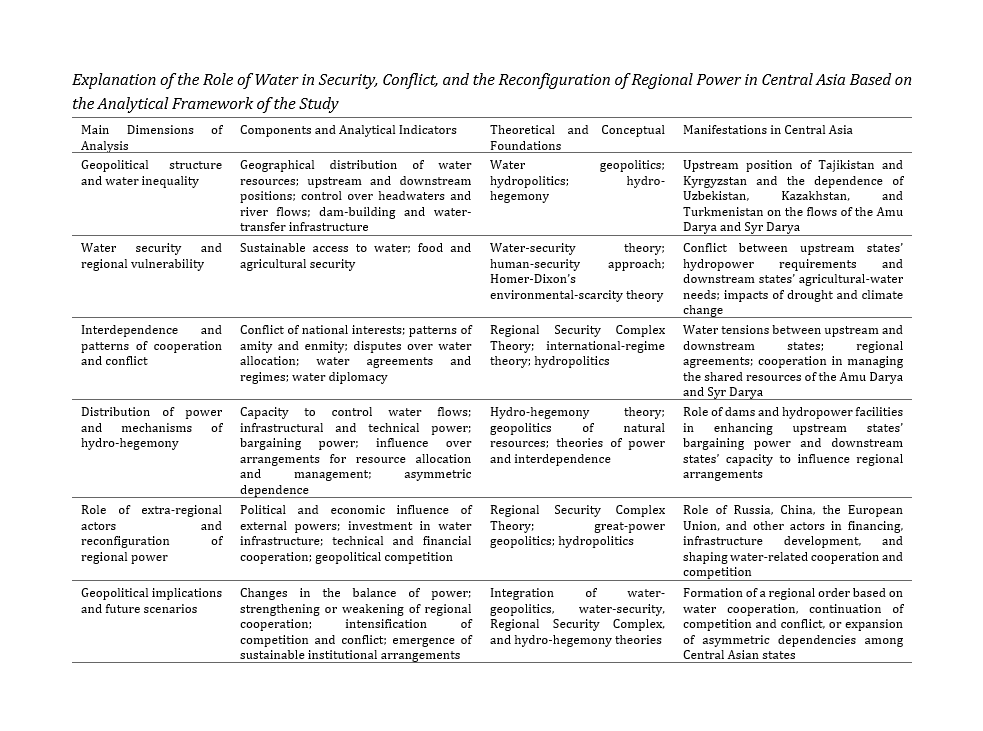
Water resources in Central Asia, due to their uneven geographical distribution, the interdependence of upstream and downstream countries, and their close nexus with energy and food security, have become one of the determining components of regional geopolitics and security. The present study aims to elucidate the role of water in regional power relations, analyze the mechanisms underlying the emergence of water-related conflicts, and examine their implications for the reconfiguration of regional power in Central Asia. In terms of purpose, this is a fundamental research study, while methodologically it adopts a qualitative approach based on a descriptive–analytical method. Research data were collected through documentary analysis and the examination of scholarly sources, specialized reports, and regional agreements, and were analyzed using the theoretical frameworks of water geopolitics, regional security, and hydro-hegemony. The findings indicate that inequalities in the distribution of water resources, control over hydraulic infrastructure, and the conflict between the energy priorities of upstream countries and the agricultural requirements of downstream states have created a structure of asymmetric interdependence that provides the basis for political competition and bargaining. Furthermore, the collapse of the Soviet Union’s integrated water–energy management system, climate change, weaknesses in institutional mechanisms, and the involvement of extra-regional powers have increased the complexity of water relations in the region. Nevertheless, bilateral and multilateral agreements, together with the potential of regional diplomacy, demonstrate that water interdependence can be transformed into institutionalized cooperation. The study concludes that the future of the geopolitical water order in Central Asia depends on how power asymmetries are managed, the extent to which joint water governance is strengthened, and the capacity of regional states to establish a balance between national interests and the imperatives of collective security.
Downloads
References
Abdullaev, I., Assubayeva, A., & Bobojonov, I. (2025). Current Challenges in Central Asian Water Governance and their Implications for Research, Higher Education, and Science-Policy Interaction. Cent. Asian J. Water Res, 11, 47-58.
Abdullaev, I., & Rakhmatullaev, S. (2015). Transformation of water management in Central Asia: From State-centric, hydraulic mission to socio-political control. Environ. Earth Sci, 73, 849-861.
Afroz, R., & Sarabdeen, M. (2026). Policy Pathways for a Green Transition: Assessing the Interplay of Energy Diversification and Economic Complexity on the OECD’s Load Capacity Curve. Energies, 19(4), 1-30.
Aituarova, G., & Kh, T. L. (2025). The Role of International and Regional Organizations in Solving the Problem of Water Shortage in Central Asia. Becmнuк нaукu, 4(4), 352-358.
Allan, J. A. (2001). The Middle East Water Question: Hydropolitics and the Global Economy. I.B. Tauris.
Bologov, P. (2017). The Rogun Dam: A Source of Division in Central Asia. https://carnegie.ru/commentary/66334
Bure, L. (2009). Chu-Talas Activities. In Transboundary Water Resources: A Foundation for Regional Stability in Central Asia. Springer.
Buzan, B., & Wæver, O. (1991). Regions and Powers: The Structure of International Security. Cambridge University Press.
Buzan, B., & Wæver, O. (2003). Regions and Powers: The Structure of International Security. Cambridge University Press.
Cannon, B. J. (2025). Central Asia and the Indo-Pacific. International Affairs, 101(4), 1177-1195.
Cohen, A., Hill, W. A., & Sánchez, W. A. (2025). Central Asia Needs Regional and International Cooperation to Bolster Water Security. https://www.atlanticcouncil.org/in-depth-research-reports/report/central-asia-needs-regional-and-international-cooperation-to-bolster-water-security/
Cuterstam, B. (2025). Towards sustainable water resources management in Central Asia. In Central Asia Water: Social, economic, environmental and governance puzzle. Helsinki University of Technology.
Didovets, I., Hattermann, F., Schaffhauser, T., Javed, M., Nurbatsina, A., & Umirzakov, G. (2026). Central Asian water resources in the face of climate change: Shifting seasonality and diverse spatial water availability. In Towards sustainable future of Central Asia: Analysis of climate, resources and human security. Springer Nature.
Dinar, S. (2012). The Geographical Dimensions of Hydro-politics: International Freshwater in the Middle East, North Africa, and Central Asia. Eurasian Geography and Economics, 53(1), 129-130.
Duku, J., Tourian, M. J., Azarderakhsh, M., Abbasov, R., & Mehran, A. (2026). The Shrinking Caspian Sea: Eco-Hydrological Responses to Human and Climate Pressures. Geophysical Research Letters, 14(6) 1-16.
Elhance, A. P. (1997). Conflict and cooperation over water in the Aral Sea basin. Studies in Conflict & Terrorism, 20(2), 207-218.
Haider Bukhari, S. R. (2026). Hydro-Nuclear Geopolitics: Water Wars and the Nuclear Future of South Asia. Journal of Political Stability Archive, 3(1), 1236-1245.
Homer-Dixon, T. F. (1994). Environmental Scarcities and Violent Conflict: Evidence from Cases. International Security, 19(1), 5-40.
Huang, J., Bashiri, Z., & Disse, M. (2026). Climate-Informed Water Allocation in Central Asia: Leveraging Decision Support System. Water, 18(2), 1-19.
International Crisis, G. (2005). The Curse of Cotton: Central Asia’s Destructive Monoculture.
Jonoski, A., & Seid, A. H. (2016). Decision support in water resources planning and management: The Nile basin decision support system. In Real-World Decision Support Systems: Case Studies. Springer.
Khan, K. H., & Koch, H. (2023). Emerging Central Asia: Managing great power relations. Springer.
Khikmatov, F. (2026). State of Water Resources Across Central Asia and Current Trends. In Towards Sustainable Future of Central Asia: Analysis of Climate, Resources and Human Security (Vol. 84). Springer.
Khikmatov, F., Kalashnikova, O., Nurbatsina, A., Niyazov, J., Umirzakov, G., Yunusov, G., & Erlapasov, N. (2026). State of water resources across Central Asia and current trends. In Towards sustainable future of Central Asia: Analysis of climate, resources and human security. Springer Nature.
Kong, L., Li, Y., Ma, L., Zhang, J., Deng, X., Abuduwaili, J., & Gulayozov, M. (2025). Climate Change Impacts and Atmospheric Teleconnections on Runoff Dynamics in the Upper-Middle Amu Darya River of Central Asia. Water, 17(5), 1-22.
Mikhalev, A. V. (2025). From geopolitics to hydropolitics: In search of the discipline boundaries. Rudn Journal of Political Science, 27(1), 7-17.
Murthy, S. L., & Mendikulova, F. (2017). Water, conflict, and cooperation in Central Asia: The role of international law and diplomacy. Vt. J. Environ. Law, 18, 400-454.
Omelicheva, M. Y. (2018). Russia’s foreign policy in Central Asia. https://nwc.ndu.edu/Portals/71/Images/Publications/OmelichevaRussiaFPinCentralAsia.pdf
Peña-Ramos, J. A., Bagus, P., & Fursova, D. (2021). Water conflicts in Central Asia: Some recommendations on the non-conflictual use of water. Sustainability, 13(1), 1-24.
Prniyazova, A., Turaeva, S., Turgunov, D., & Jarihani, B. (2025). Sustainable Transboundary Water Governance in Central Asia: Challenges, Conflicts, and Regional Cooperation. Sustainability, 17(1), 1-21.
Reyer, C. P., Otto, I. M., & Adams, S. (2017). Climate Change Impacts in Central Asia and their Implications for Development. Reg. Environ. Chang, 17, 1639-1650.
Sadyrov, S., Isaev, E., Tanaka, K., Murata, A., & Sidle, R. C. (2025). High-Resolution Assessment of Climate Change Impacts on the Surface Energy and Water Balance in the Glaciated Naryn River basin, Central Asia. J. Environ. Manag, 374(1), 1-15.
Saeed, A., & Saud, A. (2026). Hydropolitics in Central Asia: The Role of Water Security in Shaping Regional Stability. Central Asia, 97(4), 65-82.
Saidmamatov, O. (2020). Water–Energy–Food Nexus Framework for Promoting Regional Integration in Central Asia. Water, 12(7), 1-18.
Salangi, A. S. (2021). The Water Situation in Central Asia and Its Relationship with Afghanistan. Water Diplomacy, 2(2), 17-60.
Strilchuk, S., Matsovityi, O., & Taranov, V. (2025). The Role of Central Asia in Modern Geopolitics. Political Science and Security Studies Journal, 6(4), 30-43.
Suleimenova, Z. (2018). Water Security in Central Asia and the Caucasus – A Key to Peace and Sustainable Development.
Tian, L., Disse, M., & Huang, J. (2023). Drought cascades across multiple systems in Central Asia identified based on the dynamic space–time motion approach. Hydrol. Earth Syst. Sci, 27, 4115-4133.
Van den Bosch, J., Fauve, A., & De Cordier, B. (2021). The Routledge handbook of contemporary Central Asia. Routledge.
Wang, X., Chen, Y., Li, Z., Fang, G., Wang, F., & Hao, H. (2021). Water Resources Management and Dynamic Changes in Water Politics in the Transboundary River Basins of Central Asia. Hydrol. Earth Syst. Sci, 25, 3281-3299.
Wang, Y., Wang, R., Tanaka, K., Ciais, P., Penuelas, J., Balkanski, Y., Sardans, J., Hauglustaine, D., Cao, J., & Chen, J. (2025). Global spatiotemporal optimization of photovoltaic and wind power to achieve the Paris Agreement targets. Nature Communications, 16(1), 1-19.
Waterbury, J. (1979). Hydropolitics of the Nile Valley. Syracuse University Press.
Wilson, C. (2025). The great power rivalry in Central Asia. https://www.wilsoncenter.org/publication/the-great-power-rivalry-central-asia
World, B. (2025). Country Profiles with Climate Risks. https://climateknowledgeportal.worldbank.org/country-profiles
Xenarios, S. (2022). The Aral Sea Disaster and Implications for Regionalism In Central Asia. https://www.ispionline.it/en/publication/aral-sea-disaster-and-implications-regionalism-central-asia-29957
Xenarios, S., Shenhav, R., Abdullaev, I., & Mastellari, A. (2018). Current and Future Challenges of Water Security in Central Asia. In Global Water Security: Lessons Learnt and Long-Term Implications. Springer.
Yan, L., & Bolshakov, A. G. (2026). Ensuring Regional Stability in Central Asia: The Geopolitical Aspect Cover Page. Ensuring Regional Stability in Central Asia: The Geopolitical Aspect, 32(2), 108-117.
Zhiltsov, S. S. (2018). Water Resources in Central Asia: International Context. People’s Friendship University of Russia.
Zhiltsov, S. S. (2023). The Problem of water scarcity in Central Asia: The factor of Afghanistan. Post-Soviet Issues, 10(2), 110-119.
Zhiltsov, S. S. (2025). Water politics in Central Asian countries: Political aspects. Rudn Journal of Political Science, 27(1), 66-79.
Zonn, I. S., & Kostianoy, A. G. (2014). The Turkmen Lake Altyn Asyr and Water Resources in Turkmenistan. Springer.
Downloads
Additional Files
Publication Timeline
- Submitted
- Revised
- Accepted
Issue
Section
License
Copyright (c) 2025 Zharkyn Kalykova (Author); Ardeshir Noorian (Corresponding author)

This work is licensed under a Creative Commons Attribution-NonCommercial 4.0 International License.