The Role of Renegotiation in Commercial Disputes under Iranian and Iraqi Law
Keywords:
Renegotiation, Commercial Disputes, Contractual Adaptation, Changed Circumstances, Good Faith, Iranian Law, Iraqi Law, ArbitrationAbstract
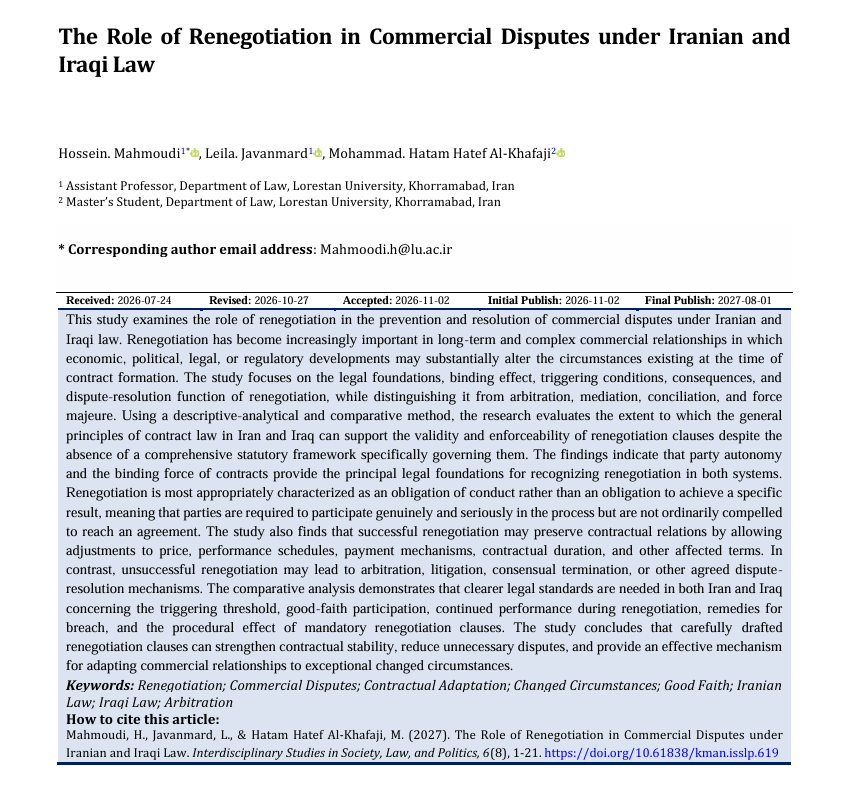
This study examines the role of renegotiation in the prevention and resolution of commercial disputes under Iranian and Iraqi law. Renegotiation has become increasingly important in long-term and complex commercial relationships in which economic, political, legal, or regulatory developments may substantially alter the circumstances existing at the time of contract formation. The study focuses on the legal foundations, binding effect, triggering conditions, consequences, and dispute-resolution function of renegotiation, while distinguishing it from arbitration, mediation, conciliation, and force majeure. Using a descriptive-analytical and comparative method, the research evaluates the extent to which the general principles of contract law in Iran and Iraq can support the validity and enforceability of renegotiation clauses despite the absence of a comprehensive statutory framework specifically governing them. The findings indicate that party autonomy and the binding force of contracts provide the principal legal foundations for recognizing renegotiation in both systems. Renegotiation is most appropriately characterized as an obligation of conduct rather than an obligation to achieve a specific result, meaning that parties are required to participate genuinely and seriously in the process but are not ordinarily compelled to reach an agreement. The study also finds that successful renegotiation may preserve contractual relations by allowing adjustments to price, performance schedules, payment mechanisms, contractual duration, and other affected terms. In contrast, unsuccessful renegotiation may lead to arbitration, litigation, consensual termination, or other agreed dispute-resolution mechanisms. The comparative analysis demonstrates that clearer legal standards are needed in both Iran and Iraq concerning the triggering threshold, good-faith participation, continued performance during renegotiation, remedies for breach, and the procedural effect of mandatory renegotiation clauses. The study concludes that carefully drafted renegotiation clauses can strengthen contractual stability, reduce unnecessary disputes, and provide an effective mechanism for adapting commercial relationships to exceptional changed circumstances.
Downloads
References
Al-Ajuz, A. M. M. M. (2018). Renegotiation to Address Changed Circumstances in Administrative Contracts.
Al-Asaad, B. M. (2007). Investment Contracts in Private International Relations: Their Nature, Applicable Law, and Means of Dispute Settlement. Al-Halabi Legal Publications.
Amini, A. M., & Pilvar, R. (2023). The Nature and Effects of a Renegotiation Clause with Respect to the Court and the Contracting Parties: A Comparative Study. Legal Research Quarterly, 313-336.
Ashour, F. (2018). Addressing Changed Circumstances in the Performance of International Trade Contracts. Scientific Research Notebooks, Tipaza University Center, 13(13).
Awad, S. M. H. (2019). Contractual Guarantees for Foreign Investment in the Kingdom of Saudi Arabia: A Comparative Study. Journal of Research of the Faculty of Arts, Prince Mohammad Bin Fahd University, 30(17).
Ben Driss, H. (2021). Renegotiation in Contracts: A Study in Light of the UNIDROIT Principles and National Legislation. Judicial Ijtihad Journal, Mohamed Khider University of Biskra, 13(2).
Berge, K. P. (2003). Renegotiation and Adaptation of International Investment Contracts. Vanderbilt Journal of Transnational Law, 36(4).
Bernardini, P. (1998). The Renegotiation of Investment Contract. FOREIGN INVESTMENT LAW JOURNAL, 13(2).
Boukhalfa, A. (2019). The Renegotiation Clause as a Mechanism for Restoring Economic Balance in International Investment Contracts. Journal of Legal and Economic Research, Aflou University Center, 3(1).
Carneiro, L. (2013). Les Clauses de Hardship dans les Contrats Maritimes
Ghanbari, M., & Mohammadi, M. (2025). Renegotiation Clauses in Foreign Investment Contracts under International Law 21st International Conference on Legal and Judicial Studies,
Hassan, A. K., & Fatima, A. M. D. (2018). Renegotiation Mechanisms in International Trade Contracts. Risalat al-Huquq Journal, University of Karbala, 10(13).
Heni, A. L. (2016). Limits of Applying the Concept of Renegotiation in Contracts: A Comparative Study
Husam al-Din, M. H. (2022). The Renegotiation Clause as a Mechanism for Restoring Balance in Investment Contracts. Journal of Legal and Economic Research, Mansoura University, 32(3).
Husam, S. A. a.-R. (2023). Application of the Hardship Renegotiation Clause in International Trade Contracts. Journal of Legal Studies, Assiut University, 49(3).
Hussein, I. A. a.-H. (2018). Contractual Guarantees for Investment: A Comparative Study. Kufa Journal of Political and Legal Sciences, University of Kufa, 10(23).
Kamal, M. A.-S. A. a.-Q. A. (2022). The Effect of Changed Economic Circumstances on Contractual Transactions: A Comparative Study. Journal of Legal and Economic Research, Menoufia University, 40(1).
Lamari, W. (2021). Legal Security in International Investment Contracts. Journal of Research in Contracts and Business Law, Mentouri Brothers University Constantine, 6(7).
Marouk, A. (2019). The Renegotiation Clause in International Trade Contracts
Masoumi, P. (2012). ICC Arbitration Rules and Alternative Dispute Resolution Methods. Special Issue of the International Law Review, 25-32.
Matray, D., & Vidts, F. (2005). Les Clauses d’Adaptation de Contrats 55th Seminar of the Commission Droit et Vie des Affaires, Belgium.
Mohammed, A. S., & Ali, G. A. (2018). Legal Means for Avoiding Investment Disputes: A Comparative Legal Study. Al-Nahrain University Journal, 31(12).
Sharif, M. G. (2007). The Effect of Changed Circumstances on International Trade Contracts: The Effect of Force Majeure and Hardship on the Performance of International Contracts (1 ed.). Fujairah National Printing Press.
Sharif, M. G. (2010). The Effect of Changed Circumstances on International Trade Contracts. Dar al-Jami'a al-Jadida.
Shiravi, A., & Kazemi, M. J. (2019). Economic Analysis of Negotiation in the Settlement of Commercial Disputes. Majles and Strategy, 26(99), 227-247.
Yahiaoui, S. (2019). Alternative Means to Public and Private Judiciary in Resolving Commercial Disputes
Zouak, N. (2023). The Theory of Unforeseen Circumstances and Its Applications in International Contracts. Academic Journal of Legal and Political Research, Amar Telidji University of Laghouat, 7(2).
Downloads
Additional Files
Publication Timeline
- Submitted
- Revised
- Accepted
Issue
Section
License
Copyright (c) 2025 Hossein Mahmoudi (Corresponding author); Leila Javanmard, Mohammad Hatam Hatef Al-Khafaji (Author)

This work is licensed under a Creative Commons Attribution-NonCommercial 4.0 International License.