A Penological Analysis of the Doctrine of “Soft Punishment”: The Challenge of Balancing Retribution, Deterrence, and Resocialization in the Criminal Justice Systems of Iran and Türkiye
Keywords:
soft punishment, alternatives to imprisonment, probation, risk and needs assessment, restorative justice, comparative criminal law (Iran and Türkiye)Abstract
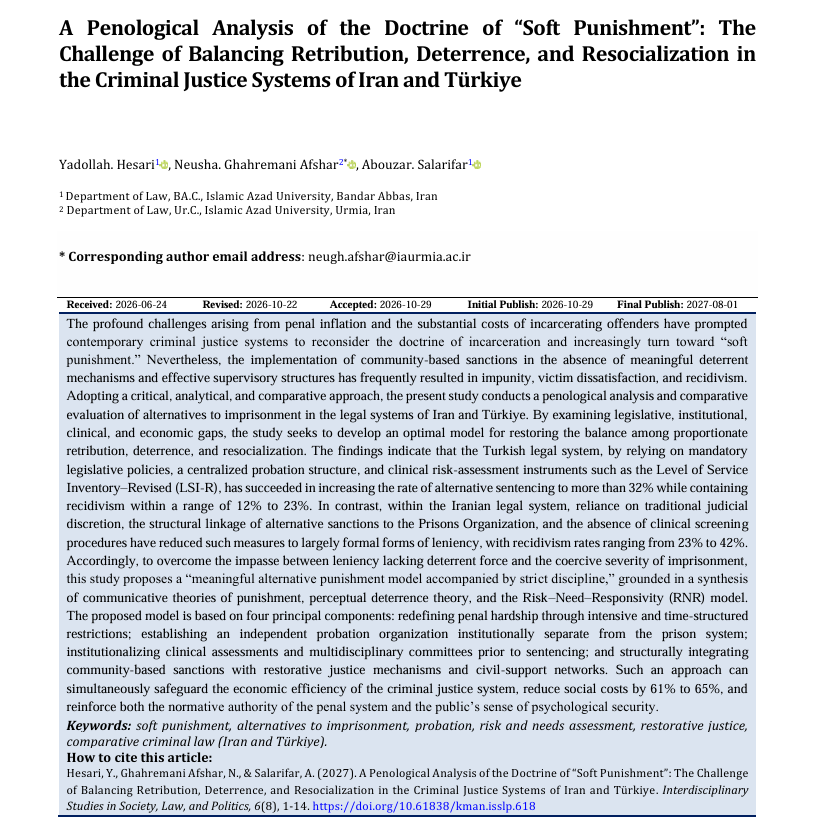
The profound challenges arising from penal inflation and the substantial costs of incarcerating offenders have prompted contemporary criminal justice systems to reconsider the doctrine of incarceration and increasingly turn toward “soft punishment.” Nevertheless, the implementation of community-based sanctions in the absence of meaningful deterrent mechanisms and effective supervisory structures has frequently resulted in impunity, victim dissatisfaction, and recidivism. Adopting a critical, analytical, and comparative approach, the present study conducts a penological analysis and comparative evaluation of alternatives to imprisonment in the legal systems of Iran and Türkiye. By examining legislative, institutional, clinical, and economic gaps, the study seeks to develop an optimal model for restoring the balance among proportionate retribution, deterrence, and resocialization. The findings indicate that the Turkish legal system, by relying on mandatory legislative policies, a centralized probation structure, and clinical risk-assessment instruments such as the Level of Service Inventory–Revised (LSI-R), has succeeded in increasing the rate of alternative sentencing to more than 32% while containing recidivism within a range of 12% to 23%. In contrast, within the Iranian legal system, reliance on traditional judicial discretion, the structural linkage of alternative sanctions to the Prisons Organization, and the absence of clinical screening procedures have reduced such measures to largely formal forms of leniency, with recidivism rates ranging from 23% to 42%. Accordingly, to overcome the impasse between leniency lacking deterrent force and the coercive severity of imprisonment, this study proposes a “meaningful alternative punishment model accompanied by strict discipline,” grounded in a synthesis of communicative theories of punishment, perceptual deterrence theory, and the Risk–Need–Responsivity (RNR) model. The proposed model is based on four principal components: redefining penal hardship through intensive and time-structured restrictions; establishing an independent probation organization institutionally separate from the prison system; institutionalizing clinical assessments and multidisciplinary committees prior to sentencing; and structurally integrating community-based sanctions with restorative justice mechanisms and civil-support networks. Such an approach can simultaneously safeguard the economic efficiency of the criminal justice system, reduce social costs by 61% to 65%, and reinforce both the normative authority of the penal system and the public’s sense of psychological security.
Downloads
References
Andrews, D. A., & Bonta, J. (2019). The Risk-Need-Responsivity (RNR) Model: Does Reducing Recidivism Increase Public Safety? Criminology & Public Policy, 18(1), 195-205.
Arslan, Ç. (2013). Denetimli Serbestlik Sisteminin Türk Hukukundaki Yeri ve Gelişimi. Ankara Barosu Dergisi, 71(4), 51-72.
Bicakci, S., Kurt, G., & Duman, T. (2020). Risk Assessment Tools and Predictive Validity of LSI-R in Turkish Probation System. Journal of Forensic and Penal Studies, 8(1), 25-48.
Braithwaite, J. (2002). Restorative Justice & Responsive Regulation. Oxford University Press.
Cohen, M. A. (2020). The Costs of Crime and Justice (2nd ed.). Routledge.
Farrington, D. P., & Murray, J. (2017). Labeling Theory, Stigma and Criminal Careers. In Key Issues in Criminological Theory (pp. 195-218). Routledge.
Garland, D. (2001). The Culture of Control: Crime and Social Order in Contemporary Society. Oxford University Press.
Gazal-Ayal, O., & Roberts, J. V. (2019). Alternative Sentencing and Decarceration Strategies in Comparative Criminal Justice. Criminal Justice and Behavior, 46(1), 5-22.
Mackenzie, D. L. (2001). Sentences and Effective Interventions: Reconsidering the Role of Incarceration and Alternatives. Crime & Delinquency, 47(3), 105-125.
Nagin, D. S. (2013). Deterrence in the Twenty-First Century. Crime and Justice, 42(1), 199-263.
Öncu, E., Yildirim, T., & Karaca, B. (2021). Post-Release Employment and Reintegration under Electronic Monitoring in Turkey. Journal of Offender Rehabilitation, 60(3), 148-168.
Sevdiren, F. (2011). Alternatives to Imprisonment in Turkey: A Legal and Sociological Evaluation. Springer.
Turkish Justice, M. (2022). Denetimli Serbestlik İstatistikleri Yıllığı (2021).
von Hirsch, A. (1976). Doing Justice: The Choice of Punishments. Hill and Wang.
Zedner, L. (2007). Pre-Crime and Post-Criminology? Theoretical Criminology, 11(2), 261-281.
Zehr, H. (2015). The Little Book of Restorative Justice. Good Books.
Downloads
Additional Files
Publication Timeline
- Submitted
- Revised
- Accepted
Issue
Section
License
Copyright (c) 2025 Yadollah Hesari (Author); Neusha Ghahremani Afshar (Corresponding author); Abouzar Salarifar (Author)

This work is licensed under a Creative Commons Attribution-NonCommercial 4.0 International License.