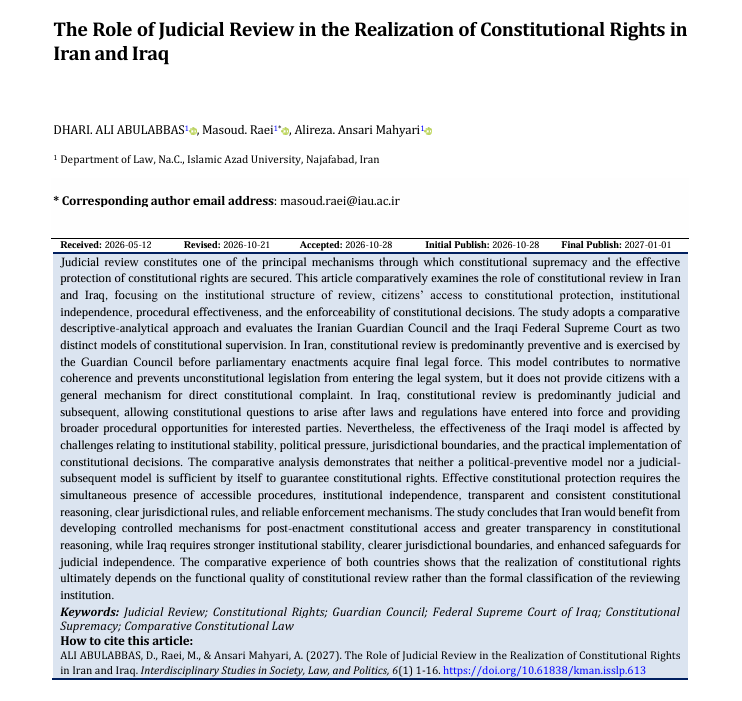
The Role of Judicial Review in the Realization of Constitutional Rights in Iran and Iraq
Keywords:
Judicial Review, Constitutional Rights, Guardian Council, Federal Supreme Court of Iraq, Constitutional Supremacy, Comparative Constitutional LawAbstract
Judicial review constitutes one of the principal mechanisms through which constitutional supremacy and the effective protection of constitutional rights are secured. This article comparatively examines the role of constitutional review in Iran and Iraq, focusing on the institutional structure of review, citizens’ access to constitutional protection, institutional independence, procedural effectiveness, and the enforceability of constitutional decisions. The study adopts a comparative descriptive-analytical approach and evaluates the Iranian Guardian Council and the Iraqi Federal Supreme Court as two distinct models of constitutional supervision. In Iran, constitutional review is predominantly preventive and is exercised by the Guardian Council before parliamentary enactments acquire final legal force. This model contributes to normative coherence and prevents unconstitutional legislation from entering the legal system, but it does not provide citizens with a general mechanism for direct constitutional complaint. In Iraq, constitutional review is predominantly judicial and subsequent, allowing constitutional questions to arise after laws and regulations have entered into force and providing broader procedural opportunities for interested parties. Nevertheless, the effectiveness of the Iraqi model is affected by challenges relating to institutional stability, political pressure, jurisdictional boundaries, and the practical implementation of constitutional decisions. The comparative analysis demonstrates that neither a political-preventive model nor a judicial-subsequent model is sufficient by itself to guarantee constitutional rights. Effective constitutional protection requires the simultaneous presence of accessible procedures, institutional independence, transparent and consistent constitutional reasoning, clear jurisdictional rules, and reliable enforcement mechanisms. The study concludes that Iran would benefit from developing controlled mechanisms for post-enactment constitutional access and greater transparency in constitutional reasoning, while Iraq requires stronger institutional stability, clearer jurisdictional boundaries, and enhanced safeguards for judicial independence. The comparative experience of both countries shows that the realization of constitutional rights ultimately depends on the functional quality of constitutional review rather than the formal classification of the reviewing institution.
Downloads
References
Al-Abadi, A. (2011). The Role of Constitutional Judiciary in Realizing the Rule-of-Law State in Iraq. Journal of Legal Studies(23), 135-156.
Al-Shammari, A. M. (2024). Jurisdiction of the Federal Supreme Court to Review the Legality of Regulatory Decisions Issued by the Council of Ministers.
Al-Zawawi, H. (2011). Constitutional Judiciary and Its Role in Consolidating the Rule-of-Law State. Dar Al-Nashr Al-Jami'iyya.
Alidadzadeh, R., Rezaei, M., & Vakilian, H. (2024). The Structure of the Guardian Council and the Authority of Its Decisions with Reference to Constitutional Adjudicatory Institutions in Egypt, Iraq, and Algeria. Contemporary Comparative Law Studies, 15(34), 171-206.
Ansari Jam, H., & Raoufi Fard, Z. (2023). A Reflection on Sharia Supervision and Constitutional Supervision by the Guardian Council: Assessing the Importance of Sharia Rights and Constitutional Rights in the Islamic Republic of Iran. Religion and Law, 11(40), 43-62.
Friedman, H. (1962). Law and Politics. University of Chicago Press.
Hirschl, R. (2004). Towards Juristocracy: The Origins and Consequences of the New Constitutionalism. Harvard University Press.
Kamel Jouzari, K. G., & Kashkoulian, E. (2025). The Function of Constitutional Review Institutions in Realizing a Law-Governed State.
Khabouri Gol Ashkani, A., Faghih Habibi, A., & Varesteh Bazghaleh, M. (2025). Enforcement Guarantees of Individual and Social Rights and Freedoms in Iranian and Iraqi Law. Comparative Studies of Law in Islamic Countries, 3(3), 23-45.
Raz, J. (1979). The Authority of Law. Clarendon Press.
Sharifani, M., Gorji Azandaryani, A. A., & Rahimi, F. (2026). Analysis of the Role of the Guardian Council in Realizing the Rule of Law as a Component of Good Governance: With Emphasis on the Legislative Process. Contemporary Political Essays, 17(2).
Stone Sweet, A. (2000). Governing with Judges: Constitutional Politics in Europe. Oxford University Press.
Downloads
Additional Files
Publication Timeline
- Submitted
- Revised
- Accepted
Issue
Section
License
Copyright (c) 2025 DHARI ALI ABULABBAS (Author); Masoud Raei (Corresponding author); Alireza Ansari Mahyari (Author)

This work is licensed under a Creative Commons Attribution-NonCommercial 4.0 International License.