Challenges in Ascertaining Common Intention in the Interpretation of Contracts Concluded through Algorithmic Systems: The Conflict between Subjective and Objective Will in Light of the Principles of Contract Law
Keywords:
Algorithmic Contracts, Common Intention, Contract Interpretation, Subjective Will, Objective Will, Smart Contracts, Autonomy of Will, Algorithmic Decision, MakingAbstract
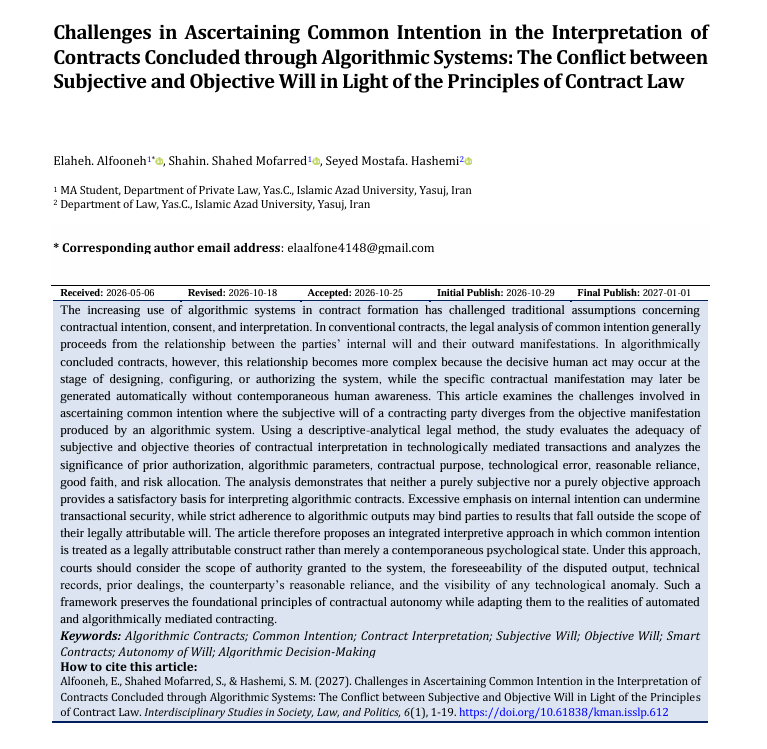
The increasing use of algorithmic systems in contract formation has challenged traditional assumptions concerning contractual intention, consent, and interpretation. In conventional contracts, the legal analysis of common intention generally proceeds from the relationship between the parties’ internal will and their outward manifestations. In algorithmically concluded contracts, however, this relationship becomes more complex because the decisive human act may occur at the stage of designing, configuring, or authorizing the system, while the specific contractual manifestation may later be generated automatically without contemporaneous human awareness. This article examines the challenges involved in ascertaining common intention where the subjective will of a contracting party diverges from the objective manifestation produced by an algorithmic system. Using a descriptive-analytical legal method, the study evaluates the adequacy of subjective and objective theories of contractual interpretation in technologically mediated transactions and analyzes the significance of prior authorization, algorithmic parameters, contractual purpose, technological error, reasonable reliance, good faith, and risk allocation. The analysis demonstrates that neither a purely subjective nor a purely objective approach provides a satisfactory basis for interpreting algorithmic contracts. Excessive emphasis on internal intention can undermine transactional security, while strict adherence to algorithmic outputs may bind parties to results that fall outside the scope of their legally attributable will. The article therefore proposes an integrated interpretive approach in which common intention is treated as a legally attributable construct rather than merely a contemporaneous psychological state. Under this approach, courts should consider the scope of authority granted to the system, the foreseeability of the disputed output, technical records, prior dealings, the counterparty’s reasonable reliance, and the visibility of any technological anomaly. Such a framework preserves the foundational principles of contractual autonomy while adapting them to the realities of automated and algorithmically mediated contracting.
Downloads
References
Abdollahi, M. (2022). A Jurisprudential and Legal Study of Smart Contracts in Light of the Autonomy of Will. Islamic Jurisprudence and Law Research Journal(31).
Ben Saadia, M. (2022). Restrictions on the Principle of Freedom of Will in the Field of Contracts University of Mohamed Boudiaf, M'Sila].
Hacker, P. (2021). The semantics of smart contracts: Reconsidering intention in algorithmic contracting. European Review of Private Law, 29(2), 175-210.
Karimi, H., & Karimi, A. (2024). Analysis of the Parties' Intention and Consent regarding Imposed Contractual Terms: A Comparative Study of Iranian and French Law. Biannual Journal of Research and Development in Private Law.
Karimi, S. (2023). Challenges in the interpretation of smart contracts and the role of parties’ intention. Comparative Law Research Quarterly, 10(4), 55-88.
Kaviani, F. (2025). Distinguishing Intention and Consent as Fundamental Conditions of Will in Contracts: An Analysis of the Legal Effects of Nullity and Non-Enforceability in Imami Jurisprudence and Iranian Law Ninth International Conference on Social Studies, Law, and Popular Culture,
Paknejad, F. (2023). A comparative study of the rules of intention and consent in electronic contracts in Iran and the European Union. Private Law Research Quarterly, 18(1), 55-78.
Pasban, M., & Sadeghi, N. (2023). Examining the Role of Intention in Smart Contracts with Emphasis on the Iranian Legal System. Private Law Research Quarterly(41).
Rashvand, M., & Naser, M. (2019). The Intention of Contracting Parties in Smart Contracts. Islamic Law Research Journal(49).
Sacco, R. (2007). Contractual Freedom and Contractual Will. International Review of Comparative Law, 59(4), 743-760.
Safaei, S. H., & Shomali, N. (2017). Countering the Unfairness of Contractual Terms from the Perspective of Restrictions on Freedom of Will in Jurisprudence and Positive Law. Quarterly Journal of Jurisprudence and Foundations of Islamic Law, 10(3).
Shabahang, A., Badini, H., & Almasi, N. A. (2026). The Effect of Intentional or Gross Fault on the Contractual Limitation of the Multimodal Transport Operator's Liability under International Multimodal Transport Documents and Iranian Law. Legal Studies in Digital Age, 5(4).
Shafi‘i, A. (2020). A legal analysis of smart contracts and the issue of ascertaining intention. Journal of Private Law Research, 8(3), 121-150.
Shavand, M., & Nasr, M. (2019). Intention of Parties in Smart Contracts. Quarterly Journal of Islamic Law, 17(66), 85-110.
Tetley, W. (2004). Good faith in contract law: particularly in the contracts of arbitration and chartering. Journal of Maritime Law & Commerce, 35(4).
Williamson, O. E. (1979). Transaction-Cost Economics: The Governance of Contractual Relations. Journal of Law and Economics, 22(2), 233-261. https://doi.org/10.1086/466942
Willmott, L., Christensen, S., & Butler, D. (2005). Contract Law. Oxford University Press.
Downloads
Additional Files
Publication Timeline
- Submitted
- Revised
- Accepted
Issue
Section
License
Copyright (c) 2025 Elaheh Alfooneh (Corresponding author); Shahin Shahed Mofarred, Seyed Mostafa Hashemi (Author)

This work is licensed under a Creative Commons Attribution-NonCommercial 4.0 International License.