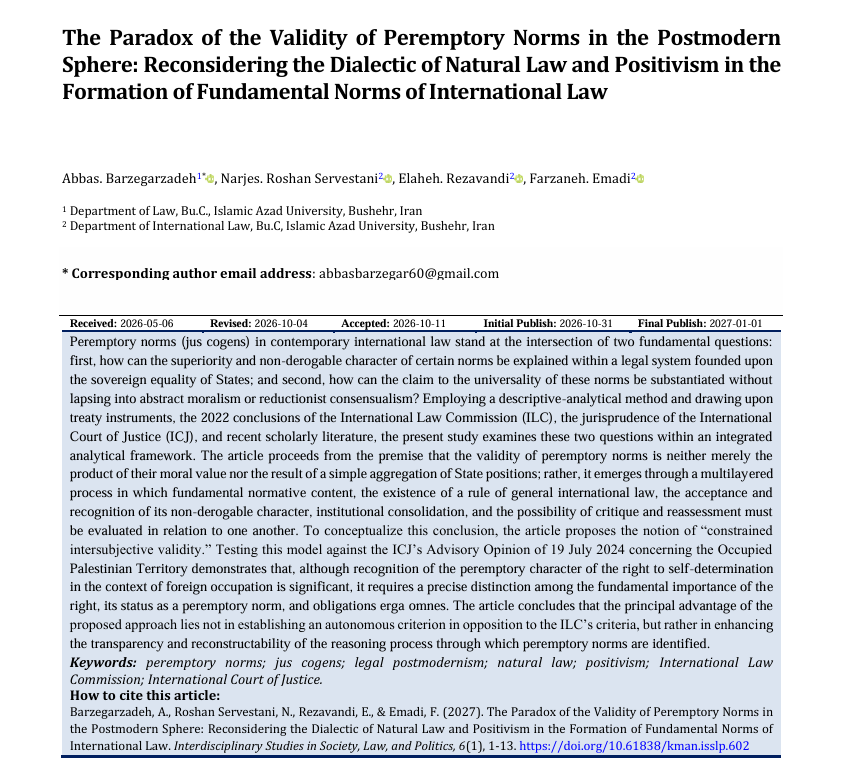
The Paradox of the Validity of Peremptory Norms in the Postmodern Sphere: Reconsidering the Dialectic of Natural Law and Positivism in the Formation of Fundamental Norms of International Law
Keywords:
peremptory norms, jus cogens, legal postmodernism, natural law, positivism, International Law Commission, International Court of JusticeAbstract
Peremptory norms (jus cogens) in contemporary international law stand at the intersection of two fundamental questions: first, how can the superiority and non-derogable character of certain norms be explained within a legal system founded upon the sovereign equality of States; and second, how can the claim to the universality of these norms be substantiated without lapsing into abstract moralism or reductionist consensualism? Employing a descriptive-analytical method and drawing upon treaty instruments, the 2022 conclusions of the International Law Commission (ILC), the jurisprudence of the International Court of Justice (ICJ), and recent scholarly literature, the present study examines these two questions within an integrated analytical framework. The article proceeds from the premise that the validity of peremptory norms is neither merely the product of their moral value nor the result of a simple aggregation of State positions; rather, it emerges through a multilayered process in which fundamental normative content, the existence of a rule of general international law, the acceptance and recognition of its non-derogable character, institutional consolidation, and the possibility of critique and reassessment must be evaluated in relation to one another. To conceptualize this conclusion, the article proposes the notion of “constrained intersubjective validity.” Testing this model against the ICJ’s Advisory Opinion of 19 July 2024 concerning the Occupied Palestinian Territory demonstrates that, although recognition of the peremptory character of the right to self-determination in the context of foreign occupation is significant, it requires a precise distinction among the fundamental importance of the right, its status as a peremptory norm, and obligations erga omnes. The article concludes that the principal advantage of the proposed approach lies not in establishing an autonomous criterion in opposition to the ILC’s criteria, but rather in enhancing the transparency and reconstructability of the reasoning process through which peremptory norms are identified.
Downloads
References
Arcari, M. (2025). Divisive jus cogens reloaded: Some remarks on the peremptory character of self-determination under the ICJ advisory opinion of 19 July 2024. Polish Yearbook of International Law, 44, 37-48.
Bianchi, A. (2008). Human rights and the magic of jus cogens. European Journal of International Law, 19(3), 491-508.
Chas, C. (2023). Hans J. Morgenthau's critique of legal positivism: Politics, justice, and ethics in international law. Jus Cogens, 5, 59-84.
Golshani, E., & Hosseini Modarres, S. M. (2025). Overriding mandatory rules within private international law. Legal Research(61), 129-168.
International Law, C. (2022). Draft conclusions on identification and legal consequences of peremptory norms of general international law (jus cogens), with commentaries (Report of the International Law Commission, Seventy-third Session, Issue.
Ispolinov, A. (2025). The lives of the doctrine of peremptory norms (jus cogens) in international law. International Justice, 1(53), 70-97. https://doi.org/10.21128/2226-2059-2025-1-70-97
Mojtahedzadeh, S. (2026). Criteria for identifying peremptory norms in contemporary international law with a view to the International Law Commission's 2022 draft conclusions. Public Law Research, 27(90), 229-264.
Murphy, S. D. (2023). Peremptory norms of general international law (jus cogens) (revisited) and other topics: The seventy-third session of the International Law Commission. American Journal of International Law, 117(1), 92-112.
Orakhelashvili, A. (2006). Peremptory norms in international law. Oxford University Press.
Pezzano, L. (2026). Legal consequences of breaches of peremptory norms in the ICJ's advisory opinions: Jus cogens or erga omnes? Polish Review of International and European Law, 15(1), 49-82. https://doi.org/10.21697/2026.15.1.02
Tladi, D. (2024). The International Law Commission's draft conclusions on peremptory norms. Oxford University Press.
Tladi, D. (2025). Jus cogens and reparations: Can we just end the separation? American Journal of International Law, 119(3), 530-549. https://doi.org/10.1017/ajil.2025.10079
Yahyaoui Krivenko, E. (2017). The ICJ and jus cogens through the lens of feminist legal methods. European Journal of International Law, 28(3), 959-987.
Downloads
Additional Files
Publication Timeline
- Submitted
- Revised
- Accepted
Issue
Section
License
Copyright (c) 2025 Abbas Barzegarzadeh (Corresponding author); Narjes Roshan Servestani, Elaheh Rezavandi, Farzaneh Emadi (Author)

This work is licensed under a Creative Commons Attribution-NonCommercial 4.0 International License.