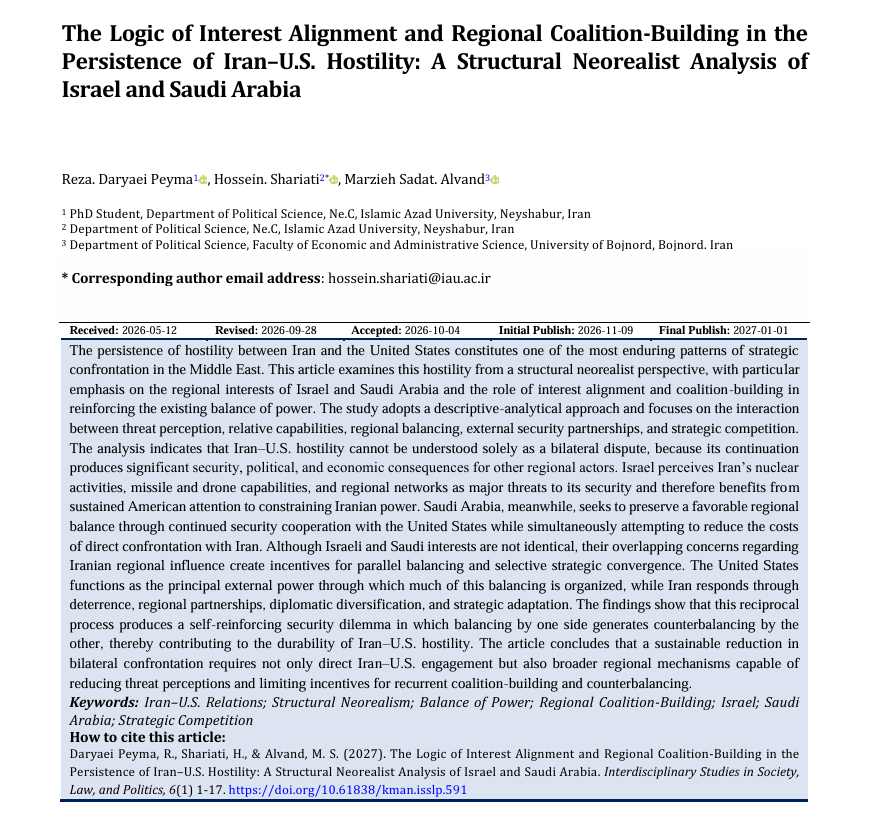
The Logic of Interest Alignment and Regional Coalition-Building in the Persistence of Iran–U.S. Hostility: A Structural Neorealist Analysis of Israel and Saudi Arabia
Keywords:
Iran–U, S, Relations, Structural Neorealism, Balance of Power, Regional Coalition, Building, Israel, Saudi Arabia, Strategic CompetitionAbstract
The persistence of hostility between Iran and the United States constitutes one of the most enduring patterns of strategic confrontation in the Middle East. This article examines this hostility from a structural neorealist perspective, with particular emphasis on the regional interests of Israel and Saudi Arabia and the role of interest alignment and coalition-building in reinforcing the existing balance of power. The study adopts a descriptive-analytical approach and focuses on the interaction between threat perception, relative capabilities, regional balancing, external security partnerships, and strategic competition. The analysis indicates that Iran–U.S. hostility cannot be understood solely as a bilateral dispute, because its continuation produces significant security, political, and economic consequences for other regional actors. Israel perceives Iran’s nuclear activities, missile and drone capabilities, and regional networks as major threats to its security and therefore benefits from sustained American attention to constraining Iranian power. Saudi Arabia, meanwhile, seeks to preserve a favorable regional balance through continued security cooperation with the United States while simultaneously attempting to reduce the costs of direct confrontation with Iran. Although Israeli and Saudi interests are not identical, their overlapping concerns regarding Iranian regional influence create incentives for parallel balancing and selective strategic convergence. The United States functions as the principal external power through which much of this balancing is organized, while Iran responds through deterrence, regional partnerships, diplomatic diversification, and strategic adaptation. The findings show that this reciprocal process produces a self-reinforcing security dilemma in which balancing by one side generates counterbalancing by the other, thereby contributing to the durability of Iran–U.S. hostility. The article concludes that a sustainable reduction in bilateral confrontation requires not only direct Iran–U.S. engagement but also broader regional mechanisms capable of reducing threat perceptions and limiting incentives for recurrent coalition-building and counterbalancing.
Downloads
References
Banihashemi, S. A., Heydarpour, M., & Kiani, D. (2022). Factors influencing the confrontational approach between the Islamic Republic of Iran and the United States of America. International Relations Research, 12(3), 249-276.
Bazoobandi, S. (2026). Power Transition and Pragmatic Adaptation: Iran's Strategic Approach to China, Russia and The GCC. Global Policy, 17(2), 200-209. https://doi.org/10.1111/1758-5899.70139
Darini, A. A., & Nourmohammadi, M. (2023). Examining Israel's omnibalancing strategy toward the Islamic Republic of Iran. Security Horizons, 16(58), 161-189.
Eslami, M. (2026). Between Hedging and Bandwagoning: E3 and Iran's Nuclear Program From The JCPOA to the 2026 “Ramadan War”. Global Policy, 17(4), 658-669. https://doi.org/10.1111/1758-5899.70213
Golmohammadi, V., & Azizi, H. (2025). A Status Quo Power in a Changing Region: Iran’s Regionalism in the South Caucasus. Nationalities Papers, 54(3), 593-606. https://doi.org/10.1017/nps.2025.10084
Hamidi, S., Abdollah, A., & Mozdkhah, E. (2021). Futures studies using the present-extrapolation model and its application to the Joe Biden administration's Middle East policy. American Strategic Studies, 1(4), 89-117.
Keynoush, B. (2025). Saudi Arabia and Iran: Spoilers or Enablers of Conflict? Middle East Policy, 32(1), 38-53. https://doi.org/10.1111/mepo.12808
Khodaei, A., Yousefi Jouybari, M., & Ghorbani Golshan Abad, M. (2022). Effects of plausible scenarios of Saudi-US arms cooperation on Iran's interests in West Asia. International Relations Research, 12(2), 213-243.
Khosravi, G. (2019). America and the Middle East: Strategies and challenges. Research Institute for Strategic Studies.
Ko, J. (2025). The Peace Penalty of Backsliding: Autocratization and Interstate Conflict Worldwide (1970–2023). Social Science Quarterly, 106(7). https://doi.org/10.1111/ssqu.70118
Munassar, O. (2025). Rethinking GCC Security: Lessons From the Saudi-Led Coalition’s Intervention in Yemen. Alternatives Global Local Political, 51(3), 265-282. https://doi.org/10.1177/03043754251370456
Pesaran, E. (2026). Outside In? Iran’s Mixed Responses to International Stigmatization. Iranian Studies, 59(2), 365-371. https://doi.org/10.1017/irn.2025.10135
Pinfold, R. G., Jones, C., & Ehteshami, A. (2025). Collision Course: How Iran and Israel Brought the Middle East to the Brink of War. Global Policy, 16(2), 289-298. https://doi.org/10.1111/1758-5899.70004
Radfar, F., & Dehghani Firouzabadi, S. J. (2020). Biden's foreign policy toward the Islamic Republic of Iran. Strategic Studies, 23(90), 225-252.
Rahimi, R. (2023). An analysis of China's mediation in Iran-Saudi relations in 2023. Foreign Relations Quarterly, 15(4), 125-148.
Rajabi Dehbarzouei, A., & Bidgoli, M. (2021). Prospects for political, economic, and security relations between Iran and the United States in the Middle East through 2026. Political Science Quarterly, 17(57), 2-27.
Shafaghat Niabad, J., & Jafari, A. A. (2021). The effects of Russia-Israel relations on Iran's national interests, 1990-2020. World Politics, 10(4), 71-104.
Souri, R. (2022). The security dilemma between the Islamic Republic of Iran and Saudi Arabia. Nations Research, 7(82), 2.
Tabatabaei, S. M., & Nourani, S. A. S. (2019). A futures study of political relations between the Islamic Republic of Iran and the United States through 2024. Iranian Futures Studies, 4(2), 81-107.
Downloads
Additional Files
Publication Timeline
- Submitted
- Revised
- Accepted
Issue
Section
License
Copyright (c) 2025 Reza Daryaei Peyma (Author); Hossein Shariati (Corresponding author); Marzieh Sadat Alvand (Author)

This work is licensed under a Creative Commons Attribution-NonCommercial 4.0 International License.