The Impact of Restorative Justice Programs on Preventing Child Victimization in Iranian and English Law
Keywords:
Restorative justice, child victimization, social prevention, Iran, EnglandAbstract
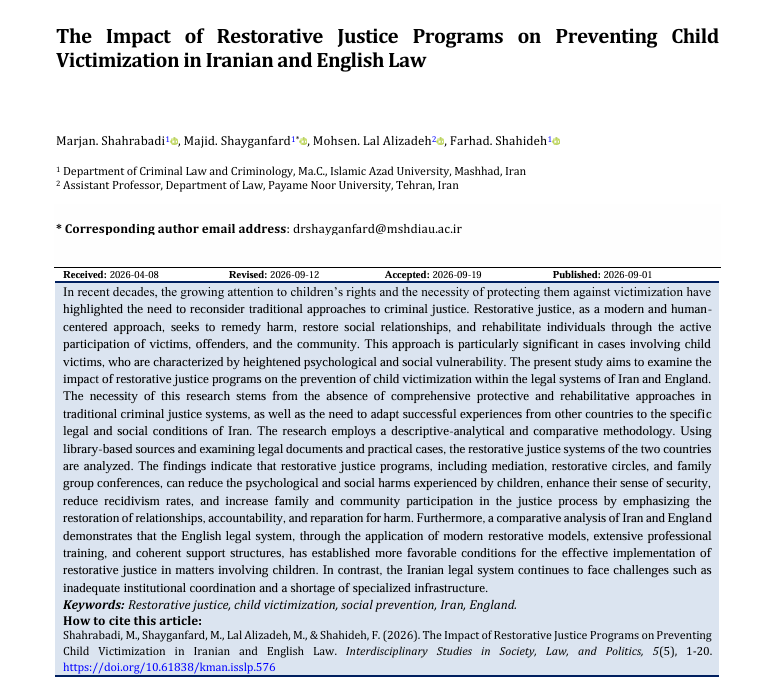
In recent decades, the growing attention to children’s rights and the necessity of protecting them against victimization have highlighted the need to reconsider traditional approaches to criminal justice. Restorative justice, as a modern and human-centered approach, seeks to remedy harm, restore social relationships, and rehabilitate individuals through the active participation of victims, offenders, and the community. This approach is particularly significant in cases involving child victims, who are characterized by heightened psychological and social vulnerability. The present study aims to examine the impact of restorative justice programs on the prevention of child victimization within the legal systems of Iran and England. The necessity of this research stems from the absence of comprehensive protective and rehabilitative approaches in traditional criminal justice systems, as well as the need to adapt successful experiences from other countries to the specific legal and social conditions of Iran. The research employs a descriptive-analytical and comparative methodology. Using library-based sources and examining legal documents and practical cases, the restorative justice systems of the two countries are analyzed. The findings indicate that restorative justice programs, including mediation, restorative circles, and family group conferences, can reduce the psychological and social harms experienced by children, enhance their sense of security, reduce recidivism rates, and increase family and community participation in the justice process by emphasizing the restoration of relationships, accountability, and reparation for harm. Furthermore, a comparative analysis of Iran and England demonstrates that the English legal system, through the application of modern restorative models, extensive professional training, and coherent support structures, has established more favorable conditions for the effective implementation of restorative justice in matters involving children. In contrast, the Iranian legal system continues to face challenges such as inadequate institutional coordination and a shortage of specialized infrastructure.
Downloads
References
Aghayari Kordkandi, M. (2024). Examining the Role of Restorative Justice in Crimes against the Family. Tehran.
Barton, J. (2015). Restorative Justice and Young Offenders. Oxford University Press.
Bazemore, G., & Umbreit, M. (2001). A Comparison of Four Restorative Conferencing Models. https://www.ojp.gov/pdffiles1/ojjdp/184738.pdf
Beigi, J. (2021). Protection of Child Victims in Iranian Law. Mizan Publishing.
Braithwaite, J. (2002). Restorative Justice and Responsive Regulation. Oxford University Press.
Cheraghi Navid, Z. (2016). Challenges and Barriers to the Implementation of Restorative Justice in Iran's Criminal Justice System Shahid Ashrafi Esfahani University].
Fereydouninia, E., & Salehi, A. (2024). Restorative Justice Culture and Crime Prevention.
Gholami, H. (2021). Restorative Justice. SAMT.
Khalilian, M. (2023). Iran's Criminal Policy on Protecting Minors against Sexual Crimes Islamic Azad University, Yazd Branch].
Latimer, J., & Kleinknecht, S. (2000). Restorative Justice: A Canadian Perspective. Canadian Journal of Criminology, 42(3), 293-315.
McCold, P. (2000). Restorative Justice Practice: The State of the Field. Contemporary Justice Review, 3(2), 123-135.
McCold, P. (2003). The Recent History of Restorative Justice: Mediation, Circles, and Conferencing. Restorative Justice, 1(1), 1-12.
Moghaddasi, M. B., & Habibzadeh, M. J. (2006). An Introduction to Criminal Protection of Child Victims in Iranian Law with Reference to International Instruments. Nameh-ye Mofid(55), 57-66.
Najafi Chaleshtari, J. (2022). Examining the Role of the Welfare Organization in Preventing Child Abuse Victimization in Iran Islamic Azad University, Shahrekord Branch].
Rahami, M. (2006). Foundations of Restorative Justice in Iranian Criminal Law. University of Tehran Law Journal(74).
Samavati Pirouz, A. (2017). Restorative Justice. Negah-e Bineh Publications.
Samiei, H., & Naghdi Nejad, M. (2010). Restorative Justice, Shame, and Forgiveness. Crime Prevention Studies Quarterly(16).
Shapland, J., & Atkinson, A. (2007). Multiple Articles on Restorative Justice Evaluation.
Tajari, A. (2012). Restorative Justice and Its Role in Judicial Security Islamic Azad University, Damghan Branch].
Van Ness, D., & Strong, K. H. (2010). Restoring Justice. Anderson Publishing.
Zahnd, E., O'Rourke, P., & Harris, A. (2007). Restorative Justice: A New Approach to Criminal Justice. Criminal Justice Studies, 20(2), 123-137. https://doi.org/10.1080/14786010701312263
Zare, A. (2019). Implementation of the Restorative Justice System in Iranian Military Proceedings and a Comparative Study with English Law Islamic Azad University, Khorasgan Branch].
Downloads
Additional Files
Publication Timeline
- Submitted
- Revised
- Accepted
Issue
Section
License
Copyright (c) 2026 Marjan Shahrabadi (Author); Majid Shayganfard (Corresponding author); Mohsen Lal Alizadeh, Farhad Shahideh (Author)

This work is licensed under a Creative Commons Attribution-NonCommercial 4.0 International License.