Explanation of the Factors Influencing China’s Foreign Policy toward the United States from a Geopsychological Perspective
Keywords:
Geopsychology, China, Middle Kingdom, Strategic Culture, Tianxia SystemAbstract
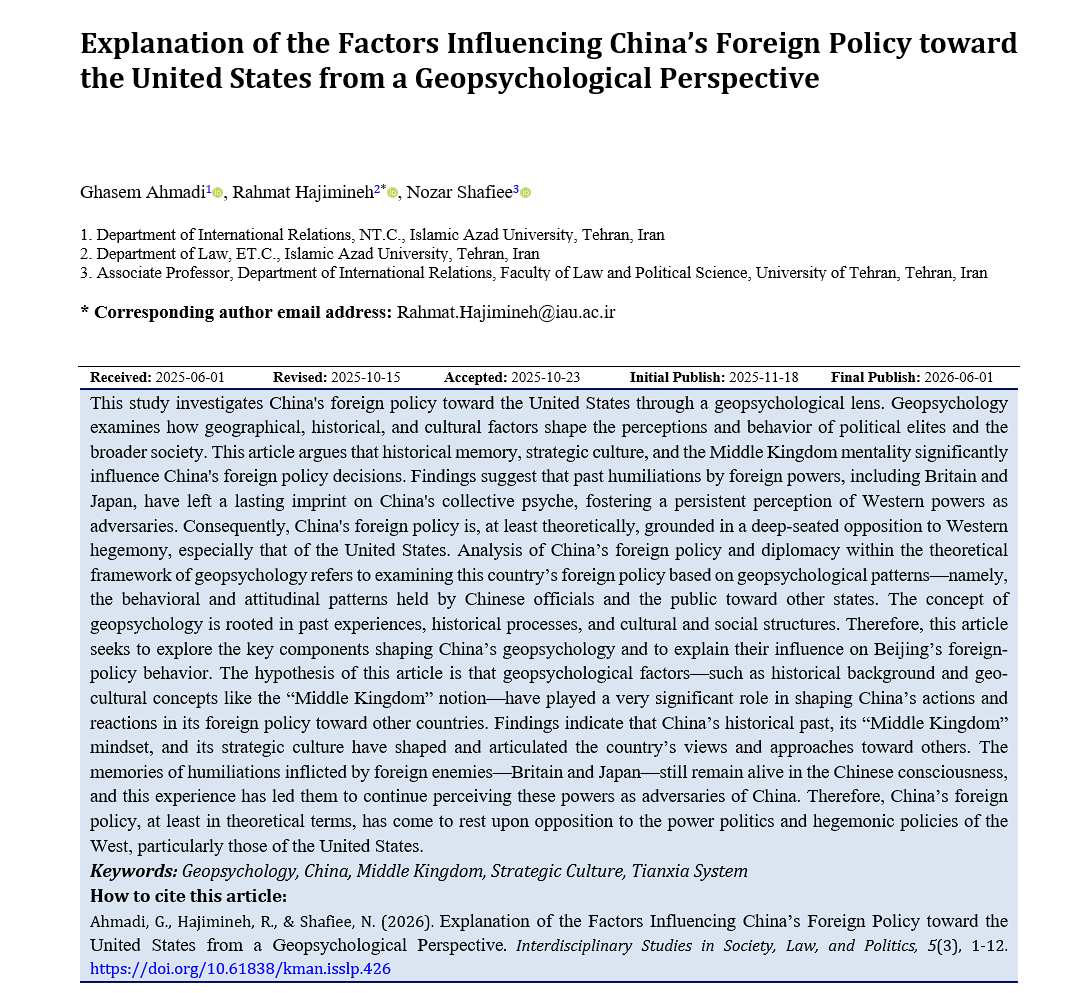
This study investigates China's foreign policy toward the United States through a geopsychological lens. Geopsychology examines how geographical, historical, and cultural factors shape the perceptions and behavior of political elites and the broader society. This article argues that historical memory, strategic culture, and the Middle Kingdom mentality significantly influence China's foreign policy decisions. Findings suggest that past humiliations by foreign powers, including Britain and Japan, have left a lasting imprint on China's collective psyche, fostering a persistent perception of Western powers as adversaries. Consequently, China's foreign policy is, at least theoretically, grounded in a deep-seated opposition to Western hegemony, especially that of the United States. Analysis of China’s foreign policy and diplomacy within the theoretical framework of geopsychology refers to examining this country’s foreign policy based on geopsychological patterns—namely, the behavioral and attitudinal patterns held by Chinese officials and the public toward other states. The concept of geopsychology is rooted in past experiences, historical processes, and cultural and social structures. Therefore, this article seeks to explore the key components shaping China’s geopsychology and to explain their influence on Beijing’s foreign-policy behavior. The hypothesis of this article is that geopsychological factors—such as historical background and geo-cultural concepts like the “Middle Kingdom” notion—have played a very significant role in shaping China’s actions and reactions in its foreign policy toward other countries. Findings indicate that China’s historical past, its “Middle Kingdom” mindset, and its strategic culture have shaped and articulated the country’s views and approaches toward others. The memories of humiliations inflicted by foreign enemies—Britain and Japan—still remain alive in the Chinese consciousness, and this experience has led them to continue perceiving these powers as adversaries of China. Therefore, China’s foreign policy, at least in theoretical terms, has come to rest upon opposition to the
Downloads
References
Alfred, K. (2017). Shape China's Push for Global Power. Alfred Knopf.
Barabantseva, E. (2014). Beyond World Order: Change in China's Negotiation over the World. In A. C. William & B. Elena (Eds.), China Orders the World: Normative Soft Power and Foreign Policy (pp. 188). Woodrow Wilson Press.
Brown, K. (2017). The True Deficit with China is Not With Trade - But Knowledge. https://thediplomat.com/2017/10/the-true-deficitwith-china-is-not-with-trade-but-knowledge
Budryk, Z. (2019). China Ready for Long Economic Battle with US: Communist Party Journal. https://thehill.com/policy/international/ trade/448807-china-ready-for-long-economic-battle-with-us-communist-party
Callahan, W. A. (2008). Chinese Visions of World Order: Post-Hegemonic or a New Hegemony? International Studies Review, 10(4), 749-761.
Callahan, W. A., & Barabantseva, E. (2011). China Orders the World: Normative Soft Power and Foreign Policy. Johns Hopkins University Press.
Ja'fari Valdani, A., & Rahmati Pour, L. (2014). Strategic Culture and China's Behavioral Model in Managing International Crises: A Case Study of the Syrian Crisis. Strategic Policy Research Quarterly, 2(6, 36), 168.
Khodaverdi, H., & Shahmohammadi, Y. (2017). The Role of Culture in International Relations Theories. International Journal of Political Science, 7(3), 94-60.
Kissinger, H. A. (2013). China. Farhang-e Moaser.
Lams, L. (2018). Examining Strategic Narratives in Chinese Official Discourse under Xi Jinping. Journal of Chinese Political Science, 23(3), 387-411. https://doi.org/10.1007/s11366-018-9529-8
Mahnken, T. G. (2011). Secrecy& Stratagem: Understanding Chinese Strategic Culture.
Miller, R. M. (2014). Time to Make Psychology a Part of International Relations. https://nationalinterest.org/feature /time-make-psychology-part-international-relations-11872
Moore, S. (2025). China: A Discussion of the Middle Kingdom, Population, and Industrialization. owlcation.com/humanities/China-A-Discussion-of-the-Middle-Kingdom-Population-and-Industrialization.
Ng, T. (2014). Xi Jinping attacks concept of global hegemony, in dig at United States. https://www.scmp.com/ news/china/article/1542702/xi-jinping-attacks-concept-global-hegemony-dig united-states
Scobell, A. (2020). written testimony for U.S.-China Economic and Security Review Commission, Hearing on U.S.-China Relations in 2020: Enduring Problems and Emerging Challenges.
Snow, E. (1973). China's Long Revolution. Penguin Books Ltd.
Tingyang, Z. (2011). Tianxia System: An Introduction to the Philosophy of World Institutions. Renmin University of China Press.
Wang, Z. (2012). Never Forget National Humiliation: Historical Memory in Chinese Politics and Foreign Relations. Columbia University Press.
Washington, P. (2017). Washington Post Article.
Zhao. (2013). Foreign Policy Implications of Chinese Nationalism Revisited: the Strident Turn. Journal of Contemporary China, 22(82). https://doi.org/10.1080/10670564.2013.766379
Downloads
Additional Files
Publication Timeline
- Submitted
- Revised
- Accepted
Issue
Section
License
Copyright (c) 2026 Ghasem Ahmadi (Author); Rahmat Hajimineh (Corresponding author); Nozar Shafiee (Author)

This work is licensed under a Creative Commons Attribution-NonCommercial 4.0 International License.