Unification of Private International Law Rules
Keywords:
Unification, Legal Rules, Private International LawAbstract
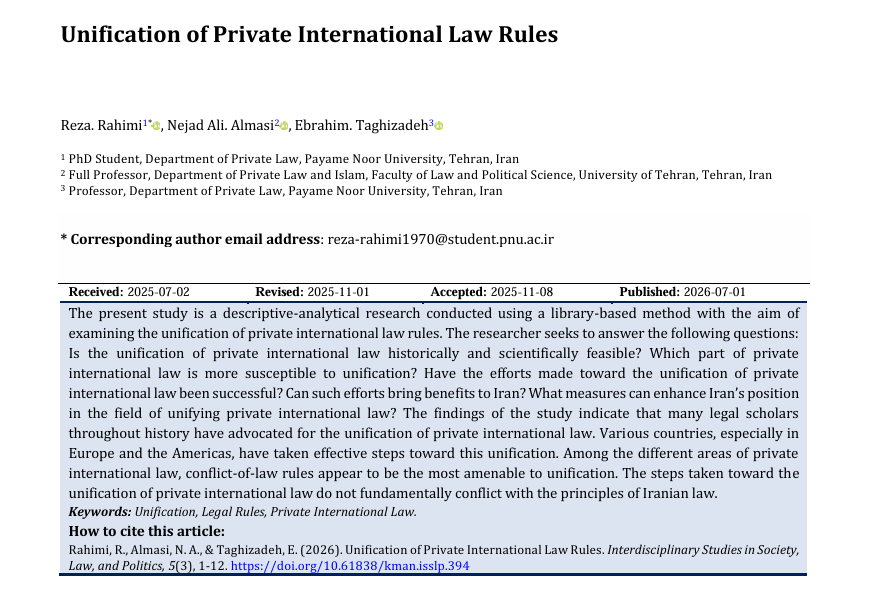
The present study is a descriptive-analytical research conducted using a library-based method with the aim of examining the unification of private international law rules. The researcher seeks to answer the following questions: Is the unification of private international law historically and scientifically feasible? Which part of private international law is more susceptible to unification? Have the efforts made toward the unification of private international law been successful? Can such efforts bring benefits to Iran? What measures can enhance Iran’s position in the field of unifying private international law? The findings of the study indicate that many legal scholars throughout history have advocated for the unification of private international law. Various countries, especially in Europe and the Americas, have taken effective steps toward this unification. Among the different areas of private international law, conflict-of-law rules appear to be the most amenable to unification. The steps taken toward the unification of private international law do not fundamentally conflict with the principles of Iranian law.
Downloads
References
Abbāsi Sarmadi, M., & Ābīd, M. (2017). Iran's Accession to the Hague Conference on Private International Law from the Perspective of Soft Power. Journal of Soft Power Studies(16).
Afzali Mehr, M., & Vahdati Shobeyri, S. H. (2016). The Conceptual Evolution of Criteria for Determining the Governing Law on Contracts in Private International Law. Journal of Comparative Law Research, 20(3).
Ardabīlī, M. A. (2004). International Criminal Law. Mizan Publishing.
Block-Lieb, S., & Halliday, T. (2007). Harmonization and Modernization in UNCITRAL's Legislative Guide onInsolvency Law. Texas International Law Journal, 42, 475.
Červenkovà, L. (2008). Europeanization and Unification of Private International Law. COFOLA 2008 Conference: Key Points and Ideas, Brno.
Dārābpūr, M. (1995). An Interpretation of International Sales Law: The 1980 Vienna Convention (CISG). Ganj-e Danesh Publications.
Farber, J. M. (2004). Justifying Judicial Review: Liberalism andPopular Severity. Capital University Law Review, 32.
Ghavvam, A. (2003). Jahānī Shodan va Jahān-e Sevom: Ravand-e Jahānī Shodan va Mavqe'iyyat-e Javāme' dar Hāl-e Towse'e dar Nezām-e Beyn al-Melal (Globalization and the Third World: The Trend of Globalization and the Position of Developing Societies in the International System). Ministry of Foreign Affairs, Office of Political and International Studies.
Graglia, L. A. (2002). Judicial Review: Wrong in Principle, a Disasterin Practice. Mississippi College Law Review, 21.
Hāshemī, H. (2019). Implementation of International Obligations in the Iranian Judicial System: Limitations and Capacities. Legal Research Journal(5).
Hojjat Zadeh, A., & Nūshādī, I. (2011). The Governing Law on International Electronic Contracts: A Comparative Study. International Law Journal(44).
Jalālī, M., & Shakūrī, M. (2013). The Process of Unification of Contract Law at the International Level. Quarterly Journal of Private Law Research(3).
MacLean, I. (2002). The Oxford Dictionary of Political Science (Translated by H. Ahmadi ed.). Mizan.
Parvin, K., & et al. (2015). The Rule of Article Four of the Constitution over the Generality and Scope of Other Principles, Laws, and Regulations. Hokumat-e Eslami (Islamic Government) Journal, 17(14).
Qāzī, S. A. (2016). Constitutional Law and Political Institutions. Mizan Publishing.
Reich, A. (2005). The WTO as a Law-Harmonizing Institution.
Rūḥānī, H. (2001). Technology, Development Paths, and Its Challenges. Rahbord (Strategy) Journal(19).
Sarfārāzī, M., Khorramī, A., & Behbūdī, M. H. (2014). Jahānī Shodan (Mafāhim, Dīdgāhhā, Ab'ād, Āsār va Payāmadhā) (Globalization: Concepts, Perspectives, Dimensions, Effects, and Consequences). National Center for Globalization Studies.
Shāpīrā, J. (1992). International Commercial Law (Translated by Dr. Rabī'ā Eskīnī ed.). Enqelāb-e Eslāmī Publications and Education.
Shīrvī, A. H. (2008). Comparative Law. SAMT (Organization for Studying and Compiling University Humanities Books).
Sūfī Zomorrod, M. (2015). How Iran's Criminal Law is Influenced by the International Legal System. Scientific-Promotional Quarterly of International Police Studies, 6(25).
Vālī Nezhād, M. (2003). The First Challenges of the Third Millennium: Sustainable Development and Globalization. Political-Economic Information(187-188).
Zamboni, M. (2007). Globalization and Law-Making: Time to Shift a Legal Theory's Paradigm. Legisprudence, I(1). https://doi.org/10.1080/17521467.2007.11424662
Downloads
Additional Files
Publication Timeline
- Submitted
- Revised
- Accepted
Issue
Section
License
Copyright (c) 2026 Reza Rahimi (Corresponding author); Nejad Ali Almasi, Ebrahim Taghizadeh (Author)

This work is licensed under a Creative Commons Attribution-NonCommercial 4.0 International License.