A Comparative Analysis of Iranian Criminal Policy and English Criminal Policy (in the Narrow Sense) Regarding Sexual Violence in Cyberspace
Keywords:
criminal policy, sexual violence, cyberspace, criminalization, sentencingAbstract
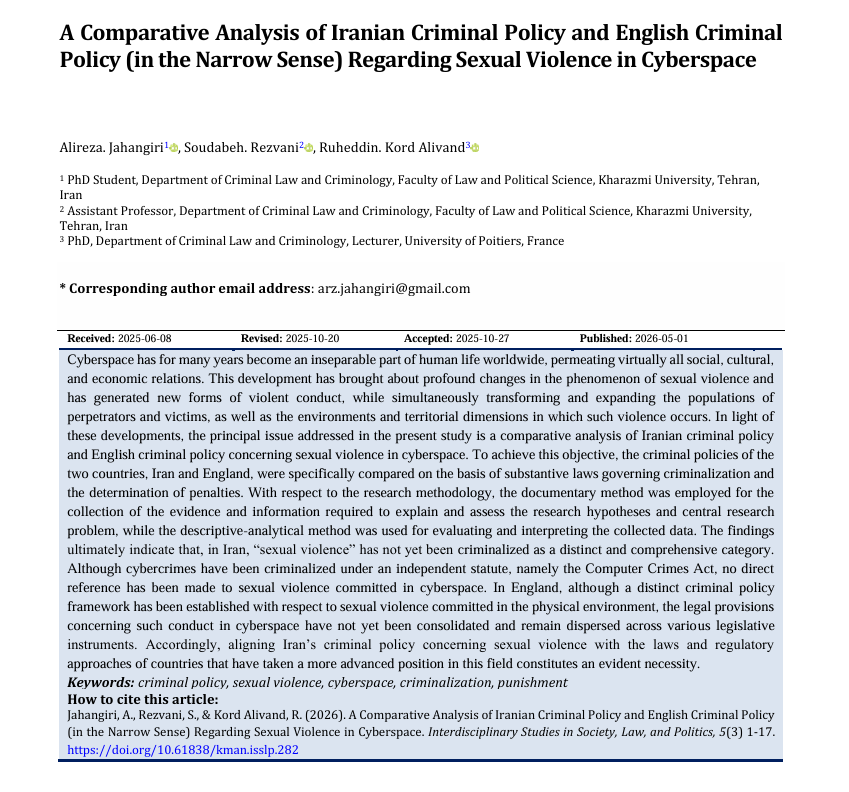
Cyberspace has for many years become an inseparable part of human life worldwide, permeating virtually all social, cultural, and economic relations. This development has brought about profound changes in the phenomenon of sexual violence and has generated new forms of violent conduct, while simultaneously transforming and expanding the populations of perpetrators and victims, as well as the environments and territorial dimensions in which such violence occurs. In light of these developments, the principal issue addressed in the present study is a comparative analysis of Iranian criminal policy and English criminal policy concerning sexual violence in cyberspace. To achieve this objective, the criminal policies of the two countries, Iran and England, were specifically compared on the basis of substantive laws governing criminalization and the determination of penalties. With respect to the research methodology, the documentary method was employed for the collection of the evidence and information required to explain and assess the research hypotheses and central research problem, while the descriptive-analytical method was used for evaluating and interpreting the collected data. The findings ultimately indicate that, in Iran, “sexual violence” has not yet been criminalized as a distinct and comprehensive category. Although cybercrimes have been criminalized under an independent statute, namely the Computer Crimes Act, no direct reference has been made to sexual violence committed in cyberspace. In England, although a distinct criminal policy framework has been established with respect to sexual violence committed in the physical environment, the legal provisions concerning such conduct in cyberspace have not yet been consolidated and remain dispersed across various legislative instruments. Accordingly, aligning Iran’s criminal policy concerning sexual violence with the laws and regulatory approaches of countries that have taken a more advanced position in this field constitutes an evident necessity.
Downloads
References
Aghababaei, H. (2005). Jurisprudential Discourse and Criminalization in Crimes against the Security of the Nation and the State. Fiqh and Law(5).
Akrami, R. (2016). The Element of Coercion in Zina from the Perspective of Islamic Jurisprudence and Iranian and English Criminal Law. Comparative Research on Islamic and Western Law, 3(1).
Allen, M. (2007). Criminal Law. Oxford University Press.
Angelies, G. (2004). Cybercrimes. Supreme Council for Judicial Development; Secretariat of the Supreme Council of Information.
Atashneh, M. (2012). Examining the Causes, Factors, and Effects of Sexual Crimes against Women from the Perspective of Iranian Criminal Law. Woman and Culture, 3(11).
Beigi, J. (2019). Criminalization of Sexual Violence in Marital Relationships with Emphasis on International Human Rights Instruments. International Studies, 16(2).
Choon, H., & Sheridan, L. (2017). Is this stalking? Perceptions of stalking behavior among young male and female adults in Hong Kong and mainland China. Journal of interpersonal violence.
Danesh Nari, H. R. (2018). Social Networks as a Tool for Committing Crime. Mizan Publishing.
De la Cerna, M. (2012). Sextortion.
Elliott, C. (2014). Criminal Law. Pearson Education Limited.
Evans, R. (2015). 5 Things I Learned Infiltrating Deep Web Child Molesters.
Fattahian, M. (2017). An Examination of the Global Causes of Increasing Cyber Violence against Women. Ghanoonyar, 3.
Ghani, M. (2022). An Examination of Adult Victimization by Digital Sexual Harassment with Attention to Transgender Individuals. Criminal Law Research, 13(1).
Gharghi, J. (2021). Criteria for Distinguishing Substantive from Procedural Laws in Terms of Objectives, Characteristics, and Functions in Iranian Criminal Law. Comparative Criminal Jurisprudence, 1(4).
Gholamloo, J. (2020). A Comparative Study in Iranian and United States Criminal Law. Criminal law and Criminology Studies, 50(2).
Hajizadeh Abadi, M. A. (2018). Etiology of Women’s Victimization on Social Networks: A Case Study of Facebook. Woman and Society, 9(3).
Hematpour, B. (2017). Identifying and Sociologically Explaining Violence against Women in Cyberspace: A Case Study of Women Aged 20–45 in Tehran. Women’s Research, 8(4).
Hirtenlehner, H., Starzer, B., & Weber, C. (2012). A differential phenomenology of stalking. International Review of Victimology, 18.
Hosseini Akbarnejad, H. (2020). Criminal Protection of Children against Online Abuse in Iranian and English Law and International Instruments. Legal Research(44).
Hosseini, S. A. (2023). Assessing the Need to Criminalize Cyberbullying in Iranian and American Criminal Law. Comparative Law, 10(1).
Jahbin, Z. (2018). Factors Affecting the Commission of Crime in Cyberspace from the Perspective of Judges of the Tehran Computer Crimes Prosecutor’s Office. Intelligence and Criminal Research, 13(3).
Jaishankar, K. (2015). Cyber Criminology. Amin Police University Press.
Jefferson, M. (2013). Criminal Law. Pearson Education Limited.
Joseph, Y. E. D. (2006). The One who is More Violent Prevails: Law and Violence from a Talmudic Legal Perspective. Canadian Journal of Law and Jurisprudence, 19(2).
Kazemi Sanjabi, B. (2017). Computer and Cyber Crimes. Ghanoonyar Publications.
Kessel, E., & Bernstein, D. A. (2003). Criminal Behavior. NAJA Research Center.
Mahmoudzadeh, S. (2012). A Sociological Study of Individuals’ Motives and the Types of Crimes Committed on the Facebook Social Network Alzahra University, Faculty of Economics and Accounting].
McKim, J. (2006). Pimp pleads Guilty to Prostituting minor. http://www.ocregister.com/ocregister/news/atoz/article_1209170.phd
Mirmohammad Sadeghi, H. (2009). A Comparative Study of the Concept of Coercion in Sexual Crimes. Dadresi(76).
Motamedi Mehr, M. (2001). Protection of Women against Violent Crimes: England’s Criminal Policy. Barg-e Zeytoon.
News, B. B. C. (2016a). The Skype sex scam - a fortune built on shame.
News, B. B. C. (2016b). Webcam blackmail cases have doubled, police say.
Niknejad, A. (2024). Sexual Violence against Women in Iranian and English Criminal Law. Teachings of Jurisprudence and Criminal Law, 3(2).
Petz, S. (2022). Teen boys make up majority of victims of recently reported sextortion crimes, new data shows.
Razavi Fard, B. (2016). Criminal Liability in Cyberspace under Iranian Law. Criminal Law Research, 5(16).
Roustaei, M. (2015). A Comparative Study of the Harm Principle and the No-Harm Rule in Justifying Criminal Intervention. Comparative Law Research, 19(2).
Salehi, S. H. (2018). A Jurisprudential and Legal Examination of Surveillance and Its Exceptions. Jurisprudential Foundations of Islamic Law(21).
Shadmani, M. (2015). Examining the Challenges Facing Women in Cyberspace. Studies on the Protection of Women’s Rights(2).
Wall, D. (2001). Crime and the Internet. Routledge.
Wilson, W. (2011). Criminal Law: Doctrine and Theory. Pearson Education Limited.
Downloads
Additional Files
Publication Timeline
- Submitted
- Revised
- Accepted
Issue
Section
License
Copyright (c) 2026 Alireza Jahangiri, Soudabeh Rezvani, Ruheddin Kord Alivand (Author)

This work is licensed under a Creative Commons Attribution-NonCommercial 4.0 International License.