Examining the Core Elements of Popper's Falsifiability Perspective and Their Compatibility
DOI:
https://doi.org/10.61838/kman.isslp.4.1.11Keywords:
falsifiability, Popper, correspondence theory, conjectureAbstract
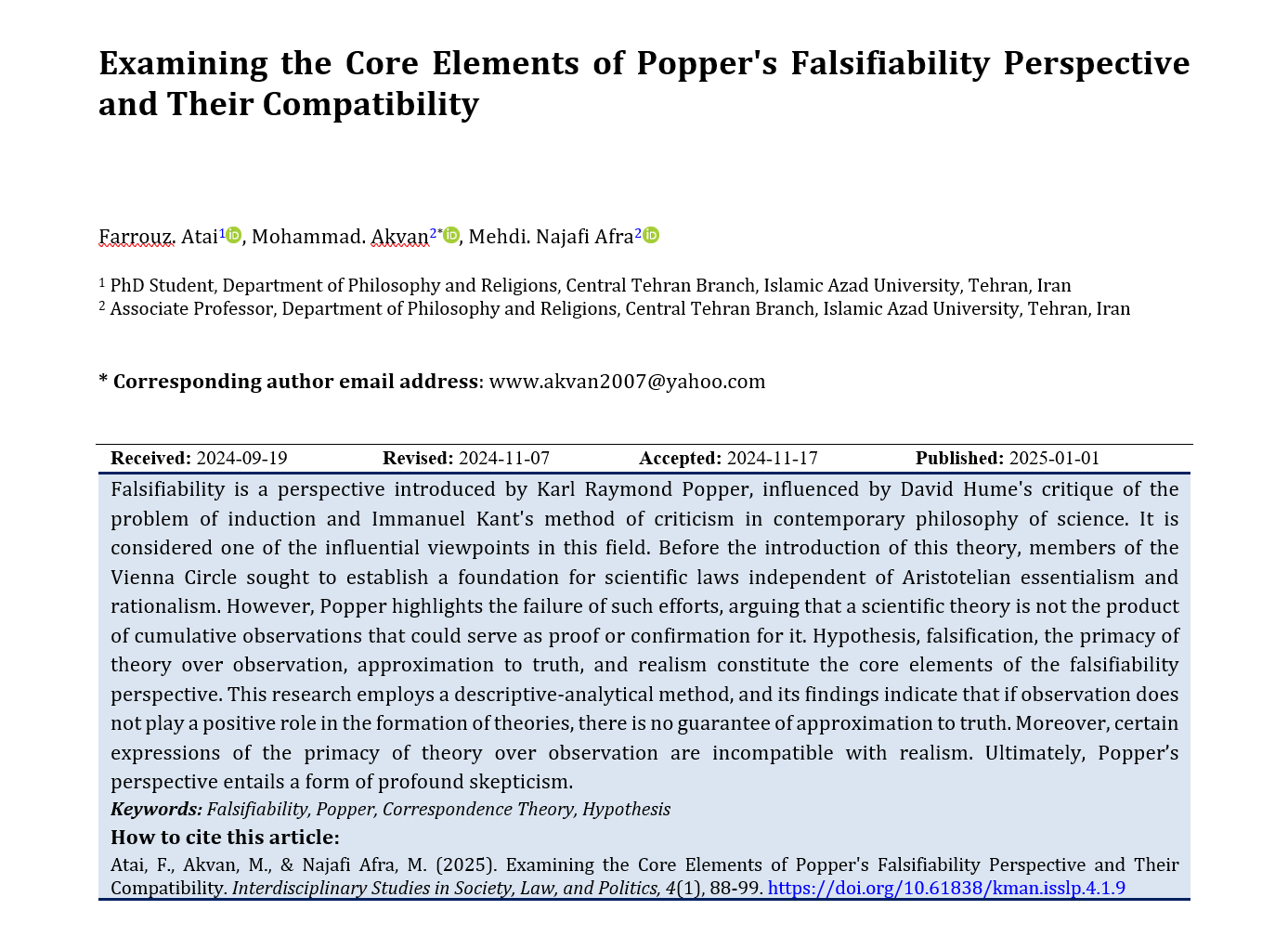
Falsifiability is a perspective introduced by Karl Raymond Popper, influenced by David Hume's critique of the problem of induction and Immanuel Kant's method of criticism in contemporary philosophy of science. It is considered one of the influential viewpoints in this field. Before the introduction of this theory, members of the Vienna Circle sought to establish a foundation for scientific laws independent of Aristotelian essentialism and rationalism. However, Popper highlights the failure of such efforts, arguing that a scientific theory is not the product of cumulative observations that could serve as proof or confirmation for it. Hypothesis, falsification, the primacy of theory over observation, approximation to truth, and realism constitute the core elements of the falsifiability perspective. This research employs a descriptive-analytical method, and its findings indicate that if observation does not play a positive role in the formation of theories, there is no guarantee of approximation to truth. Moreover, certain expressions of the primacy of theory over observation are incompatible with realism. Ultimately, Popper’s perspective entails a form of profound skepticism.
Downloads
Downloads
Additional Files
Publication Timeline
- Submitted
- Revised
- Accepted