Pathology of the Structural and Institutional Barriers to Converting Cultural Diplomacy Capacities into Sustainable Economic Presence: A Qualitative Study of Iran–Pakistan Relations
Keywords:
cultural diplomacy, structural barriers, institutional barriers, institutional trust, transaction costs, Iran–Pakistan economic relations, qualitative analysisAbstract
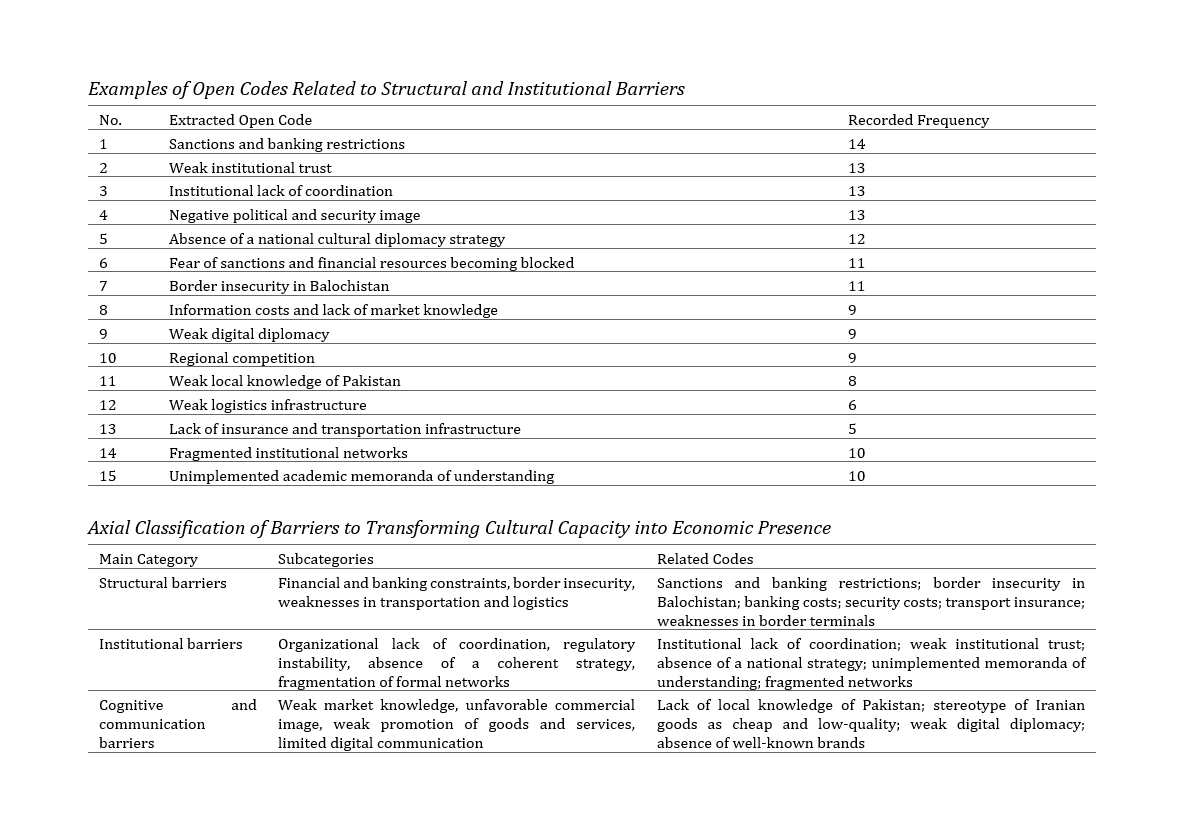
The existence of historical, civilizational, linguistic, and religious commonalities between countries does not necessarily lead to the formation of extensive and sustainable economic relations. Transforming cultural capacities into economic outcomes, in addition to the existence of social and communicative foundations, depends on institutional, infrastructural, financial, and security conditions. In Iran–Pakistan relations, despite the two countries’ numerous grounds for cultural convergence, the level of Iran’s economic presence is not fully commensurate with the potential capacities of this relationship. The main problem addressed in the present study is the identification and explanation of the barriers that constrain the process of transforming cultural diplomacy capacities into sustainable economic cooperation and presence. In terms of purpose, this research is applied, and in terms of methodology, it is qualitative and based on the reanalysis of interview data. The data were obtained from 16 semi-structured interviews with three groups of experts, including diplomats and cultural practitioners, businesspeople and economic actors, and university professors and academic researchers. The data were analyzed using open, axial, and selective coding, together with the construction of a thematic network. At the open-coding stage, 187 initial codes were extracted, and after eliminating overlaps and integrating similar concepts, 62 final codes were identified. The reanalysis of the data indicates that the barriers to transforming cultural capacity into economic presence can be explained at three interconnected levels: structural barriers, including banking and financial constraints, border insecurity, and weaknesses in transportation and logistics infrastructure; institutional barriers, including a lack of coordination among responsible organizations, regulatory instability, the absence of a long-term strategy, and disconnection between cultural and economic institutions; and cognitive and communicative barriers, including inadequate market knowledge, an unfavorable commercial image, a shortage of active elite networks, and limited use of digital capacities. The central finding of the study indicates that interpersonal trust among Iranian and Pakistani actors is more favorable than institutional trust, and that cultural diplomacy can reduce informational and communication costs; however, it cannot independently eliminate banking, security, and infrastructural costs. Accordingly, cultural diplomacy constitutes a necessary and facilitating condition for the development of economic relations, but its effectiveness depends on the removal of structural barriers and the establishment of institutional coordination.
Downloads
References
Ang, I., Isar, Y. R., & Mar, P. (2015). Cultural diplomacy: Beyond the national interest? International Journal of Cultural Policy, 21(4), 365-381. https://doi.org/10.1080/10286632.2015.1042474
Bourdieu, P. (1986). The forms of capital. In J. G. Richardson (Ed.), Handbook of theory and research for the sociology of education (pp. 241-258). Greenwood Press.
Coleman, J. S. (1988). Social capital in the creation of human capital. American Journal of Sociology, 94, S95-S120. https://doi.org/10.1086/228943
Creswell, J. W., & Plano Clark, V. L. (2018). Designing and conducting mixed methods research (3rd ed.). SAGE Publications.
Cull, N. J. (2019). Public diplomacy: Foundations for global engagement in the digital age. Polity Press.
Faucher, C., & Zhu, B. (2025). Towards a sustainable cultural diplomacy. International Journal of Cultural Policy, 923-938. https://doi.org/10.1080/10286632.2025.2470826
Franco, C., & Maggioni, D. (2022). Does international trade favor proximity in cultural beliefs? Eurasian Economic Review, 12, 449-477. https://doi.org/10.1007/s40822-022-00212-w
Ghaith, Z., & Wagner, D. (2025). The impact of cultural factors on international trade: An empirical analysis. International Economics and Economic Policy, 22, 45. https://doi.org/10.1007/s10368-025-00670-y
Granovetter, M. (1985). Economic action and social structure: The problem of embeddedness. American Journal of Sociology, 91(3), 481-510. https://doi.org/10.1086/228311
Grincheva, N. (2024). The past and future of cultural diplomacy. International Journal of Cultural Policy, 30(2), 172-191. https://doi.org/10.1080/10286632.2023.2183949
Guiso, L., Sapienza, P., & Zingales, L. (2009). Cultural biases in economic exchange? The Quarterly Journal of Economics, 124(3), 1095-1131. https://doi.org/10.1162/qjec.2009.124.3.1095
Karim, U. (2023). The Pakistan–Iran relationship and the changing nature of regional and domestic security and strategic interests. Journal of Political Power. https://doi.org/10.1332/204378921X16585144068826
Lien, D., Lo, M., & Bojanic, D. (2019). Asymmetric effects of cultural institutes on trade and foreign direct investment. The World Economy, 42(5), 1520-1553. https://doi.org/10.1111/twec.12751
Lincoln, Y. S., & Guba, E. G. (1985). Naturalistic inquiry. SAGE Publications.
North, D. C. (1990). Institutions, institutional change and economic performance. Cambridge University Press.
Saavedra, L., & Spilde, T. (2026). Cultural proximity and bilateral trade costs. Review of International Economics, 34(4), 859-876. https://doi.org/10.1111/roie.70055
Williamson, O. E. (1985). The economic institutions of capitalism: Firms, markets, relational contracting. Free Press.
Downloads
Additional Files
Publication Timeline
- Submitted
- Revised
- Accepted
Issue
Section
License
Copyright (c) 2025 Ali Alidousti (Author); Mansour Sharifi (Corresponding author); Habibollah Karimian (Author)

This work is licensed under a Creative Commons Attribution-NonCommercial 4.0 International License.