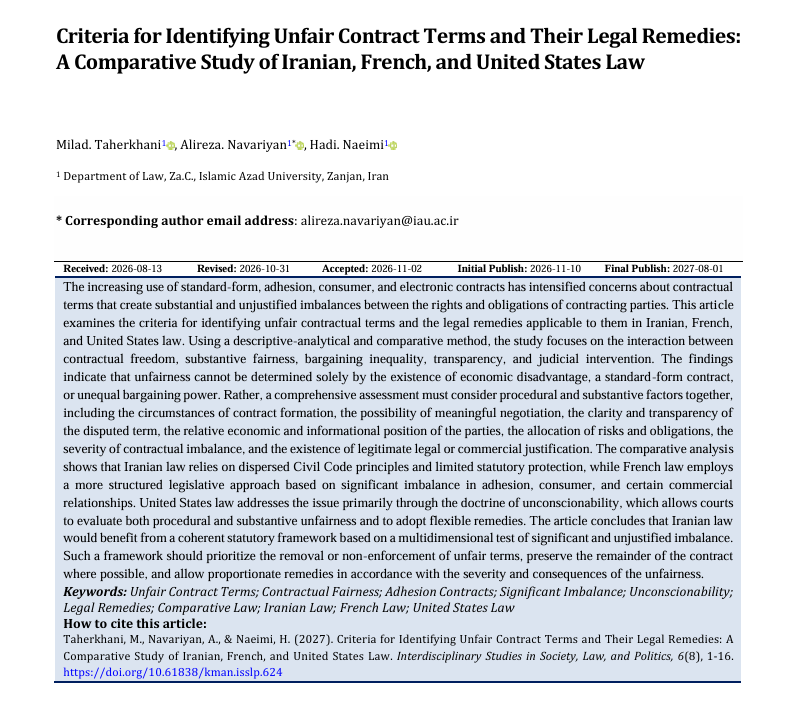
Criteria for Identifying Unfair Contract Terms and Their Legal Remedies: A Comparative Study of Iranian, French, and United States Law
Keywords:
Unfair Contract Terms, Contractual Fairness, Adhesion Contracts, Significant Imbalance, Unconscionability, Legal Remedies, Comparative Law, Iranian Law, French Law, United States LawAbstract
The increasing use of standard-form, adhesion, consumer, and electronic contracts has intensified concerns about contractual terms that create substantial and unjustified imbalances between the rights and obligations of contracting parties. This article examines the criteria for identifying unfair contractual terms and the legal remedies applicable to them in Iranian, French, and United States law. Using a descriptive-analytical and comparative method, the study focuses on the interaction between contractual freedom, substantive fairness, bargaining inequality, transparency, and judicial intervention. The findings indicate that unfairness cannot be determined solely by the existence of economic disadvantage, a standard-form contract, or unequal bargaining power. Rather, a comprehensive assessment must consider procedural and substantive factors together, including the circumstances of contract formation, the possibility of meaningful negotiation, the clarity and transparency of the disputed term, the relative economic and informational position of the parties, the allocation of risks and obligations, the severity of contractual imbalance, and the existence of legitimate legal or commercial justification. The comparative analysis shows that Iranian law relies on dispersed Civil Code principles and limited statutory protection, while French law employs a more structured legislative approach based on significant imbalance in adhesion, consumer, and certain commercial relationships. United States law addresses the issue primarily through the doctrine of unconscionability, which allows courts to evaluate both procedural and substantive unfairness and to adopt flexible remedies. The article concludes that Iranian law would benefit from a coherent statutory framework based on a multidimensional test of significant and unjustified imbalance. Such a framework should prioritize the removal or non-enforcement of unfair terms, preserve the remainder of the contract where possible, and allow proportionate remedies in accordance with the severity and consequences of the unfairness.
Downloads
References
Abhari, H., & Fallah Khariki, M. (2020). Unfair Terms in Electronic Commercial Contracts in Iranian and European Law. Comparative Law Research Quarterly, 4(1), 9-34.
Ahmadzadeh Bazzaz, S. A., Rezaei Davani, M., & Ghabouli Darafshan, S. M. S. (2018). The Concept and Status of Unfair Terms in European Law and Iranian Statutory Law: An Approach to Justice and Equity in Imami Jurisprudence. Comparative Research on Islamic and Western Law, 5(3).
Farnsworth, E. A. (2004). Contracts (4th ed.). Aspen Publishers.
Katouzian, N. (2018). General Rules of Contracts (12th ed., Vol. 1). Mizan.
Safaei, S. H. (2021). Civil Law: General Rules of Contracts (7th ed.). Mizan.
Safaei, S. H., & Shomali, N. (2019). A Comparative Study of Remedies for Unfair Contract Terms in Iran, the United States, and the European Union. Legal Research(86).
Schwartz, A. (1973). A Reexamination of Unconscionability. Yale Law Journal, 82.
Shamsollahi, M. (2021). Unfair Terms in Commercial Contracts: A Comparative Study of French Law. Comparative Law (Nameh Mofid), 8(2), 209-236.
Downloads
Additional Files
Publication Timeline
- Submitted
- Revised
- Accepted
Issue
Section
License
Copyright (c) 2025 Milad Taherkhani (Author); Alireza Navariyan (Corresponding author); Hadi Naeimi (Author)

This work is licensed under a Creative Commons Attribution-NonCommercial 4.0 International License.