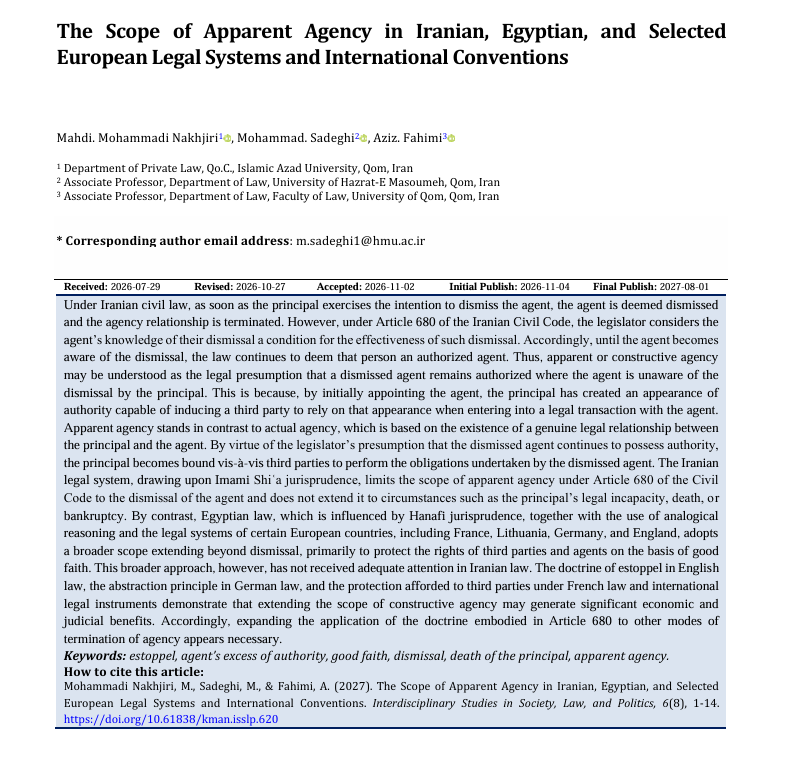
The Scope of Apparent Agency in Iranian, Egyptian, and Selected European Legal Systems and International Conventions
Keywords:
estoppel, agent’s excess of authority, good faith, dismissal, death of the principal, apparent agencyAbstract
Under Iranian civil law, as soon as the principal exercises the intention to dismiss the agent, the agent is deemed dismissed and the agency relationship is terminated. However, under Article 680 of the Iranian Civil Code, the legislator considers the agent’s knowledge of their dismissal a condition for the effectiveness of such dismissal. Accordingly, until the agent becomes aware of the dismissal, the law continues to deem that person an authorized agent. Thus, apparent or constructive agency may be understood as the legal presumption that a dismissed agent remains authorized where the agent is unaware of the dismissal by the principal. This is because, by initially appointing the agent, the principal has created an appearance of authority capable of inducing a third party to rely on that appearance when entering into a legal transaction with the agent. Apparent agency stands in contrast to actual agency, which is based on the existence of a genuine legal relationship between the principal and the agent. By virtue of the legislator’s presumption that the dismissed agent continues to possess authority, the principal becomes bound vis-à-vis third parties to perform the obligations undertaken by the dismissed agent. The Iranian legal system, drawing upon Imami Shiʿa jurisprudence, limits the scope of apparent agency under Article 680 of the Civil Code to the dismissal of the agent and does not extend it to circumstances such as the principal’s legal incapacity, death, or bankruptcy. By contrast, Egyptian law, which is influenced by Hanafi jurisprudence, together with the use of analogical reasoning and the legal systems of certain European countries, including France, Lithuania, Germany, and England, adopts a broader scope extending beyond dismissal, primarily to protect the rights of third parties and agents on the basis of good faith. This broader approach, however, has not received adequate attention in Iranian law. The doctrine of estoppel in English law, the abstraction principle in German law, and the protection afforded to third parties under French law and international legal instruments demonstrate that extending the scope of constructive agency may generate significant economic and judicial benefits. Accordingly, expanding the application of the doctrine embodied in Article 680 to other modes of termination of agency appears necessary.
Downloads
References
Abdipour, E., & Parhizgar, A. (2019). The Theory of Reliance and Its Effect on the Rules Governing Representation: A Comparative Study of Iranian and European Law. Jurisprudence and Islamic Law, 9(17), 101-122.
Ahmadi Sajadi, S. A. (1998). The Legal Nature of Commercial Representatives and Its Instances in Iranian Law. Journal of Qom Higher Education Complex(1), 73-96.
Al-Amili al-Juba'i, Z. a.-D. i. A. i. A. (2006). Al-Rawda al-Bahiyya fi Sharh al-Lum'a al-Dimashqiyya. Majd.
Al-Muhaqqiq al-Hilli, A. a.-Q. N. a.-D. J. i. H. i. Y. i. S. i. a.-H. (1998). Al-Mukhtasar al-Nafi' fi Fiqh al-Imamiyya (Vol. 1).
Al-Najafi, M. H. (1988). Jawahir al-Kalam fi Sharh Shara'i al-Islam (3 ed., Vol. 23 and 27). Dar al-Kutub al-Islamiyya.
Al-Sanhuri, A. a.-R. A. (1997). Work Translated by Hossein Ali Hosseini Nejad. (1 ed.). Tehran: Hoghooghdan.
Al-Sanhuri, A. a.-R. A. (2000). A Comparative Study of Apparent Authority with Emphasis on the Principles of European Contract Law. Legal Research Journal(62).
Amini, M., & Abdi, M. (2015). A Comparative Study of the Doctrine of Apparent Authority. Judiciary Law Journal(88).
Amirmohammadi, M. R. (2009). The Effect of Government Managers Exceeding the Limits of Their Authority in Concluding Contracts. Law Quarterly, Faculty of Law and Political Science, 38(6), 25-35.
Ansari, A. (2009). The Theory of Good Faith in Contracts. Jangal Publications.
Bonell, M. J. (1984). The Geneva Convention on Agency in the International Sale of Goods. Oxford University Press.
Busch, D., & Macgregor, J. (2002). The Unauthorised Agent: Perspectives from European and Comparative Law.
Eidi, S. (2015). A Comparative Study of Apparent Agency in Iranian and Egyptian Law
Furmston, M. (2001). Principles of Commercial Law (2 ed.). Cavendish Publishing Limited.
Ghasemzadeh, S. M. (2004). Principles of Contracts and Obligations (1 ed.). Dadgostar.
Haeri Shahbagh, S. A. (1997). Commentary on the Civil Code (1 ed., Vol. 2). Ganj-e Danesh.
Hajipour, M. (2009). A Comparative Study of the Principle of Good Faith in Contracts
Hatami, A. A., & Shanivar, G. (2017). The Theory of Implied Agency in Islamic Jurisprudence, Iranian Law, and the Law of Certain European Countries. Legal Studies Journal, Shiraz University, 9(3).
Hosseini Ameli, S. M. J. (1999). Miftah al-Karama fi Sharh Qawa'id al-Allama (1 ed., Vol. 7). Islamic Publishing Office affiliated with the Society of Seminary Teachers of Qom.
Hosseini Nejad, H. A. (1997). Contract of Agency (1 ed.). Hoghough Publications.
Inanlou, M., & Mirshakari, A. (2010). Revocation of the Agent. Islamic Law Research Quarterly(30), 53-86.
Jafari Langroudi, M. J. (2003). Legal Terminology (13 ed.). Ganj-e Danesh.
Katouzian, N. (1997). Specific Contracts: Permissive Contracts and Security Interests (2 ed.). Enteshar Joint Stock Company in cooperation with Borna and Modarres Publications.
Katouzian, N. (2008a). Civil Law: Unilateral Legal Acts (4 ed.). Mizan.
Katouzian, N. (2008b). Introductory Course in Civil Law: Legal Events (13 ed.). Enteshar Joint Stock Company.
Katouzian, N. (2010). Specific Contracts, Civil Law (Vol. 4). Enteshar Joint Stock Company in cooperation with Bahman Borna.
Khomeini, R. Tahrir al-Wasila (Vol. 2). Dar al-Ilm Press Institute.
Kilmas, T. (2001). New Agency Rules in Lithuania: Translation and Commentary. Teises Apzvalga(5).
Mafi, H., & Kadivar, H. (2014). A Study of the Representative's Apparent Authority in Iranian Law and International Instruments. Private Law Journal(24).
Mann, R. A., & Roberts, B. S. (2010). Essentials of Business Law (10 ed.).
Markesinis, B. (2006). The German Law of Contract (1 ed.). Hart Publishing.
Masoudi Tafrashi, B. (2008). Apparent Agency in European Law and International Trade. Bar Association Journal(200-201), 136-142.
Mousavi, S. M., & Asgari, S. H. (2020). Effects of Representation toward Third Parties in the International Sale of Goods: The 1983 Geneva Convention Compared with Contractual Representation in Iranian Law.
Naghibi, S. A. (2013). The Status of Good Faith in the Contract of Agency. Civil Law Knowledge, 2(1).
Rasmusen, E. (2001). Agency Law and Contract Formation.
Rezapur, H., & Karimi, G. (2015). A Study of Instant Registration of Documents and Transactions in Notary Public Offices Third International Conference on Jurisprudence, Law of Advocacy, and Social Sciences,
Shams, A. (2002). Civil Procedure (Vol. 1). Mizan.
Smits, J. M. (2006). Elgar Encyclopedia of Comparative Law. Edward Elgar Publishing.
Stone, R. (2002). The Modern Law of Contract (5 ed.). Cavendish Publishing Limited.
Turely, I. (2001). Principles of Commercial Law. Cavendish.
Vahedi, J. (1999). Translation of the Swiss Code of Obligations. Mizan.
Downloads
Additional Files
Publication Timeline
- Submitted
- Revised
- Accepted
Issue
Section
License
Copyright (c) 2025 Mahdi Mohammadi Nakhjiri, Mohammad Sadeghi, Aziz Fahimi (Author)

This work is licensed under a Creative Commons Attribution-NonCommercial 4.0 International License.