The Impact of Climate Change on Property Rights and Civil Liability
Keywords:
climate change, property rights, function, oriented property, regulatory taking, civil liability, causation, proportionate liability, environmental damageAbstract
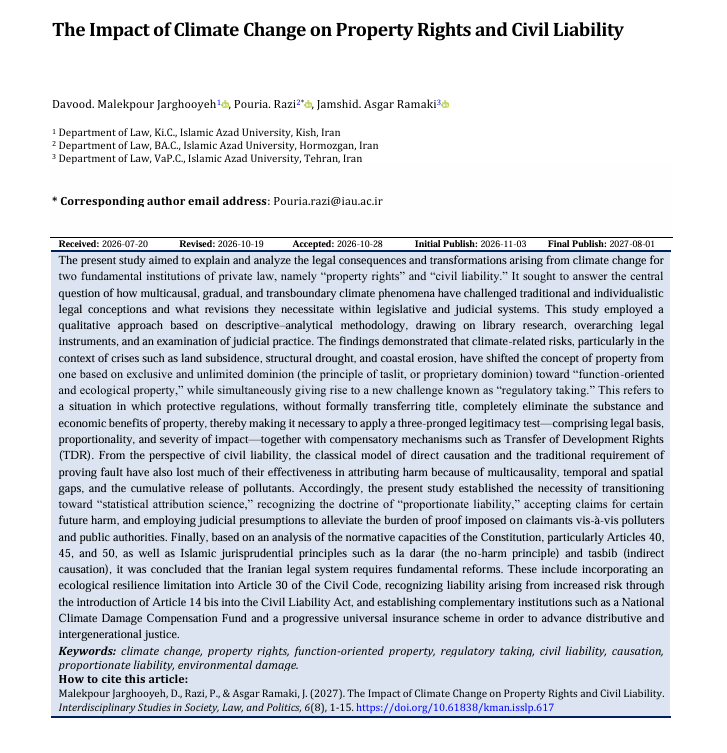
The present study aimed to explain and analyze the legal consequences and transformations arising from climate change for two fundamental institutions of private law, namely “property rights” and “civil liability.” It sought to answer the central question of how multicausal, gradual, and transboundary climate phenomena have challenged traditional and individualistic legal conceptions and what revisions they necessitate within legislative and judicial systems. This study employed a qualitative approach based on descriptive–analytical methodology, drawing on library research, overarching legal instruments, and an examination of judicial practice. The findings demonstrated that climate-related risks, particularly in the context of crises such as land subsidence, structural drought, and coastal erosion, have shifted the concept of property from one based on exclusive and unlimited dominion (the principle of taslit, or proprietary dominion) toward “function-oriented and ecological property,” while simultaneously giving rise to a new challenge known as “regulatory taking.” This refers to a situation in which protective regulations, without formally transferring title, completely eliminate the substance and economic benefits of property, thereby making it necessary to apply a three-pronged legitimacy test—comprising legal basis, proportionality, and severity of impact—together with compensatory mechanisms such as Transfer of Development Rights (TDR). From the perspective of civil liability, the classical model of direct causation and the traditional requirement of proving fault have also lost much of their effectiveness in attributing harm because of multicausality, temporal and spatial gaps, and the cumulative release of pollutants. Accordingly, the present study established the necessity of transitioning toward “statistical attribution science,” recognizing the doctrine of “proportionate liability,” accepting claims for certain future harm, and employing judicial presumptions to alleviate the burden of proof imposed on claimants vis-à-vis polluters and public authorities. Finally, based on an analysis of the normative capacities of the Constitution, particularly Articles 40, 45, and 50, as well as Islamic jurisprudential principles such as la darar (the no-harm principle) and tasbib (indirect causation), it was concluded that the Iranian legal system requires fundamental reforms. These include incorporating an ecological resilience limitation into Article 30 of the Civil Code, recognizing liability arising from increased risk through the introduction of Article 14 bis into the Civil Liability Act, and establishing complementary institutions such as a National Climate Damage Compensation Fund and a progressive universal insurance scheme in order to advance distributive and intergenerational justice.
Downloads
References
Amini, A., Mianabadi, H., & Naddaf, N. (2018). The Role of Diplomacy in the Paris Climate Agreement. Geopolitics Quarterly, 14(1), 122-148.
Arzanin, D. (2025). Examining Legal Challenges Related to Water Resource Management in the Iranian Legal System
Ashrafi, D. (1914). International Organizations and the Transformation of the Concept of National Sovereignty. Khorsandi.
Azizi, S. (2013). The Status of Article 119 of the United Nations Charter in General International Law. Islamic Jurisprudence and Law, 4(7), 12-122.
Bakhshandeh, A. (2019). The Role of Intellectual Property Rights in Promoting Green Technology
Burger, M., & Wentz, J. (2021). Climate Change and Contract Law: Emerging Issues in Private Law. Columbia Journal of Environmental Law, 46(2), 345-372.
Burger, M., Wentz, J., & Horton, R. (2020). The Law and Science of Climate Change Attribution. Columbia Journal of Environmental Law, 45(1), 57-118.
Davoudi, F. (2022). The Role of the United Nations in Managing Environmental Crises Caused by Climate Change: Examining Legal Mechanisms for Addressing Atmospheric and Climatic Crises.
Ehsani Korsikola, S., Mohammadi, S., & Abhari, H. (2022). State Responsibility after Natural Disasters with a View to the 2019 National Crisis Management Law. Quarterly Journal of New Administrative Law Research, 4(12), 227-250.
Elahai Sahar, A. (2025). Jurisprudential-Legal Foundations of Privatization of the Economy of the Islamic Republic of Iran in Accordance with the Constitutional Approach.
Farahmand, Z. (2022). Legal Responsibility of States for Climate Change Second National Conference on Healthy Environment and Sustainable Development in Light of Citizenship Rights: Challenges and Strategies, Shiraz.
Gerrard, M., & Wannier, G. (2021). Climate Litigation in a Changing World. Cambridge University Press.
Haji Ghasemi Ardabili, M., & Milani, A. R. (2019). A Critique of the Iranian Criminal Justice System's Approach to Environmental Crimes with a View to International Conventions. Geography (Regional Planning), 11(9), 921-944.
Hallegatte, S., Rentschler, J., & Rozenberg, J. (2021). Lifelines: The Resilient Infrastructure Opportunity.
Hemmati Golsafid, F., Raei Dehghi, M., & Arashpour, A. (2024). State Responsibility for Climate Change Mitigation under Customary International Law. Legal Research Journal, 24(63).
Hino, M., Field, C., & Mach, K. (2021). Managed Retreat as a Response to Natural Hazard Risk. Nature Climate Change, 11(5), 364-370.
Intergovernmental Panel on Climate, C. (2023). Climate Change 2023: Synthesis Report.
Jabrani, F., & Morid, S. (2018). A Review of Concepts and Principles for Developing Climate Change Adaptation Plans. Iranian Water Resources Research, 14(1), 221-228.
Jahandideh, A. (2022). Civil Liability of Executive Agencies for Compensation of Environmental and Personal Damages Caused by Failure to Manage Floods
Kazemi Darabad, G. (2017). An Analysis of International Conventions in Iranian Environmental Laws.
Khadivi Sohrabi, T., Ashrafi, D., & Abdollahi, M. (2020). Examining the Effectiveness of International Legal Obligations Related to the Climate Change Convention on State Performance. Geography (Regional Planning), 10(40), 379-395.
Mirian, S. S. (2019). International Obligations of States to Prevent Human Rights Violations Caused by Climate Change
Moeinian, A. R., Lotfi, H., Rahimi, M. M., & Jourablu, K. (2020). Foundations of Tourism in International Law. Geography (Regional Planning), 10(2), 141-164.
Mohammadi, S. (2026). Civil Liability of the State and Individuals for Climate Damage in Iranian, English, and American Law.
Moradi, Z., & Ali-Mohammadi, M. (2021). The Impact of Climate Change on Peace, Security and Human Rights and Domestic and International Legal Approaches to Addressing It Second International and Fifth National Conference on Protection of Natural Resources and the Environment,
Peel, J., & Osofsky, H. (2022). Climate Change Litigation. Cambridge University Press.
Ramezani Ghavamabadi, M. H., & Mirian, S. S. (2023). The Consequences of Climate Change for Individual and Collective Human Rights, with a View to State and Court Practice. Legal Research Quarterly, 101(26).
Seekamp, E., & Jo, E. (2020). Resilience and Transformation of Heritage Sites to Accommodate for Loss and Learning in a Changing Climate. Climatic Change, 162, 41-55.
Seto, K. C., Parnell, S., & Elmqvist, T. (2021). Urbanization in the Age of Climate Change. Science, 352(6288), 943-945.
Setzer, J., & Higham, C. (2022). Global Trends in Climate Change Litigation: 2022 Snapshot.
Siders, A. (2021). Managed Retreat in the United States. One Earth, 4(3), 344-353.
Tàbara, D., Jäger, J., Mangalagiu, D., & Grasso, M. (2019). Defining Transformative Climate Science to Address High-End Climate Change. Regional Environmental Change, 19, 807-818.
Downloads
Additional Files
Publication Timeline
- Submitted
- Revised
- Accepted
Issue
Section
License
Copyright (c) 2025 Davood Malekpour Jarghooyeh (Author); Pouria Razi (Corresponding author); Jamshid Asgar Ramaki (Author)

This work is licensed under a Creative Commons Attribution-NonCommercial 4.0 International License.