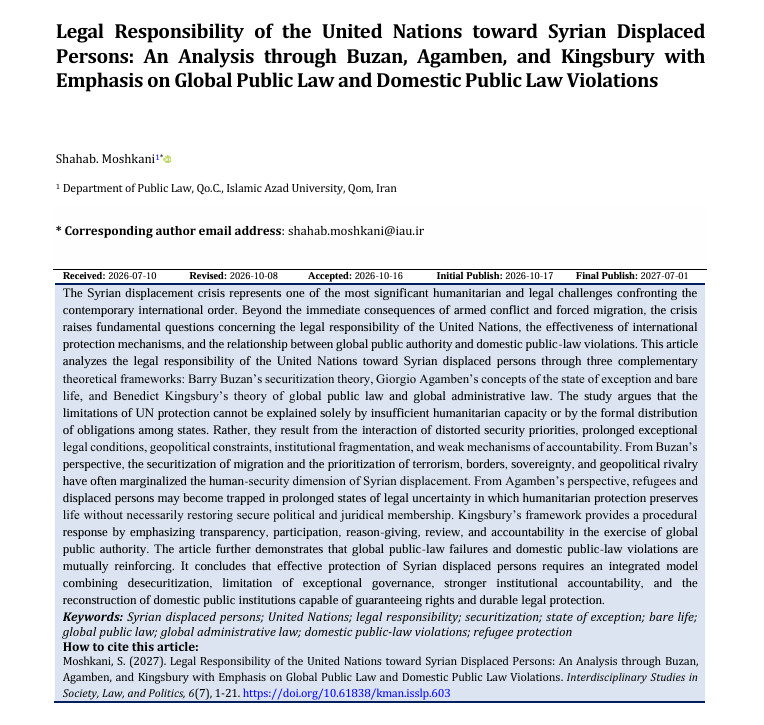
Legal Responsibility of the United Nations toward Syrian Displaced Persons: An Analysis through Buzan, Agamben, and Kingsbury with Emphasis on Global Public Law and Domestic Public Law Violations
Keywords:
Syrian displaced persons; United Nations; legal responsibility; securitization; state of exception; bare life; global public law; global administrative law; domestic public-law violations; refugee protectionAbstract
The Syrian displacement crisis represents one of the most significant humanitarian and legal challenges confronting the contemporary international order. Beyond the immediate consequences of armed conflict and forced migration, the crisis raises fundamental questions concerning the legal responsibility of the United Nations, the effectiveness of international protection mechanisms, and the relationship between global public authority and domestic public-law violations. This article analyzes the legal responsibility of the United Nations toward Syrian displaced persons through three complementary theoretical frameworks: Barry Buzan’s securitization theory, Giorgio Agamben’s concepts of the state of exception and bare life, and Benedict Kingsbury’s theory of global public law and global administrative law. The study argues that the limitations of UN protection cannot be explained solely by insufficient humanitarian capacity or by the formal distribution of obligations among states. Rather, they result from the interaction of distorted security priorities, prolonged exceptional legal conditions, geopolitical constraints, institutional fragmentation, and weak mechanisms of accountability. From Buzan’s perspective, the securitization of migration and the prioritization of terrorism, borders, sovereignty, and geopolitical rivalry have often marginalized the human-security dimension of Syrian displacement. From Agamben’s perspective, refugees and displaced persons may become trapped in prolonged states of legal uncertainty in which humanitarian protection preserves life without necessarily restoring secure political and juridical membership. Kingsbury’s framework provides a procedural response by emphasizing transparency, participation, reason-giving, review, and accountability in the exercise of global public authority. The article further demonstrates that global public-law failures and domestic public-law violations are mutually reinforcing. It concludes that effective protection of Syrian displaced persons requires an integrated model combining desecuritization, limitation of exceptional governance, stronger institutional accountability, and the reconstruction of domestic public institutions capable of guaranteeing rights and durable legal protection.
Downloads
References
Agamben, G. (1998). Homo sacer: Sovereign power and bare life. Stanford University Press.
Agamben, G. (2005). State of exception. University of Chicago Press.
Agamben, G. (2024). The camp as nomos of the modern. Verso.
Agamben, G. (2025). Voluntary return and the production of bare life. Verso.
Ager, A. (2011). Refugees: Perspectives on the experience of forced migration. Continuum.
Alter, K. J. (2014). The new terrain of international law: Courts, politics, rights. Princeton University Press.
Barnett, M., & Finnemore, M. (2004). Rules for the world: International organizations in global politics. Cornell University Press.
Bellamy, A. J. (2015). The responsibility to protect: A defense. Oxford University Press.
Betts, A., & Collier, P. (2017). Refuge: Transforming a broken refugee system. Penguin Books.
Buzan, B. (1991). People, states and fear: An agenda for international security studies in the post-Cold War era (2 ed.). Lynne Rienner.
Buzan, B. (2024). Security and the Syrian crisis. Cambridge University Press.
Buzan, B. (2025). Desecuritization and its limits. Cambridge University Press.
Buzan, B., Wæver, O., & de Wilde, J. (1998). Security: A new framework for analysis. Lynne Rienner.
Cassese, S. (2010). The global administrative law: A new research agenda. Routledge.
Daily, S. (2026, 2026/01/15). Turkey’s temporary protection system and Syrian returns.
Deetsc, S. (2012). Sayyida Zaynab in the state of exception: Shiʿi sainthood as “qualified life” in contemporary Syria. International Journal of Middle East Studies, 44(2), 285-299.
Euaa. (2026). Country guidance: Syria.
European, P. (2025). Report on the implementation of the EU-Turkey statement.
Frontex. (2016). Risk analysis for 2016.
Goodwin-Gill, G. S., & McAdam, J. (2007). The refugee in international law (3 ed.). Oxford University Press.
Haines, C. (2012). The democratic legitimacy of global administrative law. Hart Publishing.
Hathaway, J. C. (2021). The rights of refugees under international law. Cambridge University Press.
Herta, L. M. (2017). Security as speech act: Discourse constructions on the Syrian refugee crisis. Scientific Research and Education in the Air Force, 6(1), 283-287.
Huysmans, J. (2006). The politics of insecurity: Fear, migration and asylum in the EU. Routledge.
Kingsbury, B. (2005). The concept of ‘law’ in global administrative law. European Journal of International Law, 20(1), 23-57.
Kingsbury, B. (2009). The concept of global public law. European Journal of International Law, 20(1), 23-57.
Kingsbury, B. (2020). Global administrative law and the security council. Oxford University Press.
Kingsbury, B. (2024). Refugee governance and global public law. Oxford University Press.
Kingsbury, B. (2025). The limits of procedural reform in international organizations. Oxford University Press.
Kingsbury, B., Krisch, N., & Stewart, R. B. (2005). The emergence of global administrative law. Law and Contemporary Problems, 68(3/4), 15-61.
Marks, S. (2011). The false promise of global administrative law. Cambridge University Press.
Pinheiro, P. (2025). Concluding remarks by Paulo Pinheiro, Chair of the Independent International Commission of Inquiry on the Syrian Arab Republic. United Nations Office of the High Commissioner for Human Rights.
Scriven, A. (2018). Postcolonial perspectives on global administrative law. Oxford University Press.
Turner, S. (2016). What is a refugee camp? Explorations of the limits and effects of the camp. Journal of Refugee Studies, 29(2), 139-157.
Unhcr. (2023). Syria emergency.
Unhcr. (2026). Syrian refugee statistics.
Downloads
Publication Timeline
- Submitted
- Revised
- Accepted
Issue
Section
License
Copyright (c) 2025 Shahab Moshkani (Corresponding author)

This work is licensed under a Creative Commons Attribution-NonCommercial 4.0 International License.