Trilateral Relations among Iran, Russia, and China: From Soft Balancing to Hard War
Keywords:
Iran, Russia, China, trilateral relations, defensive realism, Twelve, Day War, FortyAbstract
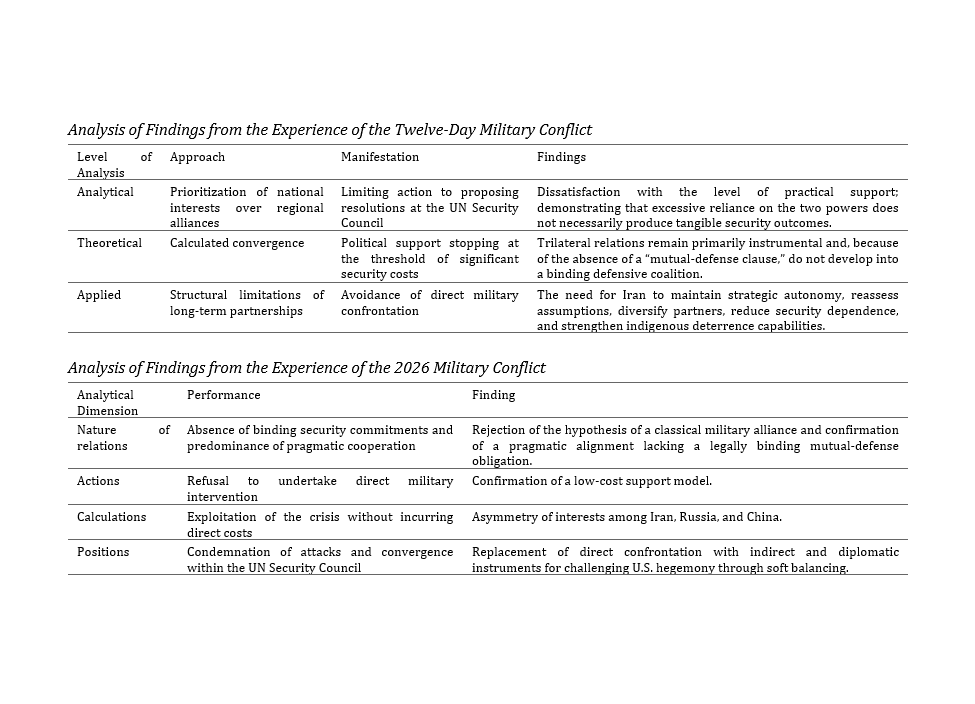
Relations among Iran, Russia, and China have emerged as an important subject in international relations in recent decades, with their nature, objectives, and implications attracting sustained scholarly attention. The Twelve-Day War between Iran and Israel in June 2025 and the Forty-Day War between Iran and the U.S.–Israeli coalition in February 2026 provided critical tests for assessing the nature and capacity of these relations under wartime conditions. The principal research question is: Under what factors and mechanisms can trilateral relations among Iran, Russia, and China be sustained amid the difficult conditions created by war? The study aims to explain the nature of these relations and to examine their capacities and limitations in confronting security crises and armed conflict. The research adopts a qualitative approach and employs a case study strategy. The data were analyzed using qualitative content analysis based on categories derived from the theoretical framework of defensive realism. The findings indicate that the rapprochement among Iran, Russia, and China can primarily be explained in terms of soft balancing against the hegemony of the United States and the West and has not resulted in the formation of a formal alliance or defensive coalition. Moreover, the experience of the wars examined demonstrates that the continuity of these relations depends less on coherent security integration than on the strategic considerations, national interests, and pragmatic calculations of each of the three actors. Accordingly, these trilateral relations may be characterized as a form of calculated and flexible convergence that facilitates limited and issue-specific cooperation.
Downloads
References
Adler, N. (2026, 2026/03/05). Where are Iran’s allies? Why Moscow, Beijing are keeping their distance. Al Jazeera. https://www.aljazeera.com/features/2026/3/5/where-are-irans-allies-why-moscow-beijing-are-keeping-their-distance
Baev, P. K. (2026). Putin’s personal fears may be the biggest strategic consequence of attacks on Iran. Peace Research Institute Oslo (PRIO). https://www.prio.org/comments/1865
Balmforth, T., & Irish, J. (2026, 2026/04/08). Russia supplies Iran with cyber support, spy imagery to hone attacks, Ukraine says. Reuters. https://www.militarytimes.com/flashpoints/middle-east/2026/04/07/russia-supplies-iran-with-cyber-support-spy-imagery-to-hone-attacks-ukraine-says/
Brands, H. (2022). Can the US take on China, Iran, and Russia all at once? Bloomberg Opinion. https://www.bloomberg.com/opinion/articles/2022-10-16/us-isn-t-ready-to-fight-china-iran-and-russia-all-at-once
Center for, S., & International, S. (2026). Russia and China: Gaining from the war with Iran? | State of Play. CSIS. https://www.csis.org/events/russia-and-china-gaining-war-iran-state-play
Chtatou, M. (2026). Abandoned in the onslaught? Russia, China, and North Korea’s strategic restraint in the face of Iran’s destruction. The Blogs, The Times of Israel. https://blogs.timesofisrael.com/abandoned-in-the-onslaught/
Cna. (2026, 2026/03/15). Iran’s foreign minister says China and Russia continue to assist Tehran; military cooperation hasn’t stopped. Central News Agency. https://www.cna.com.tw/news/aopl/202603150194.aspx
Connable, B., Campbell, J. H., & Madden, D. (2016). Stretching and exploiting thresholds for high-order war: How Russia, China, and Iran are eroding American influence using time-tested measures short of war. https://www.rand.org/pubs/research_reports/RR1003.html
Dorj, H., & Falahat Pishe, H. (2019). Iran, Russia, and China layout against US in Eurasia geopolitical arena. Research Political Geography Quarterly, 4(1), 23-62. https://doi.org/10.22067/pg.v4i1.78974
Douglas, J. (2012). Defensive realism and Chinese maritime strategy Te Herenga Waka–Victoria University of Wellington]. https://doi.org/10.26686/wgtn.17003170.v1
Drobot, G. A. (2014). Realism in international relations theory: History, foreign and domestic schools. Social and Humanitarian Knowledge(4), 182-203. https://cyberleninka.ru/article/n/realizm-v-teorii-mezhdunarodnyh-otnosheniy-istoriya-zarubezhnaya-i-otechestvennaya-shkoly
Faulconbridge, G., & Antonov, D. (2025). Putin says US strikes on Iran are pushing world to ‘very dangerous line’. Reuters. https://www.reuters.com/world/china/irans-supreme-leader-asks-putin-do-more-after-us-strikes-2025-06-23/
Fenbert, A. (2026, 2026/03/19). Iran seeking intelligence from Russia in war against US, CIA director says. Kyiv Independent. https://kyivindependent.com/iran-seeking-intelligence-from-russia-in-war-against-us-cia-director-says/
Garbuzarova, E. G. (2024). The geopolitical triangle “Russia-Iran-China” amid global transformations. Oikumena: Regional Studies(1(68)), 166-175. https://doi.org/10.24866/1998-6785/2024-1/166-175
Grafov, D. B. (2020). Lobbying Qatar’s interests in the United States and the Qatari diplomatic crisis. MGIMO Review of International Relations(2(71)), 183-204. https://doi.org/10.24833/2071-8160-2020-2-71-183-204
Grajewski, N. (2022). An illusory entente: The myth of a Russia-China-Iran “Axis”. Asian Affairs, 53(1), 164-183. https://doi.org/10.1080/03068374.2022.2029076
Inquirer.net. (2026). White House downplays report Russia aiding Iran’s targeting. INQUIRER.net. https://globalnation.inquirer.net/312857/white-house-downplays-report-russia-aiding-irans-targeting/amp
Interfax. (2025, 2025/06/24). Peskov refutes claims that Russia did not adequately support Iran. Interfax. https://www.interfax.ru/russia/1032881
Jalali Baranji, M., Yousefi, B., Shahabi, R., & Ameri Golestani, H. (2023). Comparing U.S. foreign policy approaches to the international system during the Obama and Trump presidencies based on offensive-defensive realism theory. International Studies Quarterly, 19(4), 245-265. https://doi.org/10.22034/isj.2023.351586.1863
Jamshidi, M., Fattahi, S., & Sedigh, M. A. (2022). The strategy of the Islamic Republic of Iran toward countries within its sphere of influence in the Islamic world from the perspective of defensive realism: Examining the Iraq and Syria crises. Islamic Awakening Studies, 11(1), 77-99. https://www.iabaj.ir/article_143773.html
Jones, S. G. (2021). Three dangerous men: Russia, China, Iran, and the rise of irregular warfare. W. W. Norton & Company. https://wwnorton.com/books/9781324006206
Kamneva, E. I. (2015). The evolution of the balance of power among great powers in the twenty-first century. Historical and Social-Educational Ideas, 7(5-1), 34-38. https://cyberleninka.ru/article/n/evolyutsiya-balansa-sil-velikih-derzhav-v-xxi-veke
Karataş, D., & Mustafaoğlu, A. (2026, 2026/04/12). New York Times: Intelligence estimates on Chinese support for Iran in the war. Anadolu Agency. https://www.aa.com.tr/ar/دولي/نيويورك-таймз-تقديرات-استخباراتية-حول-دعم-صيني-لإيران-في-الحرب/3902967
Keohane, R. O. (1984). After hegemony: Cooperation and discord in the world political economy. Princeton University Press.
Khatuntsev, S. (2015). The West and the “Eurasian quadriga” (Russia, China, India, Iran). Polis: Political Studies(6), 45-52. https://doi.org/10.17976/jpps/2015.06.07
Khudaykulova, A. V. (2020). Geopolitical triangles in the context of competition between traditional and rising centers of power. Outlines of Global Transformations: Politics, Economics, Law, 13(4), 53-73. https://cyberleninka.ru/article/n/geopoliticheskie-treugolniki-v-kontekste-konkurentsii-traditsionnyh-i-voshodyaschih-tsentrov-sily
Kragh, M. (2026). ‘Satanism in all its glory’: Russian reactions to the US-Israeli attack on Iran. https://sceeus.se/publikationer/satanism-in-all-its-glory-russian-reactions-to-the-us-israeli-attack-on-iran/
Manouri, S. A., & Mohammadsharifi, M. (2017). Defensive realism and the logic of NATO’s existence after September 11. Geopolitics Quarterly, 13(47), 176-202. https://journal.iag.ir/article_55811.html
Mansouri, M. (2021). Encyclopedia of political science (1 ed.). Andisheh Arshad.
Marketos, T. (2009). Iran’s geopolitical strategy in the struggle among the United States, Russia, and China for geostrategic control over Eurasia to ensure energy security. Central Asia and the Caucasus(4-5(6465)), 7-23. https://cyberleninka.ru/article/n/geopoliticheskaya-strategiya-irana-v-borbe-mezhdu-ssha-rossiey-i-kitaem-za-geostrategicheskiy-kontrol-nad-evraziey-radi-obespecheniya
Mirfakhraei, S. H., & Rahimi, O. (2017). Strategic partnership: A new pattern for Iran-Russia relations. The International Relations Research, 10(38), 131-157.
Montagu-Smith, N. (2026, 2026/03/11). Could Iran be using China’s highly accurate BeiDou navigation system? Al Jazeera. https://www.aljazeera.com/features/2026/3/11/could-iran-be-using-chinas-highly-accurate-beidou-navigation-system
Nebenzia, V. (2026). Statement by Permanent Representative Vassily Nebenzia at UNSC briefing in connection with US and Israeli strikes against Iran. Permanent Mission of the Russian Federation to the United Nations. https://russiaun.ru/en/news/28022026
News, U. S. (2025, 2025/06/24). Kremlin rejects charge it did little to help Iran. U.S. News & World Report. https://www.usnews.com/news/world/articles/2025-06-24/kremlin-rejects-charge-it-did-little-to-help-iran
Nichols, M. (2026). UN Security Council meets on Iran as Russia, China push for a ceasefire. Reuters. https://www.cnbc.com/2025/06/22/un-security-council-meets-on-iran-as-russia-china-push-for-a-ceasefire.html
Papageorgiou, M., Eslami, M., & Duarte, P. A. B. (2023). A ‘soft’ balancing ménage à trois? China, Iran and Russia strategic triangle vis-à-vis US hegemony. Journal of Asian Security and International Affairs, 23477970231152008. https://doi.org/10.1177/23477970231152008
Puri, S. (2017). The strategic hedging of Iran, Russia, and China: Juxtaposing participation in the global system with regional revisionism. Journal of Global Security Studies, 2(4), 307-323. https://doi.org/10.1093/jogss/ogx015
Rajagopalan, R. P. (2019). What’s in the growing Russia-China-Iran trilateral convergence? The Diplomat. https://thediplomat.com/2019/12/whats-in-the-growing-russia-china-iran-trilateral-convergence/
Said, K. (2025). Russia-China balancing act. Al-Ahram Weekly. https://english.ahram.org.eg/NewsContent/50/1203/548599/AlAhram-Weekly/World/RussiaChina-balancing-act.aspx
Saka, B., & Abdullahi, M. (2022). Alliance and coalition in contemporary international relations: The case of U.S.-South Korea. Zamfara Journal of Politics and Development, 3(1). https://zjpd.com.ng/index.php/zjpd/article/download/60/53
Shabaga, A. V. (2015). Methodology for the study of international relations: Realism. Vestnik of Peoples’ Friendship University of Russia: International Relations(3), 24-33. https://cyberleninka.ru/article/n/metodologiya-issledovaniya-mezhdunarodnyh-otnosheniy-realizm
Torabi, G., & Mohammadian, A. (2015). Explaining the foreign policy of the Islamic Republic of Iran toward the Syrian crisis from the perspective of defensive realism. Crisis Studies of the Islamic World, 2(2), 61-90. https://doi.org/10.2783.4999/QJPR.2002.1103.033
Walt, S. M. (1990). The origins of alliance. Cornell University Press.
Xinhua. (2026, 2026/03/27). Lavrov says Russia defends all Mideast countries’ interests, slamming U.S. interference. China.org.cn. http://www.china.org.cn/world/Off_the_Wire/2026-03/27/content_118405658.shtml
Zarshenas, S. (2018). Political-cultural dictionary (1 ed.). Maaref.
Zhang, Y. (2026). Understanding China’s stance on the Iran-Israel/U.S. conflict. https://www.grc.net/documents/69ab2fbf8b1e9Chinairanconflictcompressed.pdf
Zinovyeva, E. S., & Yanikeeva, I. O. (2022). The evolution of interaction between Russia and the United States in international information security: A historical retrospective. Vestnik of Saint Petersburg University: International Relations, 15(2), 158-173. https://cyberleninka.ru/article/n/evolyutsiya-vzaimodeystviya-rossii-i-ssha-v-oblasti-mezhdunarodnoy-informatsionnoy-bezopasnosti-v-istoricheskoy-retrospektive
Downloads
Additional Files
Publication Timeline
- Submitted
- Revised
- Accepted
Issue
Section
License
Copyright (c) 2026 Ali Akhavan (Author); Mehdi Sanaei (Corresponding author)

This work is licensed under a Creative Commons Attribution-NonCommercial 4.0 International License.