Citizenship Rights and National Unity: An Analysis of the Role of the State in the Transition from Crisis-Induced Solidarity to Sustainable Social Capital
Keywords:
national unity, citizenship rights, social capital, procedural justice, institutional trust, governance, illegitimate filteringAbstract
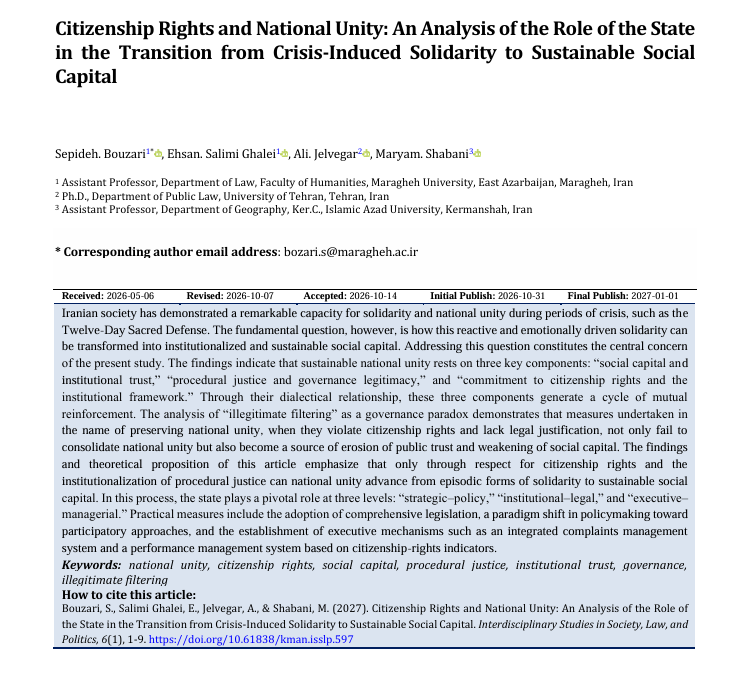
Iranian society has demonstrated a remarkable capacity for solidarity and national unity during periods of crisis, such as the Twelve-Day Sacred Defense. The fundamental question, however, is how this reactive and emotionally driven solidarity can be transformed into institutionalized and sustainable social capital. Addressing this question constitutes the central concern of the present study. The findings indicate that sustainable national unity rests on three key components: “social capital and institutional trust,” “procedural justice and governance legitimacy,” and “commitment to citizenship rights and the institutional framework.” Through their dialectical relationship, these three components generate a cycle of mutual reinforcement. The analysis of “illegitimate filtering” as a governance paradox demonstrates that measures undertaken in the name of preserving national unity, when they violate citizenship rights and lack legal justification, not only fail to consolidate national unity but also become a source of erosion of public trust and weakening of social capital. The findings and theoretical proposition of this article emphasize that only through respect for citizenship rights and the institutionalization of procedural justice can national unity advance from episodic forms of solidarity to sustainable social capital. In this process, the state plays a pivotal role at three levels: “strategic–policy,” “institutional–legal,” and “executive–managerial.” Practical measures include the adoption of comprehensive legislation, a paradigm shift in policymaking toward participatory approaches, and the establishment of executive mechanisms such as an integrated complaints management system and a performance management system based on citizenship-rights indicators.
Downloads
References
Ghahremani Afshar, Y., Parvin, K., & Mohammadzadeh Asl, M. (2021). An approach to the relationship between state sovereignty and citizenship rights: Emphasizing the legal system of the Islamic Republic of Iran. Islamic human rights studies, 10(2), 7-32.
Hamidi, A., & Alkajbaf, H. (2021). Strategies for strengthening the oversight of the Administrative Justice Court and its impact on citizenship rights in the Islamic Republic of Iran. Islamic human rights studies, 10(2), 63-88.
Hashemi, M., Mohseni, V., Javid, M., & Abbasi, B. (2022). Analysis and assessment of the relationship between citizenship rights and internet filtering. Judicial Law Views, 97-118.
Javid, M. (2013). The theory of relativity in citizenship rights and natural human rights. Human Rights(1), 59-84.
Nabavi, S., & Mortazavian, S. (2019). Legal development, Iran's national development, and challenges to the rule of law. Public Law Studies, 49(4), 1267-1287.
Naemeh, H. (2011). Transparency and combating corruption in the conclusion of administrative contracts. Legal Research(40), 9-36.
Parvin, K., & Tajalli, M. (2016). The foundations and origins of the international human rights system and the Islamic human rights system: Compatibility or conflict. Khorsandi Publications.
Yazdani, R., & Tavassoli Naeini, M. (2018). The role of the Administrative Justice Court in realizing and guaranteeing citizenship rights. Private and Criminal Law Research(38), 68-97.
Downloads
Additional Files
Publication Timeline
- Submitted
- Revised
- Accepted
Issue
Section
License
Copyright (c) 2025 Sepideh Bouzari (Corresponding author); Ehsan Salimi Ghalei, Ali Jelvegar, Maryam Shabani (Author)

This work is licensed under a Creative Commons Attribution-NonCommercial 4.0 International License.