Opportunities of Artificial Intelligence in Scientific Crime Detection: A Review of Global Experiences and Localization Capacities in Iran
Keywords:
Artificial Intelligence, Scientific Crime Detection, Criminal Investigation, Digital Forensics, Predictive Policing, Algorithmic Evidence, Explainable Artificial Intelligence, IranAbstract
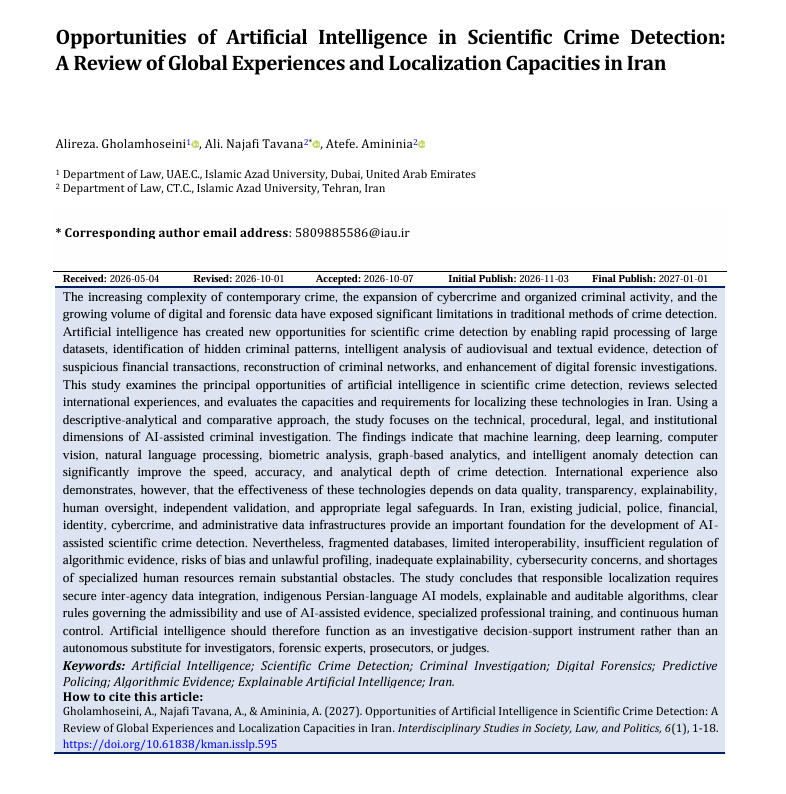
The increasing complexity of contemporary crime, the expansion of cybercrime and organized criminal activity, and the growing volume of digital and forensic data have exposed significant limitations in traditional methods of crime detection. Artificial intelligence has created new opportunities for scientific crime detection by enabling rapid processing of large datasets, identification of hidden criminal patterns, intelligent analysis of audiovisual and textual evidence, detection of suspicious financial transactions, reconstruction of criminal networks, and enhancement of digital forensic investigations. This study examines the principal opportunities of artificial intelligence in scientific crime detection, reviews selected international experiences, and evaluates the capacities and requirements for localizing these technologies in Iran. Using a descriptive-analytical and comparative approach, the study focuses on the technical, procedural, legal, and institutional dimensions of AI-assisted criminal investigation. The findings indicate that machine learning, deep learning, computer vision, natural language processing, biometric analysis, graph-based analytics, and intelligent anomaly detection can significantly improve the speed, accuracy, and analytical depth of crime detection. International experience also demonstrates, however, that the effectiveness of these technologies depends on data quality, transparency, explainability, human oversight, independent validation, and appropriate legal safeguards. In Iran, existing judicial, police, financial, identity, cybercrime, and administrative data infrastructures provide an important foundation for the development of AI-assisted scientific crime detection. Nevertheless, fragmented databases, limited interoperability, insufficient regulation of algorithmic evidence, risks of bias and unlawful profiling, inadequate explainability, cybersecurity concerns, and shortages of specialized human resources remain substantial obstacles. The study concludes that responsible localization requires secure inter-agency data integration, indigenous Persian-language AI models, explainable and auditable algorithms, clear rules governing the admissibility and use of AI-assisted evidence, specialized professional training, and continuous human control. Artificial intelligence should therefore function as an investigative decision-support instrument rather than an autonomous substitute for investigators, forensic experts, prosecutors, or judges.
Downloads
References
Buele, J., Miranda-Toapanta, D., & Rojas-Cañizares, D. (2026). Rethinking Criminal Profiling Through Cognitive Artificial Intelligence. Frontiers in Artificial Intelligence, 9. https://doi.org/10.3389/frai.2026.1824060
Campedelli, G. M. (2025). A Criminology of Machines. https://doi.org/10.48550/arxiv.2511.02895
Deb, E. (2024). Exploring the Nuptial Bond Between Neuroprediction and AI in Criminal Justice: A Theoretical Review. https://doi.org/10.20944/preprints202405.0409.v2
El-Mahrouki, M. M. (2024). Legislative Industry Challenges in Confronting Artificial Intelligence Crimes. Journal of Law and Sustainable Development, 12(4), e3566. https://doi.org/10.55908/sdgs.v12i4.3566
Ezeji, C. L. (2024). Artificial Intelligence for Detecting and Preventing Procurement Fraud. International Journal of Business Ecosystem and Strategy (2687-2293), 6(1), 63-73. https://doi.org/10.36096/ijbes.v6i1.477
Gonzaga, K., Serra, S., Gomes, M., & Malta, S. (2026). AI-Powered Social Engineering: Emerging Attack Vectors, Vulnerabilities, and Multi-Layered Defense Strategies. Computers, 15(2), 128. https://doi.org/10.3390/computers15020128
Habibi, M. S., & Rezaei, Y. (2022). Application of Artificial Intelligence in Detecting Cybercrimes. Criminological Legal Studies, 3(8).
Haghi, M., & Raisi, M. (2023). Examining the Challenges and Benefits of Using Artificial Intelligence in the Prevention and Detection of Banking and Tax Crimes. Brussels.
Hailtik, A. G. E., & Afifah, W. (2024). Criminal Responsibility of Artificial Intelligence Committing Deepfake Crimes in Indonesia. Asian Journal of Social and Humanities, 2(4), 776-795. https://doi.org/10.59888/ajosh.v2i4.222
Haley, P. (2025). The Impact of Biometric Surveillance on Reducing Violent Crime: Strategies for Apprehending Criminals While Protecting the Innocent. Sensors, 25(10), 3160. https://doi.org/10.3390/s25103160
Joseph, J. (2024). Predicting Crime or Perpetuating Bias? The AI Dilemma. Ai & Society, 40(4), 2319-2321. https://doi.org/10.1007/s00146-024-02032-9
Kahla, L. Z. (2024). Leveraging Artificial Intelligence for Crime Detection and Prevention. International Journal of Scientific Research in Engineering and Management, 08(05), 1-5. https://doi.org/10.55041/ijsrem34207
Kassa, Y. W., James, J. I., & Belay, E. G. (2024). Cybercrime Intention Recognition: A Systematic Literature Review. Information, 15(5), 263. https://doi.org/10.3390/info15050263
Keyvanpour, M., Javideh, M., & Ebrahimi, M. (2021). Computer-Based Crime Analysis Using Artificial Intelligence Methods. Detective, 4(3).
Kim, H. S., Kim, C., Shin, S., & Kang, J. (2026). SCRIPTMIND: Crime Script Inference and Cognitive Evaluation for LLM-based Social Engineering Scam Detection System. https://doi.org/10.48550/arxiv.2601.13581
Kolhe, D. (2024). Crime and Fraud at the Community Level: Social Networking Understanding Into Economic Crimes and Psychology Motivations. Journal of Social Sciences and Economics, 3(2), 109-128. https://doi.org/10.61363/g0kb2s44
Mamak, K. (2024). AGI Crimes? The Role of Criminal Law in Mitigating Existential Risks Posed by Artificial General Intelligence. Ai & Society, 40(4), 2691-2701. https://doi.org/10.1007/s00146-024-02036-5
Mohammadinia, O., & Alizadeh, A. (2023). The Role and Impact of Artificial Intelligence in the Process of Crime Detection. Scientific Quarterly of the Detective, 17(63), 85-104.
Rouhollahi, Z. (2021). Towards Artificial Intelligence Enabled Financial Crime Detection. https://doi.org/10.48550/arxiv.2105.10866
Shen, Y. (2024). Research on Criminal Risks in the Age of Artificial Intelligence. Journal of Artificial Intelligence Practice, 7(2). https://doi.org/10.23977/jaip.2024.070208
Talukder, K. A., & Shompa, T. F. (2024). Artificial Intelligence in Criminal Justice Management: A Systematic Literature Review. Non Human Journal, 1(01), 63-82. https://doi.org/10.70008/jmldeds.v1i01.42
Teresia, J. N. W. (2024). Criminology and Social Impact in the Age of Artificial Intelligence [AI]. East African Journal of Information Technology, 7(1), 221-239. https://doi.org/10.37284/eajit.7.1.2141
Vaidyan, V. M. (2025). Confidence Levels of Artificial Intelligence Generated Evidence in Cybercrime Investigations - A Survey. https://doi.org/10.21203/rs.3.rs-7401864/v1
Downloads
Additional Files
Publication Timeline
- Submitted
- Revised
- Accepted
Issue
Section
License
Copyright (c) 2025 Alireza Gholamhoseini (Author); Ali Najafi Tavana (Corresponding author); Atefe Amininia (Author)

This work is licensed under a Creative Commons Attribution-NonCommercial 4.0 International License.