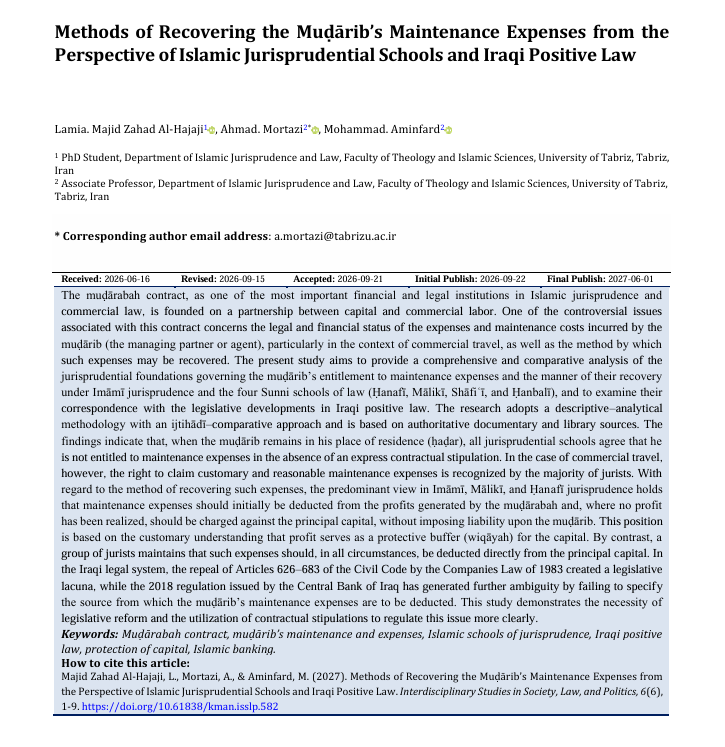
Methods of Recovering the Muḍārib’s Maintenance Expenses from the Perspective of Islamic Jurisprudential Schools and Iraqi Positive Law
Keywords:
Muḍārabah contract, muḍārib’s maintenance and expenses, Islamic schools of jurisprudence, Iraqi positive law, protection of capital, Islamic bankingAbstract
The muḍārabah contract, as one of the most important financial and legal institutions in Islamic jurisprudence and commercial law, is founded on a partnership between capital and commercial labor. One of the controversial issues associated with this contract concerns the legal and financial status of the expenses and maintenance costs incurred by the muḍārib (the managing partner or agent), particularly in the context of commercial travel, as well as the method by which such expenses may be recovered. The present study aims to provide a comprehensive and comparative analysis of the jurisprudential foundations governing the muḍārib’s entitlement to maintenance expenses and the manner of their recovery under Imāmī jurisprudence and the four Sunni schools of law (Ḥanafī, Mālikī, Shāfiʿī, and Ḥanbalī), and to examine their correspondence with the legislative developments in Iraqi positive law. The research adopts a descriptive–analytical methodology with an ijtihādī–comparative approach and is based on authoritative documentary and library sources. The findings indicate that, when the muḍārib remains in his place of residence (ḥaḍar), all jurisprudential schools agree that he is not entitled to maintenance expenses in the absence of an express contractual stipulation. In the case of commercial travel, however, the right to claim customary and reasonable maintenance expenses is recognized by the majority of jurists. With regard to the method of recovering such expenses, the predominant view in Imāmī, Mālikī, and Ḥanafī jurisprudence holds that maintenance expenses should initially be deducted from the profits generated by the muḍārabah and, where no profit has been realized, should be charged against the principal capital, without imposing liability upon the muḍārib. This position is based on the customary understanding that profit serves as a protective buffer (wiqāyah) for the capital. By contrast, a group of jurists maintains that such expenses should, in all circumstances, be deducted directly from the principal capital. In the Iraqi legal system, the repeal of Articles 626–683 of the Civil Code by the Companies Law of 1983 created a legislative lacuna, while the 2018 regulation issued by the Central Bank of Iraq has generated further ambiguity by failing to specify the source from which the muḍārib’s maintenance expenses are to be deducted. This study demonstrates the necessity of legislative reform and the utilization of contractual stipulations to regulate this issue more clearly.
Downloads
References
Ansari, M. i. M. A. (1994). Kitab al-Makasib (Vol. 3). Majma' al-Fikr al-Islami.
Balkhi, N. a.-D., & Scholars, A. G. o. I. (1892). Al-Fatawa al-Hindiyyah fi Madhhab al-Imam al-A'zam Abi Hanifah al-Nu'man (Vol. 4). Al-Matba'ah al-Kubra al-Amiriyyah.
Husayni Amili, S. J. i. M. (1998). Miftah al-Karamah fi Sharh Qawa'id al-Allamah (Vol. 20). Islamic Publications Office, Society of Seminary Teachers of Qom.
Ibn Abd al-Barr al-Namari al-Qurtubi, A. U. Y. i. A. A. (1980). Al-Kafi fi Fiqh Ahl al-Madinah (Vol. 2).
Ibn Abi Shaybah, A. B. A. A. i. M. (1988). Al-Musannaf fi al-Ahadith wa al-Athar (Vol. 4). Maktabat al-Rushd.
Ibn Abidin, M. A. i. U. (1992). Radd al-Muhtar ala al-Durr al-Mukhtar (Hashiyat Ibn Abidin) (Vol. 5). Dar al-Fikr.
Ibn Jallab, U. A. i. a.-H. (2007). Al-Tafri' fi Fiqh al-Imam Malik ibn Anas (Vol. 2). Dar al-Kutub al-Ilmiyyah.
Ibn Rushd al-Qurtubi, A. a.-W. M. i. A. (2004). Bidayat al-Mujtahid wa Nihayat al-Muqtasid (Vol. 4). Dar al-Hadith.
Ibn Sa'id al-Hilli, Y. i. A. (1974). Al-Jami' lil-Shara'i'. Imam al-Sadiq Institute.
Khatib al-Shirbini, S. a.-D. M. i. A. (1994). Mughni al-Muhtaj ila Ma'rifat Ma'ani Alfaz al-Minhaj (Vol. 2). Dar al-Kutub al-Ilmiyyah.
Khoei, S. A. a.-Q. (2009). Al-Mabani fi Sharh al-Urwah al-Wuthqa (Mawsu'at al-Imam al-Khoei) (Vol. 1). Institute for Revival of the Works of Imam Khoei.
Muhaqqiq al-Hilli, J. f. i. H. (1988). Shara'i' al-Islam fi Masa'il al-Halal wa al-Haram (Vol. 2). Ismailian Publications.
Nawawi, M. a.-D. i. S. (1991). Rawdat al-Talibin wa Umdat al-Muftin (Vol. 5). Al-Maktab al-Islami.
Sabzawari, S. A. a.-A. l. (1992). Muhadhdhab al-Ahkam fi Bayan al-Halal wa al-Haram (Vol. 19). Dar al-Tafsir.
Sanhuri, A. a.-R. A. (1998). Al-Wasit fi Sharh al-Qanun al-Madani al-Jadid: Contracts Relating to Work (Vol. 7). Al-Halabi Publications.
Downloads
Additional Files
Publication Timeline
- Submitted
- Revised
- Accepted
Issue
Section
License
Copyright (c) 2025 Lamia Majid Zahad Al-Hajaji (Author); Ahmad Mortazi (Corresponding author); Mohammad Aminfard (Author)

This work is licensed under a Creative Commons Attribution-NonCommercial 4.0 International License.