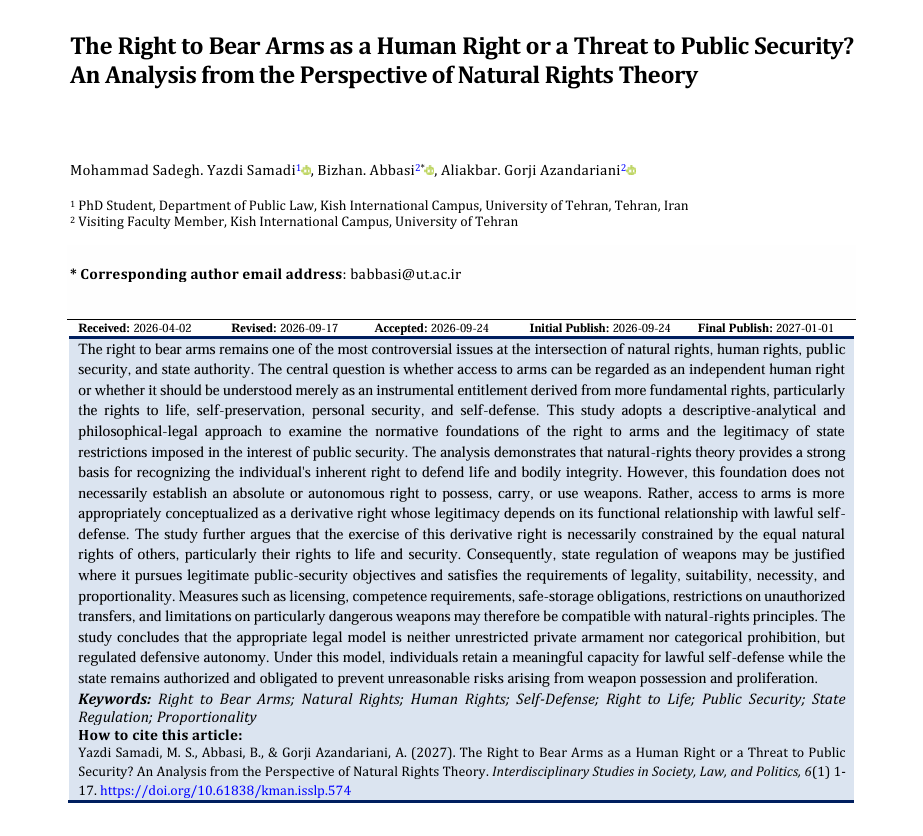
The Right to Bear Arms as a Human Right or a Threat to Public Security? An Analysis from the Perspective of Natural Rights Theory
Keywords:
Right to Bear Arms, Natural Rights, Human Rights, Self-Defense, Right to Life, Public Security, State Regulation, ProportionalityAbstract
The right to bear arms remains one of the most controversial issues at the intersection of natural rights, human rights, public security, and state authority. The central question is whether access to arms can be regarded as an independent human right or whether it should be understood merely as an instrumental entitlement derived from more fundamental rights, particularly the rights to life, self-preservation, personal security, and self-defense. This study adopts a descriptive-analytical and philosophical-legal approach to examine the normative foundations of the right to arms and the legitimacy of state restrictions imposed in the interest of public security. The analysis demonstrates that natural-rights theory provides a strong basis for recognizing the individual's inherent right to defend life and bodily integrity. However, this foundation does not necessarily establish an absolute or autonomous right to possess, carry, or use weapons. Rather, access to arms is more appropriately conceptualized as a derivative right whose legitimacy depends on its functional relationship with lawful self-defense. The study further argues that the exercise of this derivative right is necessarily constrained by the equal natural rights of others, particularly their rights to life and security. Consequently, state regulation of weapons may be justified where it pursues legitimate public-security objectives and satisfies the requirements of legality, suitability, necessity, and proportionality. Measures such as licensing, competence requirements, safe-storage obligations, restrictions on unauthorized transfers, and limitations on particularly dangerous weapons may therefore be compatible with natural-rights principles. The study concludes that the appropriate legal model is neither unrestricted private armament nor categorical prohibition, but regulated defensive autonomy. Under this model, individuals retain a meaningful capacity for lawful self-defense while the state remains authorized and obligated to prevent unreasonable risks arising from weapon possession and proliferation.
Downloads
References
Abuloye, A., & Kolade, T. M. (2024). Terrorism in Northern Nigeria and the Proliferation of Small and Light Weapons. World Journal of Social Science Research, 11(2), p150. https://doi.org/10.22158/wjssr.v11n2p150
Akthar, Z. (2023). Genocide in Kashmir: Right of Self-Determination, UNSC Resolutions and Holding India to Account Under International Humanitarian Law. Groningen Journal of International Law, 10(1), 43-72. https://doi.org/10.21827/grojil.10.1.43-72
Ashrafi, A. (2019). The Principle of Equality of Arms in Iranian Law with Emphasis on the Criminal Procedure Law Approved in 2013. Fars Law Research Journal Quarterly(2), 21-43.
Awhefeada, U. V. (2023). The Role of Regional Human Rights Institutions in Times of Armed Conflicts in Africa. Journal of Liberty and International Affairs, 9(1), 162-177. https://doi.org/10.47305/jlia2391162a
Davies, M. (2017). Law and the Right to a Fair Trial: Equality of Arms and Access to Counsel (1th ed.). Oxford University Press.
Lima, R. M. d., Maulaz, R. B. d., Brasil, D. R., & Oliveira, A. (2024). The Subtraction of International Humanitary Law: An Analysis Through the Lens of the Israel-Hamas Armed Conflict. Beijing Law Review, 15(02), 992-1013. https://doi.org/10.4236/blr.2024.152060
Mboh Ngoma Alain Pierre, L., & Victoire, N. E. D. (2024). Legal Understanding of the Failures of International Conventional Arms Control Mechanisms. International Journal of Social Science and Human Research, 07(11). https://doi.org/10.47191/ijsshr/v7-i11-21
McGlinchey, S. (2013). Richard Nixon's Road to Tehran: The Making of the U.S.-Iran Arms Agreement of May 1972. Diplomatic History, 37(4), 841-860. https://doi.org/10.1093/dh/dht026
Moniquet, C. (2013). The Involvement of Salafism / Wahhabism in the Support and Supply of Arms to Rebel Groups Around the World. http://www.europarl.europa.eu/RegData/etudes/etudes/join/2013/457137/EXPO-AFET_ET%282013%29457137_EN.pdf
Niyitunga, E. B. (2023). Armed Drones and International Humanitarian Law. Digital Policy Studies, 1(2), 18-39. https://doi.org/10.36615/dps.v1i2.2278
Norman, I. D. (2024). Civil-Military Participation in Hostility Model: Theorizing Attack of Security Personnel by Civilians and Vice Versa. International Journal of Arts and Humanities, 5(1), 234-242. https://doi.org/10.25082/ijah.2024.01.005
Silva, B. T. P., Pains, F. A., Júlia Nicole Ramos Melo, C., Ribeiro, L. A. M., Lauriene Soares Guedes da, S., Maria Clara de Souza, D., & Lima, N. F. B. (2023). The Participation of Civilians in Armed Conflicts: A Case Study of the Russian-Ukrainian War. https://doi.org/10.56238/seveniiimulti2023-218
Silva, B. T. P., Pellens, P. C., & Isabela de Castro Andrade da, S. (2023). The Arms Trade Treaty and Illicit Trade Under International Humanitarian Law. https://doi.org/10.56238/homeinternationalanais-056
Stepien, B. (2026). Sea Drones: Warships or Weapons? Legal Status and Implications. International Review of the Red Cross, 108(931), 574-594. https://doi.org/10.1017/s1816383126101167
Tavassoli Naini, M., Khosrowshahi, G., & Nasrollahi, Z. (2016). The Principle of Equality of Arms in the Preliminary Investigation Stage in the 2013 Criminal Procedure Law and International Human Rights Documents. Journal of Justice Administration Law, 80(94), 71-94.
Zakrison, T. L., Rattan, R., Sidhwa, F., Parrin, A., Crandall, M., Duncan, T. K., Ferrada, P., Santos, A., Foster, S. M., & Angelos, P. (2025). Surgeons in Conflict Zones: Ethical Considerations Beyond the Operating Room. Journal of the American College of Surgeons, 241(6), 1162-1169. https://doi.org/10.1097/xcs.0000000000001593
Downloads
Additional Files
Publication Timeline
- Submitted
- Revised
- Accepted
Issue
Section
License
Copyright (c) 2025 Mohammad Sadegh Yazdi Samadi (Author); Bizhan Abbasi (Corresponding author); Aliakbar Gorji Azandariani (Author)

This work is licensed under a Creative Commons Attribution-NonCommercial 4.0 International License.