Women’s Employment in Iranian Society: A Comparative Analysis of Iranian Law, Islamic Jurisprudence, and International Conventions
Keywords:
Women’s Employment, Employment Rights, ; Iranian Law, Islamic Jurisprudence, ; International Conventions, Gender Equality, Non-Discrimination, Women’s RightsAbstract
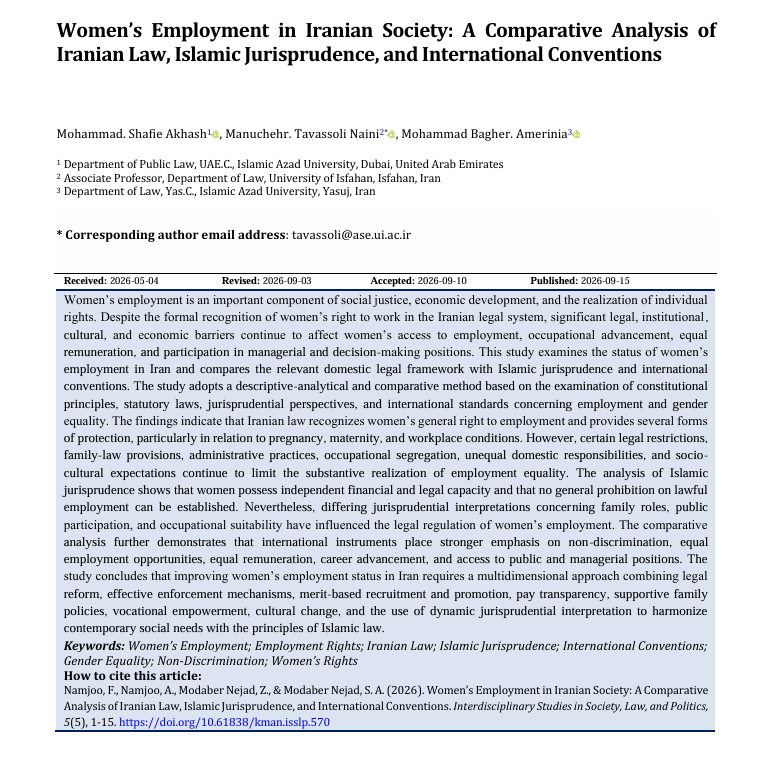
Women’s employment is an important component of social justice, economic development, and the realization of individual rights. Despite the formal recognition of women’s right to work in the Iranian legal system, significant legal, institutional, cultural, and economic barriers continue to affect women’s access to employment, occupational advancement, equal remuneration, and participation in managerial and decision-making positions. This study examines the status of women’s employment in Iran and compares the relevant domestic legal framework with Islamic jurisprudence and international conventions. The study adopts a descriptive-analytical and comparative method based on the examination of constitutional principles, statutory laws, jurisprudential perspectives, and international standards concerning employment and gender equality. The findings indicate that Iranian law recognizes women’s general right to employment and provides several forms of protection, particularly in relation to pregnancy, maternity, and workplace conditions. However, certain legal restrictions, family-law provisions, administrative practices, occupational segregation, unequal domestic responsibilities, and socio-cultural expectations continue to limit the substantive realization of employment equality. The analysis of Islamic jurisprudence shows that women possess independent financial and legal capacity and that no general prohibition on lawful employment can be established. Nevertheless, differing jurisprudential interpretations concerning family roles, public participation, and occupational suitability have influenced the legal regulation of women’s employment. The comparative analysis further demonstrates that international instruments place stronger emphasis on non-discrimination, equal employment opportunities, equal remuneration, career advancement, and access to public and managerial positions. The study concludes that improving women’s employment status in Iran requires a multidimensional approach combining legal reform, effective enforcement mechanisms, merit-based recruitment and promotion, pay transparency, supportive family policies, vocational empowerment, cultural change, and the use of dynamic jurisprudential interpretation to harmonize contemporary social needs with the principles of Islamic law.
Downloads
References
Abolhamd, A. (2000). Iran's Administrative Law. Tous Publications.
Alavioun, M. R. (2002). Women's Work in Iranian Law and International Labor Law. Roshangaran and Women's Studies Publications.
Ebadi, S. (2002). Women's Rights (1st ed.). Ganj-e Danesh Publications.
Ebadi, S. (2004). History and Documents of Human Rights in Iran (1st ed.). Roshangaran Publications.
Ghazi, A. (1992). Constitutional Law and Political Institutions. Tehran University Press.
Hashemi, M. (1996). Women's Socio-Political Rights in Four Arenas. Farzaneh Journal(8), 19.
Hosseini, A. R. (2001). Challenges of the Convention on the Elimination of All Forms of Discrimination against Women with the Constitution of the Islamic Republic of Iran. Rovagh-e Andisheh Journal(4), 98.
Kar, M. (2000). Elimination of Discrimination against Women: Comparison of the Convention on the Elimination of Discrimination against Women with Iran's Domestic Laws (3rd ed.). Nashr-e Qatreh.
Maududi, A. (2009). Islam in the Face of Contemporary Challenges. Dar al-Fikr al-Arabi.
Mehrpour, H. (1999). Human Rights and Its Implementation Strategies (1st ed.). Ettela'at Publications.
Meshkinshahr Ardabili, A. (1988). Terminologies of Principles and Most of Its Discussions. Al-Hadi Publishing Office.
Mofidian, S. (2001). The Possibility of Women's Employment from a Legal Perspective in Iran Islamic Azad University, Central Tehran Branch].
Mokhtarian, H. (2001). Methods to Increase Women's Participation in the Labor Market. Tehran.
Molaverdi, S. (2005). Women in Power and Decision-Making. Reyhaneh Quarterly(10), 262.
Motahhari, M. (1991). Hijab (34th ed.). Sadra Publications.
Mousavi, F. (2004). Comparative Study of Working Conditions of Women and Adolescents in Japan, South Korea, India, Egypt, England, and Iran. Journal of the Faculty of Law and Political Science, University of Tehran, 64, 192.
Pasgar, S. (1995). Women's Employment Level in the United Nations System. Foreign Policy Journal, 9, 781-783.
Shahbakht, P. (2003). Comparison of the Convention on the Elimination of Discrimination against Women with Iran's Constitution. Kanun-e Zanan-e Zaman Journal(2), 10.
Soroush, A. (1999). Jurisprudence on the Scales. Kiyan Journal, 9(46), 7.
Writh, L. (1998). Women in Management. International Labour Review, 137(1), 97.
Downloads
Additional Files
Publication Timeline
- Submitted
- Revised
- Accepted
Issue
Section
License
Copyright (c) 2025 Mohammad Shafie Akhash, Manuchehr Tavassoli Naini, Mohammad Bagher Amerinia (Author)

This work is licensed under a Creative Commons Attribution-NonCommercial 4.0 International License.