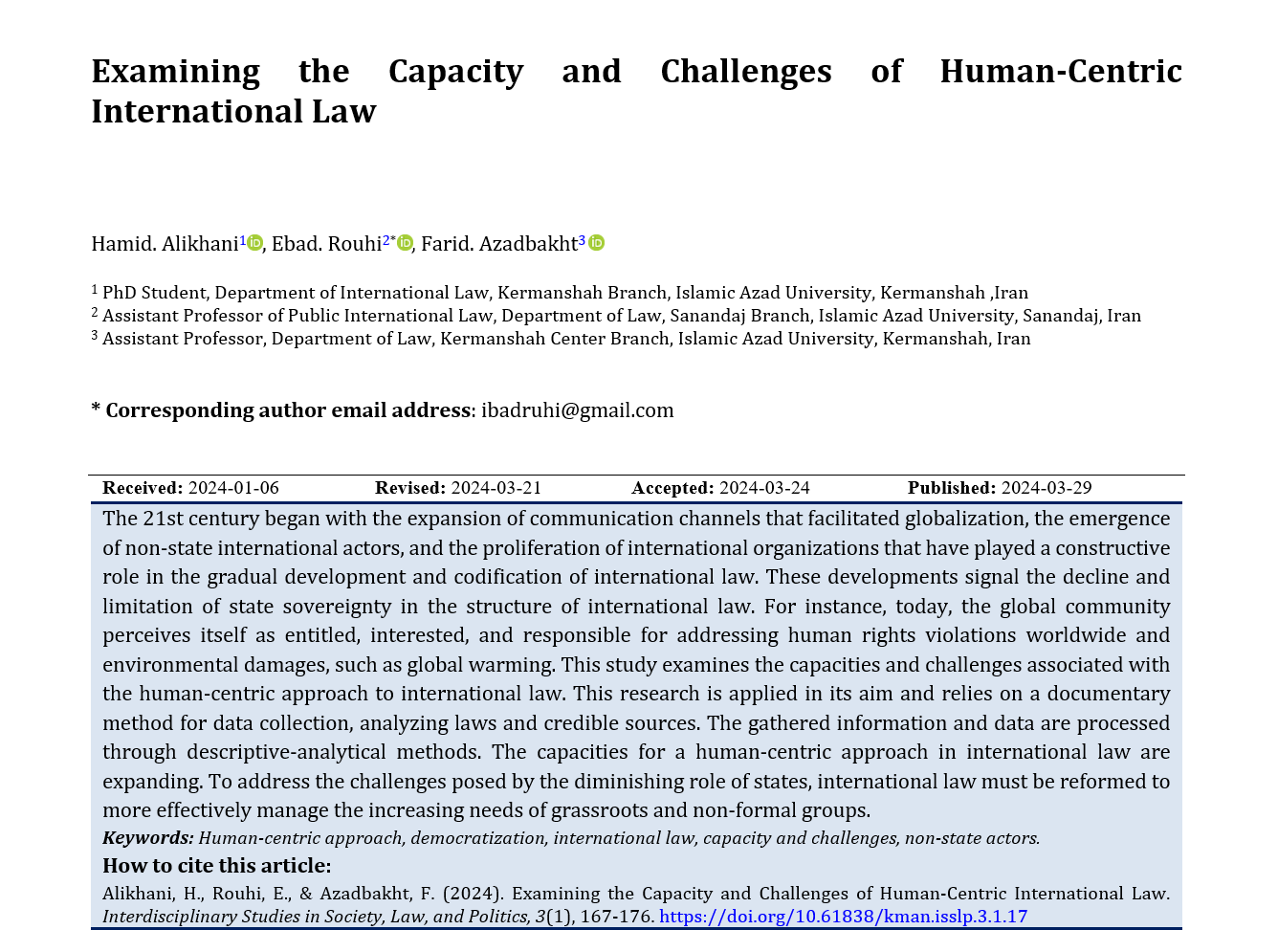
Examining the Capacity and Challenges of Human-Centric International Law
DOI:
https://doi.org/10.61838/kman.isslp.3.1.17Keywords:
popularization, international law,, capacity and challenge, non-governmentalAbstract
The 21st century began with the expansion of communication channels that facilitated globalization, the emergence of non-state international actors, and the proliferation of international organizations that have played a constructive role in the gradual development and codification of international law. These developments signal the decline and limitation of state sovereignty in the structure of international law. For instance, today, the global community perceives itself as entitled, interested, and responsible for addressing human rights violations worldwide and environmental damages, such as global warming. This study examines the capacities and challenges associated with the human-centric approach to international law. This research is applied in its aim and relies on a documentary method for data collection, analyzing laws and credible sources. The gathered information and data are processed through descriptive-analytical methods. The capacities for a human-centric approach in international law are expanding. To address the challenges posed by the diminishing role of states, international law must be reformed to more effectively manage the increasing needs of grassroots and non-formal groups.
Downloads
Downloads
Additional Files
Publication Timeline
- Submitted
- Revised
- Accepted
Issue
Section
License
Copyright (c) 2024 Interdisciplinary Studies in Society, Law, and Politics

This work is licensed under a Creative Commons Attribution-NonCommercial 4.0 International License.