Artificial Intelligence and Terrorist Groups in the Middle East: A Strategic Analysis of Capabilities and Security Implications from the Perspective of Offensive Realism
Keywords:
artificial intelligence, terrorism, Middle East, offensive realismAbstract
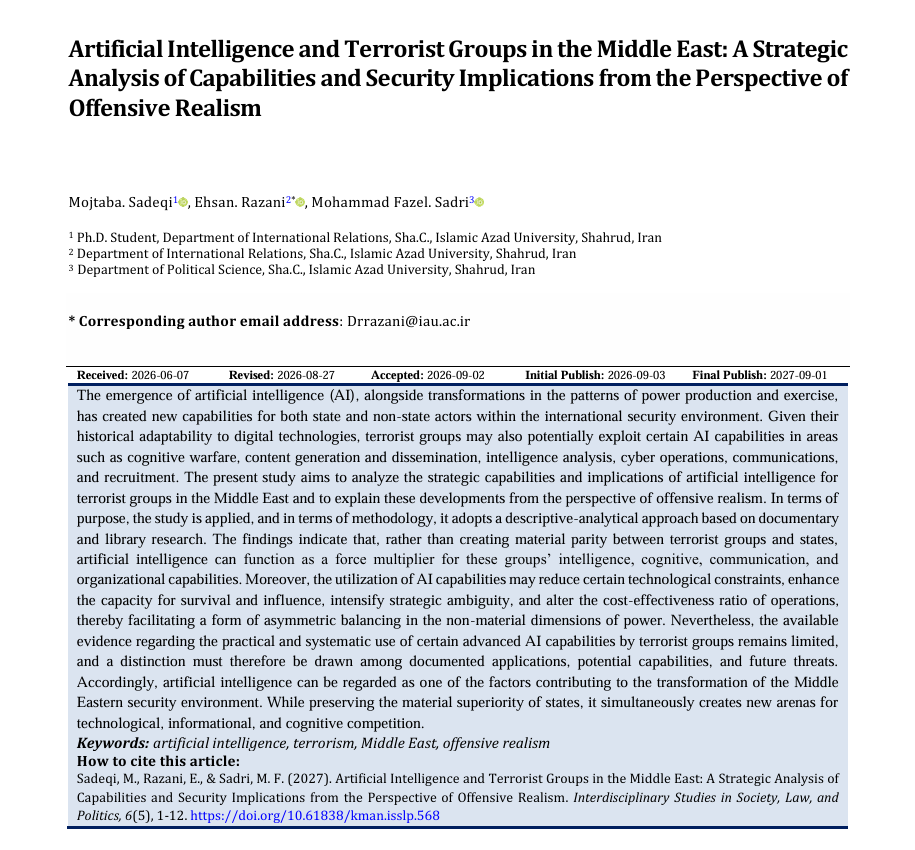
The emergence of artificial intelligence (AI), alongside transformations in the patterns of power production and exercise, has created new capabilities for both state and non-state actors within the international security environment. Given their historical adaptability to digital technologies, terrorist groups may also potentially exploit certain AI capabilities in areas such as cognitive warfare, content generation and dissemination, intelligence analysis, cyber operations, communications, and recruitment. The present study aims to analyze the strategic capabilities and implications of artificial intelligence for terrorist groups in the Middle East and to explain these developments from the perspective of offensive realism. In terms of purpose, the study is applied, and in terms of methodology, it adopts a descriptive-analytical approach based on documentary and library research. The findings indicate that, rather than creating material parity between terrorist groups and states, artificial intelligence can function as a force multiplier for these groups’ intelligence, cognitive, communication, and organizational capabilities. Moreover, the utilization of AI capabilities may reduce certain technological constraints, enhance the capacity for survival and influence, intensify strategic ambiguity, and alter the cost-effectiveness ratio of operations, thereby facilitating a form of asymmetric balancing in the non-material dimensions of power. Nevertheless, the available evidence regarding the practical and systematic use of certain advanced AI capabilities by terrorist groups remains limited, and a distinction must therefore be drawn among documented applications, potential capabilities, and future threats. Accordingly, artificial intelligence can be regarded as one of the factors contributing to the transformation of the Middle Eastern security environment. While preserving the material superiority of states, it simultaneously creates new arenas for technological, informational, and cognitive competition.
Downloads
References
Bakhshi-Sheikh-Ahmad, M. (2015). The Ideology of Takfiri-Wahhabi Terrorist Groups from Al-Qaeda to ISIS. Jahad Daneshgahi, Publications Organization.
Barzegar, K. (2009). Iran's Foreign Policy from the Perspective of Offensive and Defensive Realism. Foreign Relations(1), 113-154.
Bashiri, Q. (2022). Factors of Emergence of Terrorist Groups and Their Impact on Security. Arshadan Educational and Authoring Institute.
Basiri, M. A., & Mohseni, M. B. (2023). The Concept of the Evolution of Artificial Intelligence and the Military-Information-Security System of the Zionist Regime Proceedings of the International Conference on Artificial Intelligence and Iranian World Studies,
Bazarkina, D. (2023). Current and Future Threats of the Malicious Use of Artificial Intelligence by Terrorists: Psychological Aspects. In The Palgrave Handbook of Malicious Use of AI and Psychological Security (pp. 251-272). Springer International Publishing. https://doi.org/10.1007/978-3-031-22552-9_15
Briefs, S. (2026). Artificial Intelligence and the Future of Terrorism.
Davis, A. L. (2021). Artificial Intelligence and the Fight against International Terrorism. American Intelligence Journal, 38(2), 63-73.
Djoric, M., & Milosevic, T. (2021). Abuse of Artificial Intelligence for Extremist and Terrorist Purposes. Serbian Political Thought, 220.
Elyaari, H. R. (2024). Geopolitical Explanation of Terrorist Groups' Activism in Balochistan Region after the Islamic Revolution of Iran. Farhang-e Mehryad.
Ezeamalu, R. C. (2026). Terrorism and Its Implication on Global Security in the 21st Century: The ISIS Experience in the Middle East 2020–2025 [Doctoral dissertation, Godfrey Okoye University, Enugu].
Fong, B. C. (2026). What Is Driving the US and China to Compete—and Potentially Fight—over Taiwan: A Neo-Offensive Realist Analysis. China Perspectives(145), 7-17. https://doi.org/10.4000/chinaperspectives.17896
Ford, N. K. (2026). A Mixed Response to Terrorism in the Middle East.
Ganaie, N. A. (2025). The Role of Artificial Intelligence in Radicalisation, Recruitment and Terrorist Propaganda: Deconstructing Violent Extremism and Reimagining Counterterrorism in Contemporary Digital Ecosystems. Frontiers in Political Science, 7, 1718396. https://doi.org/10.3389/fpos.2025.1718396
Gholami, M. (2021). Media Behavior of Terrorism: Prohibition of Media Services to Individuals and Terrorist Groups in International Law Documents. Asar-e Fekr.
Hosseini, S. L., Arab-Tat, M., & Hosseinmardi, M. M. (2025). Smart Diplomacy and International Security in the Age of Digital Transformation: Analyzing the Role of Artificial Intelligence in Combating Cyberterrorism. Diplomatic Interactions, 3(10), 301-339. https://doi.org/10.22034/dpiq.2026.555275.1057
Houser, T., & Dong, B. (2025). The Convergence of Artificial Intelligence and Terrorism: A Systematic Review of the Literature. Studies in Conflict & Terrorism, 1-24. https://doi.org/10.1080/1057610X.2025.2467891
Juelich, A. (2026). 'God Has Helped Us, and So Will AI': How the Terrorist Group Boko Haram Uses Frontier AI.
Khoumich, A., Mliless, M., & Achamrah, M. (2026). The Role of Artificial Intelligence in Combating Terrorism: Exploring Capabilities and Challenges in the Dark and Deep Web. In AI-Driven Policing and Urban Security in Smart Cities (pp. 129-154). IGI Global Scientific Publishing. https://doi.org/10.4018/979-8-3373-1234-5.ch007
Li, J., Dai, Y., Woldearegay, T., & Deb, S. (2026). Cognitive Warfare and the Logic of Power: Reinterpreting Offensive Realism in Russia's Strategic Information Operations. Defence Studies, 26(1), 127-148. https://doi.org/10.1080/14702436.2025.2465678
Macdonald, S., Mattheis, A., & Wells, D. (2024). Using Artificial Intelligence and Machine Learning to Identify Terrorist Content Online.
Mearsheimer, J. J. (2001). The Tragedy of Great Power Politics. W. W. Norton & Company.
Mearsheimer, J. J. (2012). The Israel Lobby and Offensive Realism. Imam Sadegh University.
Muperi, J. T. (2026). Beyond Pure Power Politics: Cognitive and Cultural Dimensions of Russian Offensive Realism in Ukraine. Problems of Post-Communism, 73(2), 124-137. https://doi.org/10.1080/10758216.2025.2467892
Olech, A. (2026). Terror-AI-sm: The Future of Artificial Intelligence in the Hands of Terrorists. In Emerging Disruptive Technologies and Terrorism (pp. 103-122). NATO Centre of Excellence Defence Against Terrorism.
Razmkhah, N. (2024). A Critique of the European Union's Draft Law on Harmonizing AI Regulations from the Perspective of Combating Cyberterrorism. Tehran University Public Law Studies Quarterly, 54(3), 1959-1985. https://doi.org/10.22059/jplsq.2022.343006.3086
Shiroudi, M. S., Hemmati, M., & Siahpoosh, E. (2020). Artificial Intelligence and the Future of Attacks by Takfiri Terrorist Groups. Southwest Asian Studies Quarterly, 3(9).
Soliman, G. (2026). The Reshaped Terrorist Threat in the Middle East in 2025. Counter Terrorist Trends and Analyses, 18(1), 92-98.
Turner, L. (2026). Artificial Intelligence, Counter-Terrorism and the Rule of Law: At the Heart of National Security.
Vashishtha, N. (2023). Artificial Intelligence-Assisted Terrorism: A New Era of Conflict.
Downloads
Additional Files
Publication Timeline
- Submitted
- Revised
- Accepted
Issue
Section
License
Copyright (c) 2025 Mojtaba Sadeqi (Author); Ehsan Razani (Corresponding author); Mohammad Fazel Sadri (Author)

This work is licensed under a Creative Commons Attribution-NonCommercial 4.0 International License.