A Legal Analysis of Barriers to Independence, Resource Provision, and Inter-Institutional Coordination in Iraq’s Human Rights Monitoring System and the Presentation of Reform Strategies
Keywords:
human rights, Iraq, monitoring institutions, international monitoring, non-governmental organizations, rule of lawAbstract
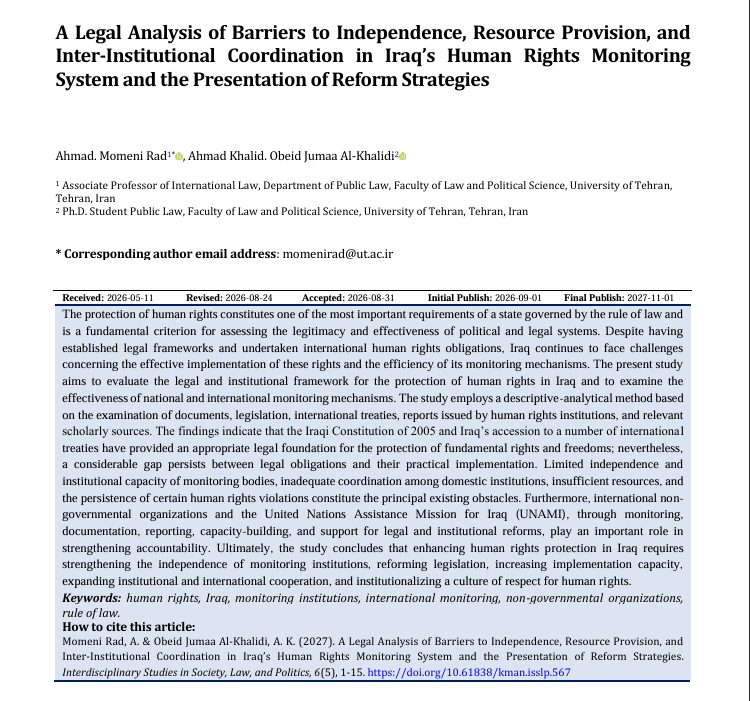
The protection of human rights constitutes one of the most important requirements of a state governed by the rule of law and is a fundamental criterion for assessing the legitimacy and effectiveness of political and legal systems. Despite having established legal frameworks and undertaken international human rights obligations, Iraq continues to face challenges concerning the effective implementation of these rights and the efficiency of its monitoring mechanisms. The present study aims to evaluate the legal and institutional framework for the protection of human rights in Iraq and to examine the effectiveness of national and international monitoring mechanisms. The study employs a descriptive-analytical method based on the examination of documents, legislation, international treaties, reports issued by human rights institutions, and relevant scholarly sources. The findings indicate that the Iraqi Constitution of 2005 and Iraq’s accession to a number of international treaties have provided an appropriate legal foundation for the protection of fundamental rights and freedoms; nevertheless, a considerable gap persists between legal obligations and their practical implementation. Limited independence and institutional capacity of monitoring bodies, inadequate coordination among domestic institutions, insufficient resources, and the persistence of certain human rights violations constitute the principal existing obstacles. Furthermore, international non-governmental organizations and the United Nations Assistance Mission for Iraq (UNAMI), through monitoring, documentation, reporting, capacity-building, and support for legal and institutional reforms, play an important role in strengthening accountability. Ultimately, the study concludes that enhancing human rights protection in Iraq requires strengthening the independence of monitoring institutions, reforming legislation, increasing implementation capacity, expanding institutional and international cooperation, and institutionalizing a culture of respect for human rights.
Downloads
References
Abd al-Latif, K. a.-D. (1984). The European Commission of Human Rights: Its Role in Protecting and Interpreting the Content of Rights under the 1950 European Convention on Human Rights [Master's thesis, Faculty of Economics and Political Science]. Cairo.
Abd al-Samarrai, I. A. (1997). International Protection of Human Rights under the United Nations [Master's thesis (and doctoral dissertation), Faculty of Law, University of Baghdad].
Abdollahi, M., Roshanfekr, P., & Deiri, Z. (2015). The Effectiveness of Countermeasures as an Enforcement Mechanism for Human Rights. International Law Review, 32(53), 127-159.
Abdullah, S. (2021). Human Rights and Their Protection Mechanisms. Dar al-Jamia al-Jadida.
Abu al-Wafa, A. (2018). International Protection of Human Rights. Dar al-Nahda al-Arabiya.
Abu Heif, A. S. (2016). Public International Law. Monshaat al-Maarif.
Abu Hijaza, A. A. (2005). Incorporation and Implementation of Security Council Resolutions Issued under Chapter VII in the Domestic Legal Systems of Member States. Egyptian Journal of International Law.
Abu Saeidi, M. (1964). Human Rights and Their Evolutionary Path in the West. Asia Publishing Institute.
Ahmad al-Shibli, H. A. (2018). Protection of Refugees under Public International Law [Master's thesis, Faculty of Law, Al al-Bayt University].
Ahmad, S. (2018). Principles of International Human Rights. Dar al-Fikr al-Arabi.
Al-Ani, A. (2019). Judicial Review of Administrative Acts in Iraqi Law. Al-Sanhouri Library.
Al-Azzawi, F. (2019). Parliamentary Oversight in the Iraqi Constitutional System. Dar al-Hamed.
Al-Daqqaq, M. a.-S. (1998). Human Rights within the United Nations System. In Studies on Global and Regional Documents (Vol. 2). Dar al-Ilm lil-Malayin.
Al-Kubaisi, K. (2022). Public Rights and Freedoms in the Iraqi Constitution. Dar al-Thaqafa.
Al-Majdhoub, M. (2018). Public International Law. Al-Halabi Legal Publications.
Al-Rashidi, A. (1997). Some Theoretical Problems of the Concept of Humanitarian Intervention.
Al-Saadi, M. (2018). The Iraqi Constitutional System. Dar al-Kutub al-Qanuniyya.
Al-Saeed, B. (2010). The Role of International Non-Governmental Organizations in Promoting and Protecting Human Rights [Master's thesis, Faculty of Law and Political Science, Mentouri University of Constantine].
Al-Shafii, M. B. (2011). Lectures on Human Rights. St. Clements University.
Al-Shukri, A. Y. (2020). Human Rights in National and International Legislation. Dar al-Kutub al-Qanuniyya.
Al-Tamawi, S. M. (2017). Administrative Judiciary. Dar al-Fikr al-Arabi.
Al-Zahra, F. (2019). The Universal Declaration of Human Rights: An Analytical Study. Dar al-Yusr.
Al-Zubaidi, H. (2020). Constitutional Institutions in Iraq. Dar Dijla.
Ayman al-Sabawi, I. a.-H. (1995). Reservations to International Treaties [Master's thesis, Faculty of Law, University of Baghdad].
Baitam, N. (2003). Protection of Human Rights between International Covenants and the Principle of Sovereignty [Master's thesis in international law and international relations,
Bassiouni, M. C. (2003). International Documents Concerning Human Rights (Vol. 2).
Bilal Hamid Badiwi, H. (2016). The Role of International Governmental Organizations in Protecting Refugees: The United Nations High Commissioner for Refugees as a Model [Master's thesis, Department of Public Law, Faculty of Law, Middle East University].
Carver, R. (2011). A New Answer to an Old Question: National Human Rights Institutions and the Domestication of International Law. Human Rights Law Review, 10(1), 1-32.
Crawford, J. (2002). The International Law Commission's Articles on State Responsibility: Introduction, Text and Commentaries. Cambridge University Press.
Dawidowicz, M. (2017). Third-Party Countermeasures in International Law. Cambridge University Press.
Evans, G. (2006). From Humanitarian Intervention to the Responsibility to Protect. Wisconsin international law Journal, 24(3), 700-715.
Fathi, F. (2025). Human Rights Challenges Across Kurdistan: A Comprehensive Analysis [Bachelor's thesis in Political Science and International Relations, University of Tuscia].
Fazaeli, M., & Khudhair, W. R. (2025). The Role of the United Nations in Supporting the Legal and Institutional Framework for Human Rights in Iraq. Lex Localis - Journal of Local Self-Government, 23(S5), 2272-2295.
Fouda, E. a.-D. (1964). International Guarantees of Human Rights. Egyptian Journal of International Law, 20.
González, F. J. (2011). Compliance with International Judgments: The Inter-American Court of Human Rights. International Journal of Human Rights, 15(3), 402-421.
Hadi, R. A. (2011). Human Rights: Their Development, Content, and Protection. Al-Atak Book Industry Company; distributed by the Legal Library.
Hamdi, O. (2025). Independent Bodies’ Oversight of the Non-Governmental Sector in Iraq. Journal of Legal Sciences, 40(2), 556-591.
Hassan, A. (2017). International Rights and Global Covenants. Dar al-Nahda.
Hijazi, A. F. B. (2019). Human Rights between Theory and Practice. Dar al-Fikr al-Jami'i.
Ignatieff, M. (2001). Human Rights as Politics and Idolatry.
Jad Allah, M. F. (2010). International Mechanisms for the Protection of Human Rights and the United Nations Human Rights Council. Dar al-Nahda al-Arabiya.
Jafari Langroudi, M. J. (2005). A New Method in the General Introduction to Legal Science. Ganj-e Danesh.
Kadivar, M. (2008). Haqq al-Nas: Islam and Human Rights. Kavir Publishing.
Khidir, J., & Salih, S. (2014). Human Rights Situation in Iraq and Kurdistan Region: Constitutional and Political Prospects. Beijing Law Review, 5(1), 298-305.
Landman, T. (2018). Human Rights and Democracy: The Precarious Triumph of Ideals. Bloomsbury Publishing.
Mahmoud al-Azzawi, L. A. a.-B. (2005). The Legal Value of United Nations Security Council Resolutions in the Field of Human Rights Protection.
Moeckli, D., Shah, S., & Sivakumaran, S. (2022). International Human Rights Law (4th ed.). Oxford University Press.
Mutua, M. (2016). Human Rights Standards: Hegemony, Law, and Politics. SUNY Press.
Negahdari, B., Zarrabi, H., & Vaezi, S. M. (2018). Cultural and Sovereignty Limitations of Rational Human Rights. Quarterly Journal of Public Law Studies, 48(4), 927-949.
Nisan al-Kashkoush, M. A. H. (2020). United Nations Mechanisms for the Protection of Human Rights.
Purwanto, A., & Hassan, M. (2025). The Challenges of Implementing International Human Rights Norms in Domestic Legal Systems of Developing Countries. Justicia Insight, 2(1), 22-27.
Rasekh, M. (2008). Theory of Rights. In Right and Expediency (Vol. 2). Mizan Publishing.
Rodriguez, Y., & Research Taqa, A. (2024). Human Rights and International Law: Examining the Enforcement Mechanisms and Challenges.
Saad, A. K. (2019). The Judiciary and the Protection of Human Rights. Dar al-Nahda al-Arabiya.
Smith, R. K. M. (2009). Textbook on International Human Rights Rules. Faculty of Law and Political Science, University of Tehran.
Tavernier, P., & Rolland, P. (2008). International Protection of Human Rights: Texts and Extracts (1st ed.). Oueidat Publications.
Tomuschat, C. (2007). Human Rights. Mizan Publishing.
Downloads
Additional Files
Publication Timeline
- Submitted
- Revised
- Accepted
Issue
Section
License
Copyright (c) 2025 Ahmad Momeni Rad (Corresponding author); Ahmad Khalid Obeid Jumaa Al-Khalidi (Author)

This work is licensed under a Creative Commons Attribution-NonCommercial 4.0 International License.