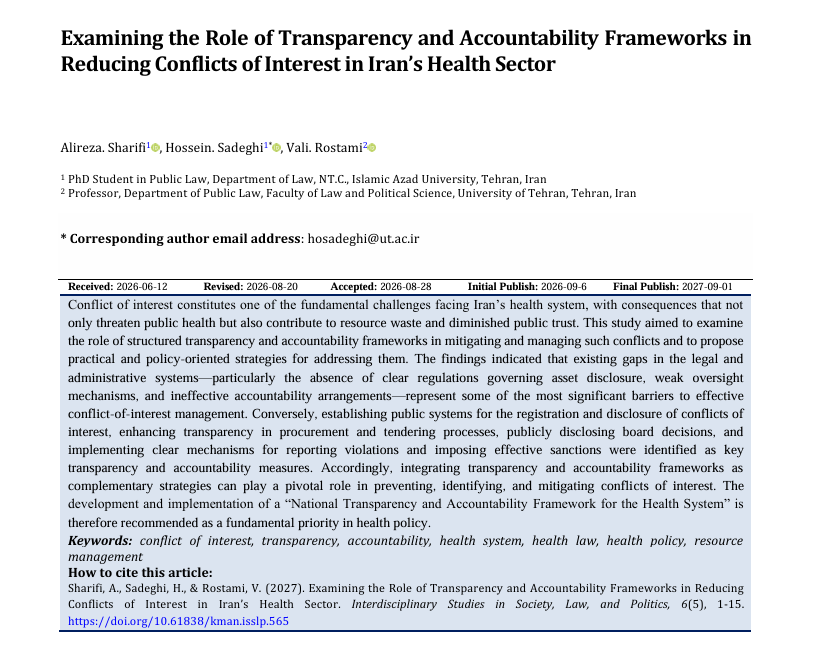
Examining the Role of Transparency and Accountability Frameworks in Reducing Conflicts of Interest in Iran’s Health Sector
Keywords:
conflict of interest, transparency, accountability, health system, health law, health policy, resource managementAbstract
Conflict of interest constitutes one of the fundamental challenges facing Iran’s health system, with consequences that not only threaten public health but also contribute to resource waste and diminished public trust. This study aimed to examine the role of structured transparency and accountability frameworks in mitigating and managing such conflicts and to propose practical and policy-oriented strategies for addressing them. The findings indicated that existing gaps in the legal and administrative systems—particularly the absence of clear regulations governing asset disclosure, weak oversight mechanisms, and ineffective accountability arrangements—represent some of the most significant barriers to effective conflict-of-interest management. Conversely, establishing public systems for the registration and disclosure of conflicts of interest, enhancing transparency in procurement and tendering processes, publicly disclosing board decisions, and implementing clear mechanisms for reporting violations and imposing effective sanctions were identified as key transparency and accountability measures. Accordingly, integrating transparency and accountability frameworks as complementary strategies can play a pivotal role in preventing, identifying, and mitigating conflicts of interest. The development and implementation of a “National Transparency and Accountability Framework for the Health System” is therefore recommended as a fundamental priority in health policy.
Downloads
References
Aghajani, M., Rezaei, B., & Karimi, S. (2021). Strategies for Combating Financial Corruption in Iran's Health System. Journal of Medical Ethics, 15(45), 123-145.
Alizadeh, P. (2022). Misconduct Reporting Systems: Challenges and Solutions. Quarterly Journal of Governance Studies in Health, 5(2), 95-110.
Amani, M. (2019). Analyzing the Impact of Interest Disclosure Laws on Reducing Corruption in the Health System. Journal of Medical Ethics, 12(3), 45-60.
Bagheri Lankarani, K. (2019). Good Governance in the Health System: Challenges and Solutions. Andisheh Arshad Publications.
Becker, G. S. (1968). Crime and Punishment: An Economic Approach. Journal of Political Economy, 76(2), 169-217.
Brinkerhoff, D. W. (2004). Accountability and health systems: toward conceptual clarity and policy relevance. Health Policy and Planning, 19(6), 371-379.
Dworkin, T. M. (2007). SOX and whistleblowing. Michigan Law Review, 105(8), 1757-1780.
Emanuel, E. J., & Emanuel, L. L. (1996). What is accountability in health care? Annals of Internal Medicine, 124(2), 229-239.
Fathi, S., & Norouzi, M. (2016). Examining Barriers to Effective Oversight of the Financial Performance of Government Agencies in Iran. Public Management Studies, 7(25), 34-56.
Faunce, T. A. (2008). Whistleblowing and scientific misconduct: Renewing legal and virtue ethics foundations. Journal of Medicine and Law, 26(3), 567-584.
General Inspection Organization of, I. (2013). Executive Regulations of the Law on Enhancing the Health of the Administrative System.
Ghodousi, M., & Razavi, S. (2018). Examining the Effectiveness of Sanctions in Preventing Administrative-Financial Violations. Journal of Medical Law, 10(4), 125-140.
Jahani, F., & Khalili, A. (2021). Presenting a Framework for Reforming the Structure of Oversight and Accountability in Health Care. Health Management Research, 8(1), 50-67.
Klitgaard, R. (2015). Addressing Corruption in Health Systems.
Lewis, D. (2014). Whistleblowing and Its Impact on Organizational Performance. Routledge.
Mohammadi, R., & Hakimi, T. (2020). The Vicious Cycle: Conflict of Interest and Institutional Weakness in the Health System. Quarterly Journal of Ethics in Science and Technology, 15(2), 40-52.
Mousavi Shafaei, M., & Sajjadi, H. (2020). The Role of Non-Governmental Organizations in Transparency and Accountability in the Health System. Journal of Community Health Research, 6(1), 78-92.
Near, J. P., & Miceli, M. P. (2016). After the wrongdoing: What managers should know about whistleblowing. Business Horizons, 59(1), 105-114.
Nouri, K., & Sajjadi, S. (2021). Legal Requirements for Conflict-of-Interest Management: Lessons from International Experiences. Iranian Journal of Health Research, 18(3), 10-25.
Oecd. (2017). Recommendation of the Council on Public Integrity.
Oecd. (2021). Managing Conflicts of Interest in the Public Sector. OECD Publishing.
Rahimi, F., Alizadeh, A., & Karimi, M. (2021). Examining Implementation Barriers to Misconduct Reporting Systems in Universities of Medical Sciences. Journal of Medical Ethics.
Rezaei, S., Mirzaei, H., & Hosseini, S. (2022). Examining Structural Barriers to Conflict-of-Interest Management in Iranian Teaching Hospitals. Journal of Tehran University of Medical Sciences, 79(4), 320-330.
Rose-Ackerman, S. (2016). Corruption and Government: Causes, Consequences, and Reform. Cambridge University Press.
Rose-Ackerman, S., & Palifka, B. J. (2016). Corruption and Government: Causes, Consequences, and Reform. Cambridge University Press.
Safari, M., & Mohammadi, R. (2020). Analysis of Legal Challenges in Protecting Corruption Whistleblowers in Iran. Quarterly Journal of Public Law Studies.
Thompson, D. (2019). Ethics in Health Care: Conflict of Interest and Transparency. Health policy.
Unodc. (2015). Resource Guide on Good Practices in the Protection of Reporting Persons.
Vandekerckhove, W. (2016). Whistleblowing and Organizational Social Responsibility. Routledge.
Downloads
Additional Files
Publication Timeline
- Submitted
- Revised
- Accepted
Issue
Section
License
Copyright (c) 2025 Alireza Sharifi (Author); Hossein Sadeghi (Corresponding author); Vali Rostami (Author)

This work is licensed under a Creative Commons Attribution-NonCommercial 4.0 International License.